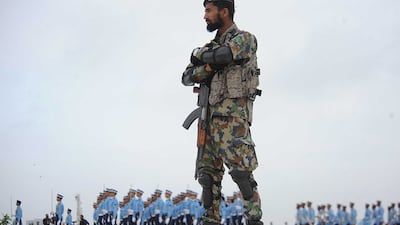

Pakistan has sent troops to Saudi Arabia as part of defence co-operation between the two countries, the Pakistani armed forces said on Sunday.
Saudi Arabia has been locked in worsening hostilities against the Iran-backed Houthi rebels since July, when the war in Yemen was reignited by the wider conflict in the Middle East.
Riyadh has since sought military support from several allies to bolster its air defences and protect strategic infrastructure.
A send-off ceremony was held on Saturday for the Pakistani troops heading to the kingdom, attended by Defence Minister Khawaja Muhammad Asif and Saudi ambassador to Pakistan Rajeh Al Bugamy, authorities said.
The deployment reflected Pakistan’s commitment to Saudi Arabia’s “security, sovereignty and territorial integrity” and was rooted in the two countries’ longstanding strategic partnership, the military said.
The troops would perform assigned duties within Saudi territory under agreed commitments and the established framework of defence co-operation, it added.
The deployment would contribute to strengthening Saudi Arabia’s defensive capabilities amid emerging security concerns, the statement said. It did not specify the number of troops or the nature of their assignment.
Pakistan also reaffirmed its commitment to protecting the security of the kingdom and the sanctity of the Haramain Sharifain, referring to the two holy mosques in Makkah and Madinah.
The Houthis have intensified attacks on Saudi airports, energy infrastructure and buildings since Yemen's civil war escalated in July.
Previous attacks have temporarily disrupted some of Saudi Aramco's operations and led to the cancellation of most international flights to Riyadh.
Saudi Arabia signed the Makkah Joint Defence Agreement with Pakistan and Turkey in August. The pact stipulates that an armed attack against any one of the three countries would be regarded as an attack against all.
As the Houthi missile and drone threat grows, Saudi Arabia, with energy sites and airports spread across its vast territory, has become increasingly exposed to the spillover from the wider US-Iran conflict, which could once again escalate into full-scale war.
The latest developments come amid a broader effort by Riyadh to strengthen its regional security partnerships. They include Egypt’s confirmation of a military presence in the kingdom, an agreement with Syria on military training and sharing expertise, reports of Sudanese forces now in Yemen, and a defence pact with Turkey and Pakistan.
Egyptian Foreign Minister Badr Abdelatty confirmed this week that Egyptian forces were in Saudi Arabia at Riyadh’s request and that Cairo was strengthening its presence. “We already have a military presence there at the request of our brothers and sisters in Saudi Arabia to help, and we are strengthening that,” he told France 24.
Mr Abdelatty said the mission was “mainly for defensive objectives to defend sensitive sites, including holy sites and others”, referring to Makkah and Madinah.
Syria is also deepening military co-operation with Riyadh following a defence agreement signed by Saudi Crown Prince Mohammed bin Salman and President Ahmad Al Shara during the Syrian leader’s visit to the kingdom earlier in November. A Syrian diplomatic source told state news agency Sana that the agreement covered training, the exchange of expertise and military consultation, in the interests of both countries.
The latest escalation between Saudi Arabia and the Houthis comes as the Yemeni rebels have advanced into strategic areas along Yemen's Red Sea coast, moving towards the Bab Al Mandeb strait.
Saudi Arabia has led a military coalition supporting Yemen's internationally recognised government against the Houthis since 2015. The rebels seized the capital, Sanaa, and other parts of the country in 2014.

