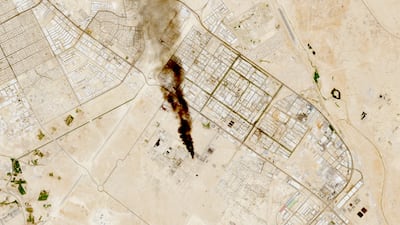
An administrative building of Saudi Arabia's state oil company Aramco was attacked by a missile on Tuesday night, causing a fire but no casualties, as fighting intensifies between the kingdom and Yemen’s Iran-backed Houthi rebels.
The kingdom's Energy Ministry said the missile strike happened in Dhahran, in the Eastern Province. Authorities responded to the attack, with no deaths or injuries reported, the Saudi Press Agency reported.
People living near the Aramco compound described terror as a powerful explosion shook the area.

“This was the loudest explosion I have ever heard in my life,” one woman told The National.
Another resident said relatives living closer to the site had reported seeing smoke and flames rising from the area.
“They couldn't go outside to check what had happened because the smoke was everywhere,” she said.
Debris from two cruise missiles intercepted and destroyed over the capital Riyadh injured four people – two women, a man and a child – state television quoted the Saudi Civil Defence as saying. A Civil Defence representative said the falling debris also damaged 15 residential homes in the Saudi capital. Authorities implemented established procedures in response.
Bloomberg reported that the site was Aramco’s executive headquarters, while a company source quoted by Reuters identified the target as an Aramco headquarters complex. Neither Aramco nor Saudi authorities had officially confirmed which building was hit.
The Saudi-led coalition fighting the Houthis in Yemen separately said it had intercepted and destroyed a ballistic missile launched towards Dhahran, with debris falling in a residential area. It also reported intercepting a missile targeting Haradh and three drones north of the capital, Riyadh.
The coalition said late on Tuesday that it had carried out an operation against energy sites in Houthi-held areas of Yemen, including the Al Sabahah station in Yemen's capital, Sanaa, and piers used for loading fuel at the Red Sea port of Hodeidah.
Coalition spokesman Maj Gen Turki Al Malki accused the Houthis of using civilian infrastructure to support their military operations and supply their arsenals.
Coalition hits Sanaa
“It has been established that the Houthi terrorist militia uses civilian objects and vital resources to sustain its war effort," he said on X. "These include the Al Sabaha central station in Sanaa, underground strategic fuel reserves and storage facilities and fuel and dedicated fuel-loading and unloading berths in Hodeidah, Sanaa and Dhamar.”
Video posted on social media appeared to show a huge orange fireball erupting above Sanaa, followed by a towering column of thick black smoke. The strikes came after the coalition had warned civilians near the oil facility to leave “for their safety”.
The scale of the damage to the site and the impact on fuel supplies were not immediately clear. The Houthis said fuel reserves had been dispersed before the attack, a claim that has not been independently verified.
Saudi energy infrastructure has been been hit before. A refinery in Jazan, in the kingdom's west, was shut after a strike, and a key oil export port on the Red Sea coast was also targeted.
A cross-country pipeline used by Aramco to transport crude to export markets was temporarily shut in September following an attack launched from Iraq. The pipeline is strategically important because it offers an alternative route for Saudi oil exports when shipping through the Gulf faces disruption.
Oil prices rose on Wednesday after news of the attack on the Aramco building, as traders weighed the risk of further disruption to regional energy supplies. It is unclear how the latest incidents could affect production, refining or exports.
Dhahran lies at the centre of Saudi Arabia’s oil industry, close to major oil fields in Eastern Province and the Gulf.

