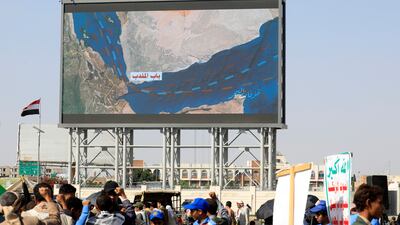
Several tankers loaded with Saudi oil turned around in the Red Sea on Tuesday, a day after Houthi rebels threatened to attack the kingdom's shipping.
The tankers, which were carrying millions of barrels of oil to markets including China and India, abandoned their course for the Bab Al Mandeb and turned towards the Suez Canal.
The U-turns came a day after Yemen's Houthis declared a “maritime embargo” against the Saudi Arabia, a move that could worsen the energy shock caused by the regional war.

Analysts told The National higher costs are expected if more tankers are forced to reroute away from the Red Sea, which has become an alternative to the Strait of Hormuz since the outbreak of the US-Iran war.
“This route was essential for continued supply of food, energy and all other goods and commodities in Saudi Arabia and the rest of the Gulf Co-operation Council,” said Junaid Ansari, the head of investment strategy and research at Kamco Invest. “Threats to Saudi crude oil exports could easily push crude oil prices over the $100 per barrel levels.”
The Houthis have previously attacked Red Sea shipping as part of the regional conflict, forcing ships to make costly detours.
On Tuesday, shipping data showed the Xin Long Yang, a freighter which finished loading two million barrels of Saudi crude destined for China, turning towards Suez. The smaller tanker Rodos, which had loaded about 700,000 barrels for India, performed the same manoeuvre.
Maritime intelligence firm Windward said a total of five tankers linked to Saudi Arabia had reversed course. The manoeuvres came as US President Donald Trump Washington will “take care of business” if Yemen’s Houthi rebels attempt to blockade the Red Sea.
“We’ve done that with the Houthis before, and we haven’t heard from them in a while since we did what we did originally,” he said. “They’ve had no problem with us for a long period of time, including during this conflict.”
Niels Rasmussen, chief shipping analyst at Bimco, said Saudi Arabia's exports of oil and related products via the Red Sea had hit 4.7 million barrels per day from March to June, up from 1.6 million on the same period last year.
More than 90 per cent of those exports went via Bab Al Mandeb, he said. If this is no longer possible, ships will have to sail through the Suez Canal into the Mediterranean before proceeding to their destination.
“This will at least double the sailing distance to all ports in Asia and could increase global tonne miles by at least 5 per cent and 10 per cent … leading to increased freight rates,” Mr Rasmussen said.

Saudi Arabia on Tuesday condemned the Houthi announcement, accusing the Iran-backed group of making false claims. Gulf countries also voiced their support for the kingdom.
The Saudi Foreign Ministry rejected what it called the Houthis’ “allegations of the kingdom’s siege of the Yemeni people”, saying Riyadh had instead worked for years to ease Yemen’s humanitarian crisis through aid, development support and economic assistance.
It accused the Houthis of rejecting several initiatives for resuming flights from Sanaa International Airport, including one recently announced by Jordan to operate Royal Jordanian flights between Amman and Sanaa, the Yemeni capital, which the Houthis took over in 2014.
The ministry also said Saudi Arabia had supported Yemen by “continuing development projects, supporting the Yemeni government’s budget, providing fuel supplies to operate power stations”, and facilitating the entry of food, fuel and building materials through ports in northern Yemen.
Anwar Gargash, diplomatic adviser to the UAE President, said on Tuesday that sectarian militias in the region were facing a “difficult period” after strikes against them.
“Yet their greatest challenge lies not in their military losses, but in the growing public support for a unified state and the rejection of illegitimate and illegal arms outside state control,” he wrote on X.
The Houthis announced the maritime embargo on Monday, which the group said would take effect immediately without specifying how or where it would apply, sparking fears of further chaos for Gulf trade. The move comes in response to Houthi accusations of a Saudi blockade of Yemen.
A spokesman for the Saudi-led coalition, which was formed to restore Yemen's government to power in 2015, said that any claims by the Houthis of a Saudi blockade of ports and airports were “disinformation”.
The UN also denounced the Houthis' recent threats, saying they created a risk of greater regional escalation. “We call for immediate de-escalation. We urge all parties to address their differences through dialogue and diplomacy,” said a spokesman for Secretary General Antonio Guterres.