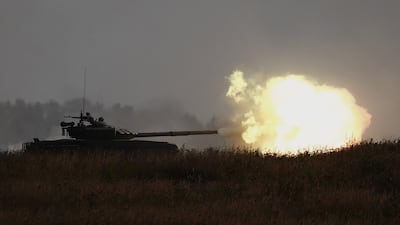

Russia does not “actively seek” war with Nato, the head of Britain’s military intelligence has said, but there are deep concerns that a miscalculation could lead to widespread conflict.
There was also close scrutiny of “the arc of conflict” across the Middle East and the rapid lessons being learnt from modern AI and drones, said Lt Gen Matthew Jones, chief of defence intelligence.
His warnings about deteriorating global security came in a week in which three Russian Kh-101 cruise missiles crashed inside Poland, while Ukraine launched successful attacks on Russian maritime targets in the Gulf of Finland and Libya.


While there are a growing number of Russian drone incursions across eastern Europe and “grey zone” warfare incidents, including cyber attacks, “with some confidence I can say Russia does not actively seek war with Nato”, Lt Gen Jones said in his speech at Cambridge University.
But he immediately added that “my greatest fear is the risk of a significant miscalculation”, especially with Russian President Vladimir Putin under increasing pressure because of heavy personnel losses and economic challenges.
“There are too many recent examples of reckless Russian behaviour where, if the incident had been slightly different, the results could have been extremely serious,” he said.

Although Russian ground forces are suffering casualties of more than 2,000 a day in Ukraine, the military is “adapting rapidly”, and Britain is “very watchful about the prospects of further developments”.
Russia’s air and submarine fleets, alongside its military intelligence, ballistic missile and nuclear forces, “all continue to pose a substantial threat”.
Russian operations
He cited a series of incidents illustrating the dangers of escalation, including the drone attack at Leipzig in Germany, which he said was carried out by Russian proxies in August, and the sinking of merchant ships in the territorial waters of Romania, which Defence Intelligence was investigating.
While there is a risk of escalation in Europe, British intelligence is also watching “the arc of conflict across the Horn of Africa, Arabian Peninsula, and Middle East”, alongside “the mind-boggling scale and pace” of the military build-up in East Asia and the “exponential rise in AI-driven offensive cyber attacks”.
Defence Intelligence is “spending a lot of time looking at how the wars in Ukraine and the Middle East are being fought”, learning from those conflicts to “ensure the UK could fight and win in this environment”.
He added that warfare is “being transformed seemingly daily through the combination of artificial intelligence and uncrewed systems” and concluded that “the global security environment is definitely deteriorating”.

German worry
A recent poll found growing evidence of public reluctance in Europe to take a more active international security role, with 48 per cent of Germans stating their country should show greater restraint in international crises. Support for a more active role has fallen from 48 to 40 per cent.
While 82 per cent of respondents to the Körber Foundation poll regard Russia as a military threat, opposition to continued military assistance to Ukraine has risen sharply, with 53 per cent now against it, compared with 39 per cent a year ago.
The findings suggest a growing preference for diplomacy over military engagement, with 77 per cent of those favouring greater international involvement prioritising diplomatic rather than military measures.