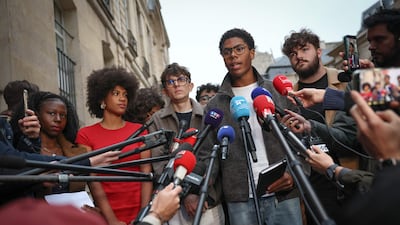
French student leaders vowed to carry out further protests despite government concessions on education, keeping pressure on President Emmanuel Macron as the movement spreads to unions and other activists, stokes unrest and increases the economic damage.
The government measures included a commitment to cap the size of some high school classes, €4 billion ($4.5 billion) of loans for renovating schools and the replacement by 2028 of a university admissions system that students consider socially unfair.
Speaking to broadcaster France 2 on Tuesday, Louis Letoublon, a representative of high school pupils, said protest leaders were unsatisfied with proposals made by government officials at a meeting in Paris.

"If we don’t see concrete changes in the lives of high school students, we will call for mobilisation. We are expecting new proposals from the government," Mr Letoublon said.
In another proposal aimed at quelling the protests, Philippe Baptiste, Minister of Higher Education, vowed that the university admissions system would become "more transparent".
Students have expressed frustration about failing to obtain a university spot, with little explanation on the platform.
'Right to study'
Asked whether he expected further sit-in protests in schools and universities on Monday, Mr Baptiste said: "I also believe there is a right to study."

"What I want now is for everyone to get back to work," he added.
The protests, which have broadened beyond education to draw in trade unions and so-called yellow vest activists, known for their high-visibility jackets, pose a test for Mr Macron's minority government.
The government has little room to spend its way out of the unrest, with national debt approaching 120 per cent of GDP, while the turmoil has boosted support for far-right frontrunner Marine Le Pen before next year's presidential election.
The package of concessions also included €1 billion of investment in university campuses, a move to increase student grants with inflation and the opening of a further 15,000 higher education places. "It's clear we have to ease the pressure being felt in the education system," Education Minister Edouard Geffray said.
There was no overall figure announced for how much funding the package would require. High borrowing needs are already complicating efforts to agree on a budget for next year.
The protests, initially caused by student discontent, have shown little sign of ending, after violence nine days ago engulfed dozens of cities in France, leading to fears the state had lost control of the streets.
Earlier, Mr Macron acknowledged it was probable that there would be more unrest this weekend, before a nationwide day of demonstrations on November 5.
During a tour to survey the damage in Marseille and to thank emergency services after protests on Saturday, he said he would keep security measures in place and work to move demonstrations outside city centres.

Ms Le Pen has benefitted from the unrest and perceptions that authorities are struggling to keep the peace.
An opinion poll published on Sunday put her at 32 per cent to 33.5 per cent, well ahead of her nearest rival, hard-left leader Jean-Luc Melenchon, who was on 17 per cent. Surveys suggest she would easily defeat Mr Melenchon in a run-off ballot, expected to be held in early May.
Confrontations
Interior Minister Laurent Nunez earlier said that 1,435 people were arrested across the country during demonstrations on Saturday. He added that police also reported a new phenomenon, with organised far-right gangs confronting far-left activists in several cities.
"We knew there had been calls from numerous identity-based and nationalist movements to come out, officially, to defend businesses," he said. "In a number of cities, such as Nice and Montpellier, these groups arrived in organised formations, mainly to target the ultra-left movement."
A sell-off in French government bonds was paused on Monday after rating agency Moody's on Friday refrained from downgrading the country's sovereign debt. But business leaders said the unrest was continuing to inflict heavy economic damage.
Alain Di Crescenzo, head of the CCI France network of chambers of commerce and industry, said many retailers remained closed as a precaution after the violence of October 17, leading to a sharp drop in sales.
"We have shopkeepers who are tired and demoralised, and we are killing local commerce," he told Radio Classique.
Agencies contributed to this report