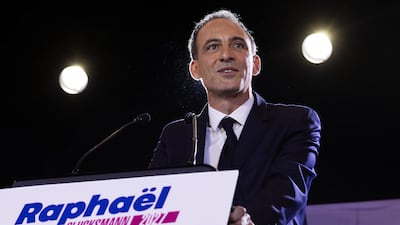

Raphael Glucksmann, a pro-Ukraine defender of liberal democracy, has won a centre-left presidential primary, paving the way for him to run next year in the race to succeed President French Emmanuel Macron.
Mr Glucksmann won with 66 per cent of the vote. He will now seek to unify the left in the hope of winning next year's election in which far-right candidate Marine Le Pen is the favourite.
“We are going to put an end to the psychological, cultural, political and ideological hegemony of brutes over the French left,” Mr Glucksmann, 46, told radio France Inter on Monday. “Finally, we have a democratic left that is regaining momentum and can win the presidential election.”

Mr Glucksmann is co-president of centre-left political party Place Publique. He has been a member of the European Parliament since 2019 and is a prominent supporter of Ukraine in its war with Russia and of the Uighur minority in China.
His campaign has highlighted the role of his partner, Lebanese-French journalist Lea Salame, who has had to step back from presenting the evening news on national broadcaster France 2 to avoid accusations of any conflict of interest.
Ms Salame, the daughter of prominent Lebanese diplomat Ghassan Salame, will continue to anchor a weekly non-political talk show.
“Thinking of Lea Salame,” Valerie Trierweiler, a journalist and former partner of former socialist president Francois Hollande, wrote on X immediately after the announcement of Mr Glucksmann's victory late on Sunday.

Uphill battle
Mr Glucksmann faces an uphill battle to be elected, with recent polls projecting Ms Le Pen to win more than 30 per cent of the vote, and hard-left candidate Jean-Luc Melenchon and centre-right former prime minister Edouard Philippe trailing at around 15 per cent. Mr Glucksmann is sitting at about 9 per cent.
The first round of the election takes place in April 2027.
Divisions on the left are viewed as the main obstacle to defeating Ms Le Pen's far-right political party, the National Rally, which has never governed in France.
Founded by her father Jean-Marie Le Pen and Nazi sympathisers in the 1970s, its popularity has skyrocketed in recent years as the party has campaigned to demonstrate more moderate views.

The centre has so far struggled to make its voice heard in the presidential campaign. Mr Glucksmann has rejected the possibility of an alliance with Mr Melenchon.
A controversial topic of the left's campaign has been the Gaza war. Mr Melenchon describes Israel's military campaign as genocide, while Mr Glucksmann uses expressions such as “war crimes” and “crimes against humanity”.
His critics have attempted to portray him as holding similar views to the sitting president, Mr Macron, who has used comparable rhetoric on the Israel-Palestine conflict, while also remaining staunchly pro-Ukraine.

However, Mr Glucksmann has distanced himself from Mr Macron's pro-business policies by championing measures such as increasing taxation on inheritance.
In power since 2017, Mr Macron cannot run again next year. Since losing a majority in parliament last year after a snap election, Mr Macron's government has struggled to implement new policies and has had to freeze what many regard as much-needed pension reforms.
Many residential candidates, such as Mr Philippe, have distanced themselves from Mr Macron's legacy as France struggles with a debt crisis, social unrest and nationwide school protests.