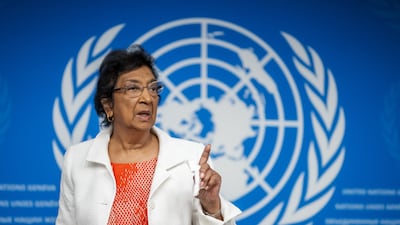

The 2026 Nobel Peace Prize has been awarded to South African judge Navanethem “Navi” Pillay for her efforts to promote peace and international law.
The Nobel Committee said on Friday the 85-year old had shown exceptional courage and integrity ensuring war crimes and genocide are prosecuted, brought hope to victims of violence and conflict, and demonstrated a firm moral compass in her long career.
The former UN human rights chief headed the world body's Commission of Inquiry into the Occupied Palestinian Territory, which concluded last year. The commission determined that war crimes had been committed both by Hamas and Israel in the wake of the October 7 attacks.
The Nobel judges said Ms Pillay has enlarged the scope and impact of international law as a judge in the High Court in South Africa and the International Criminal Court.
"A common thread runs from her early work defending Nelson Mandela and others who stood up against apartheid to her service as a judge in some of the key international court cases of our time," the committee said.
Ms Pillay has "held states and national leaders accountable and brought hope to victims of violence and conflict", they said. "Navi Pillay is one of the great defenders of international legal principles in our time.
"Her distinguished career reminds us of the need to support, fortify and expand the global rule of law. Navi Pillay’s commitment to justice and human dignity is a source of hope and inspiration to all who seek to bring about a more peaceful world."
The prize, worth 12 million Swedish crowns, or about $1.2 million, is due to be presented in Oslo on December 10, the anniversary of the death of Swedish industrialist Alfred Nobel, who founded the awards in his 1895 will.
Born into an Indian Tamil family in Durban, South Africa, Ms Pillay founded her own law firm in 1967 and earned a doctorate from Harvard University in 1988. She was the first non-white judge of the High Court of South Africa.
The United Nations human rights office on Friday welcomed the award to Ms Pillay, acknowledging her longstanding advocacy for human rights.
"It is amazing news, we need more dedication and commitment to human rights," Shabia Mantoo, spokesperson for the UN human rights office.

“The system of international law is under tremendous pressure, and its institutions are under attack,” Watne Frydnes, chair of the Norwegian Nobel Committee, said. “We see a shift towards power politics at the expense of legal frameworks and global respect for law and justice.
“Whenever might overtakes right, it undermines stability, trust and peaceful coexistence.”
He said the committee wanted to remind the world that the rule of law, national and international, underpins the system we have set up to ensure peace and resolve conflicts non-violently. Peace requires justice.”
Ahead of the award, there were wild swings in betting on the Polymarket platform, with Yulia Navalnaya, the widow of late Russian opposition leader Alexey Navalny emerging as the frontrunner overnight. An hour before the announcement, she was neck-and-neck with Mykola Kuleba, Ukrainian children’s rights activist.
Last year’s peace prize winner, Venezuelan opposition leader Maria Corina Machado gave her prize to US President Donald Trump in January as she sought US support for her efforts in Venezuela.
Mr Trump has again suggested he should be the recipient of the prize, although he acknowledged it was unlikely.
Mr Trump, who this year has waged war with Iran and has yet to broker peace in Ukraine, said on Wednesday: "They have a reputation for maybe not giving it to people like me."
Since his return to the White House last year, Mr Trump has repeatedly said he deserves what may be the world's most prestigious award.
"It is about that time," Mr Trump said in the Oval Office. "But I was very honoured to receive it indirectly last time by the recipient, who said nobody in history deserves it more than President Trump."
The leaders of Cambodia, Israel and Pakistan have said they nominated Mr Trump, though there is no way of verifying that.
Canadian poet Anne Carson has won the 2026 Nobel Prize in Literature on Thursday, with the Swedish Academy recognising her experimental approach to writing and her ability to bring ancient Greek literature into the modern world.
The 76-year-old author’s best-known works include Autobiography of Red, The Beauty of the Husband and Nox.
The prize for physiology or medicine was awarded to Karl Deisseroth, Peter Hegemann and Georg Nagel for discoveries concerning light-gated ion channel and optogenetics.
Francis Halzen won the physics prize for contributions to the IceCube Neutrino Observatory.
The Chemistry prize went to Henri B. Kagan and Kenso Soai for work in non-linear effects and autocatalysis in asymmetric organic synthesis.