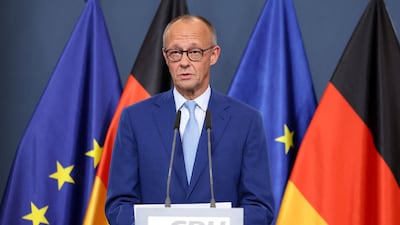

Friedrich Merz has insisted he will remain chancellor of Germany after his party suffered its worst-ever result in a state election, failing to enter a regional assembly parliament for the first time in the country’s post-Second World War history.
Mr Merz waited more than 20 years for his turn to rule Germany, but his government is teetering on the brink of collapse just 16 months after another scathing verdict from voters.
Sunday's losses raise questions about his position, with voters appearing increasingly doubtful that Mr Merz, 70, can revive Germany's economy and bring down the cost of living.

The Christian Democratic Union (CDU) won 4.9 per cent of the vote in the state of Mecklenburg-Western Pomerania on Sunday, according to preliminary results from the state election authority, just missing a 5 per cent threshold required to be given a seat. The far-right Alternative for Germany (AfD) won the contest with 38.2 per cent, while the long-dominant Social Democrats came second with 35.5 per cent.
In an election in Berlin, the governing CDU was defeated by the anti-capitalist Left party.
“We can’t sugarcoat it, it was a disaster,” Mr Merz said in Berlin in a statement after exit polls were released, breaking with the past practice of chancellors speaking the day after an election. He gathered senior CDU officials at party headquarters, where he sought to gauge their support for his leadership.
The results leave in tatters Mr Merz's plan to defeat the populists by “solving the problems” fuelling their support, notably by reducing migration from the Middle East.
Germany’s political establishment was shaken when the CDU suffered a stunning defeat to the anti-immigration Alternative for Germany two weeks ago in Saxony-Anhalt, another eastern state that could lead the first far-right government in the country since the Second World War.

Can the firewall hold?
The fallout has dealt a blow to the chancellorship, prompting calls among rank-and-file members to push out Mr Merz.
Within his party, there is increasing doubt whether its long-held “firewall” policy – meaning no co-operation with the far-right AfD at any level – can still hold.
The support base for the AfD is now “far larger than the extreme right-wing fringe”, said Matthias Quent, a sociologist, speaking before Sunday's polls. He said people wanted to see change and fewer “lectures about all the things that can't be done”.
Like Keir Starmer in Britain, Mr Merz has become desperately unpopular – one poll put his approval rating at just 10 per cent – without any one catastrophic mistake to blame for it. Instead there is a general feeling that Mr Merz is out of touch and has failed to grow into the job.
Clips of his awkward interactions with voters often go viral. A reception last week for budding young scientists turned into a stern lecture from Mr Merz about social media harms during which he said: “Don't come at me with free speech.”
Unlike in Britain, though, there is no recent history of a chancellor being replaced mid-term. Under a system designed for stability after the Second World War, MPs cannot oust Mr Merz unless they also agree on a successor. Still, there is nothing to stop Mr Merz being forced to fall on his sword by sheer political pressure.
One rival potentially waiting in the wings is Hendrik Wust, the leader of Germany's most populous state. After another AfD election victory in early September, Mr Wust appeared in Berlin the following day to address supporters at Brandenburg Gate.
He has since joined a statement by CDU state premiers giving their qualified backing to Mr Merz, with a thinly veiled call for him to “solve the issues and problems that people are dealing with in their daily lives”.
Mr Merz cancelled a planned trip to the United Nations General Assembly in New York this week. He will meet more party leaders on Monday and lawmakers in the CDU-led bloc on Tuesday.
Germany's weak economy is becoming a deciding factor at the polls, with voters from across the spectrum frustrated by high living costs and economic uncertainty.
Campaigning in both states took place against a backdrop of surging fuel prices linked to the Middle East conflict and tens of thousands of additional job cuts in German industry. Years of economic stagnation have prompted some voters to look outside the political centre.
In Berlin, the Left Party struck a chord with its focus on the city's housing shortage, pledging to build affordable new homes, forcibly reduce rents on properties that are 20 per cent or more above the local average, and curb holiday rentals.
The AfD won support with a proposal to revive the Nord Stream gas pipeline from Russia, which terminates in Mecklenburg-Western Pomerania. The party says reviving the pipeline with Russian gas would lower energy costs.

Lars Klingbeil, the SPD co-leader and vice-chancellor, said the government needs to take stock and ask why voters voiced such uncertainty about policymaking in Berlin, where Mr Merz’s coalition has struggled to sell its plan to overhaul the pension system and take on more debt to boost spending on defence and infrastructure.
The election in Mecklenburg-Western Pomerania was the latest demonstration of the AfD’s appeal, with the far right more than doubling its support and winning the state for the first time with calls to deport migrants and oppose military support for Ukraine.
The party’s national co-leader, Alice Weidel, said Mr Merz was the “wrong chancellor” and was doing damage to his party.

Merz's rise and fall
Wealthy, tall and articulate, Mr Merz first rose through the ranks in the 1990s. But an internal power struggle with Angela Merkel in 2002, which Mr Merz lost, banished him to the wilderness for most of her long reign.
It was only after two further defeats in CDU leadership contests that Mr Merz finally won at the third attempt in 2022, in what was seen as a rightward shift for the party after the vaguely defined centrism of the Merkel years.
After three years as opposition leader, Mr Merz won power in Germany last year with a promise of change after Olaf Scholz's four turbulent years. But he entered the job with egg on his face after requiring a rerun vote in parliament to confirm his appointment, a first in modern Germany.
Forced to drop his frugal, pro-American instincts by US President Donald Trump's threats to tear up Nato, Mr Merz instead backed a debt-financed spending spree on the military. Migration policy has been tightened, but not as far as the AfD would like.
Having promised to vanquish the far right, Mr Merz has instead seen the Alternative for Germany grow to unprecedented strength. A CDU social media personality, Clara von Nathusius, last week kicked off a major debate about whether the party should now rip up the “firewall” policy.
“The firewall is a failed project,” she told German television. “We have spent the last few years only defining what we oppose, and not what we stand for.” Still, she said merely replacing Mr Merz would be of no help.
In Middle East affairs, Mr Merz's government has at times been critical of Israel – at one point announcing a partial arms embargo due to the Gaza war – but without shedding Germany's reputation as a close friend of the country. In June it failed to win a seat on the UN Security Council, again leading critics to round on Mr Merz.

