

Western leaders will meet in London on Friday with the intention of putting a “chokehold” of financial pressure on Russia and build on President Donald Trump’s latest strict oil sanctions.
Europe’s “coalition of the willing” will assemble to decide on what further financial pressure it can put on President Vladimir Putin following the collapse of peace talks with Mr Trump, with plans to "cripple Russia's ability to wage war".
It follows a week of swinging fortunes for Ukraine’s President Volodymyr Zelenskyy, who has had to deal with Mr Trump refusing him Tomahawk missiles during fractious White House talks, then the US leader cancelling a meeting in Budapest with Mr Putin and imposing tough measures on Russian two biggest oil companies. He ordered direct sanctions on Rosneft and Lukoil, citing Moscow’s “lack of serious commitment” to ending the Ukraine war. Oil prices rose nearly 5 per cent on Thursday.

That coincided with the EU adding further sanctions on Russia – its first measures targeting Russian liquefied natural gas, and also 117 shadow fleet vessels.
As the Europeans want to show resilience, strength and unity, Mr Zelenskyy will arrive in London to be greeted in person, as well as virtually, by 20 continental leaders to discuss how to battle onwards.
British Prime Minster Keir Starmer said ahead of the meeting in London: “Time and again we offer Putin the chance to end his needless invasion, to stop the killing and recall his troops, but he repeatedly rejects those proposals and any chance of peace."
He added that the allies had to “ratchet up the pressure on Russia and build on President Trump’s decisive action”.
On Thursday, Mr Zelenskyy said during a visit to Brussels for talks with European Union leaders that Ukraine needs funds from frozen Russian assets by the start of next year. Using the immobilised assets to provide Ukraine with a €140 billion ($162.6 billion) loan would save lives, he said.
The EU was due to agree in principle to finance Ukraine for the next two years, European Council chief Antonio Costa said at the summit.
Mr Zelenskyy also urged European allies to supply Ukraine with long-range weapons after being left disappointed by Mr Trump, who even took to his Truth Social platform to deny that missiles that had hit deep into Russia were approved by the US.
Fourth year of bloodshed
A ceasefire in Ukraine now appears even more distant, with the collapse in talks between the US and Russian leaders and overnight attacks continuing in both directions. Two Ukrainian journalists were killed by a Russian drone in the eastern city of Kramatorsk on Thursday in an attack described by Ukraine's human rights ombudsman as a war crime.
Europe, and potentially the US, have to prepare themselves for the long haul of a war that will soon complete its fourth bloody year. It appears Washington, after much procrastination, now comprehends that Moscow is not interested in peace unless it is on its own impossible terms, said Bob Seely, an expert on Russia and former Conservative MP.
The current situation is “forcing Europe to wake up out of its own stupor and realise that it needs to defend its part of the world”, he told The National.
Mr Seely does not believe Mr Trump is “beholden to Putin in some way”, although “the Russians probably see him as an agent of chaos and therefore useful”.
But he was “genuinely surprised” that Mr Putin had not pushed harder for the Hungary meeting as the “Americans were still ripe for a bit of manipulating”.

Fortress line
The reason a proposed meeting in Hungary between the pair was called off was reportedly because Russia was unwilling to compromise on its war demands.
Mr Trump, who has consistently attempted to cajole Mr Putin into a ceasefire, said he did not want to have a “wasted meeting” and there are no plans one in the future.
Mr Putin’s demand is for Russia to take the entire Donbas region, but this would mean Ukraine surrendering its fortress belt that Russia could seize only at great human cost. It has already suffered more than one million casualties, a third of them fatal.

Mr Trump seemed to accept Mr Zelenskyy's refusal to hand over that land during their meeting but then appeared to be wavering, hence Nato Secretary General Mark Rutte this week dashing across the Atlantic to harden up America’s position.
Mr Rutte will be among those present at “Coalition of the Willing” summit hosted by Mr Starmer, with 20 leaders dialling in.

Slogging on
The war will now trundle on. But there are dangers ahead that could yet see it escalate further.
Russian troops continue to slog forwards, taking Ukraine terrain incrementally but at high cost. Can they sustain those losses for another year?
Ukraine’s electrical grid is being pummelled, with more than 40 per cent taken out. Can its population tolerate another austere winter?
What is clear is that Mr Zelenskyy would quickly lose popular support if he surrendered a chunk of the Donbas fortress line to Russia.
Military analyst Frank Ledwidge said it now appears the Trump administration accepts the fortress line is a reasonable demarcation “because that's a line Ukraine can hold into the future”. Mr Zelenskyy has called it "a good compromise".

But some western officials are concerned that given Ukraine’s critical manpower shortages it may not even be able to hold the fortress line. “There needs to be some realism here, as we're not sure whether the Ukrainians can hold this together, whether their manpower is going to be able to sustain the effort,” said one official.
A greater worry, according to Mr Seely, who has just published The New Total War on the campaign, is that Moscow's troops could ultimately break through the fortress line by next summer next, “at which point Russia will be in geographically valuable territory, because the defendable rolling hills of Donbas give way to pretty much a flat line to Kyiv”.
To succeed the Ukrainians needed to “grind the Russians down to an actual stalemate rather than a slow advance”.
The other key battlefield issue is who will gain the upper-hand in swarming drone technology married to AI.
“By next year the frontline areas will become so lethal that it will be almost impossible for humans to move around, because the numbers of drones and reconnaissance drones will be so significant,” said Mr Seely. He added that when he visited the front line last year, the drone-dominated area was 10km deep but “the drone zone is now up to 30km”.
-
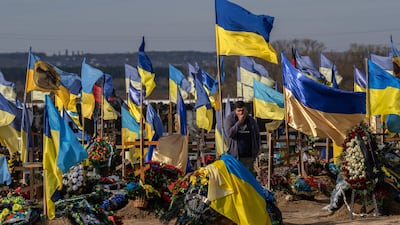
To mark the third year of the Ukraine-Russia war, The National looks back at some of the striking images captured during the conflict. Getty Images -
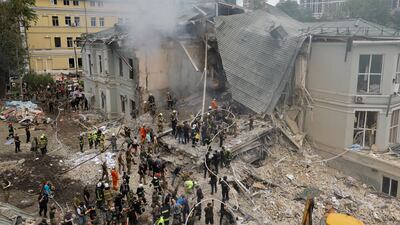
Ukrainians working at the site of a rocket strike on the 'Okhmadyt' children's hospital in Kyiv in 2024. EPA -
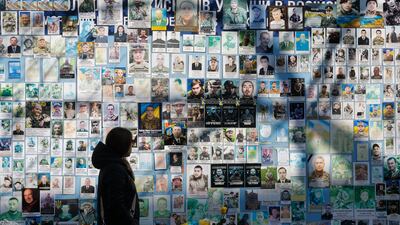
A woman walks past a memorial wall dedicated to fallen defenders of Ukraine in downtown Kyiv in 2024. EPA -
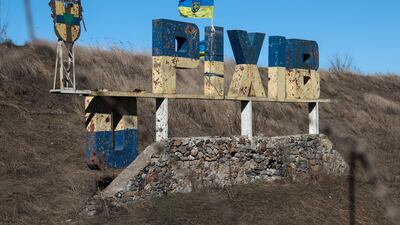
A damaged town sign in Orikhiv, near the frontline in the Zaporizhzhia region, in 2024. EPA -

Gravediggers prepare the burial site for victims of a Russian missile strike in Hroza in 2023. Getty Images -
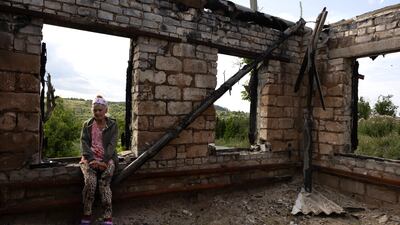
Widow Lubov Doroshenko, 67, returns to her destroyed home in 2023 in Bohorodychne. Getty Images -

A Ukrainian serviceman of the 24 Separate Mechanized Brigade fires a mortar towards Russian positions, at an undisclosed location in the Donetsk region in 2023. EPA -
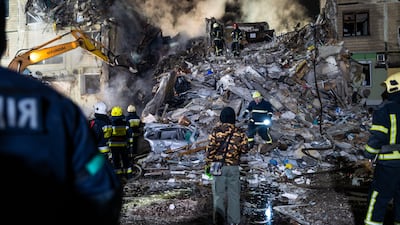
Emergency workers search the remains of a residential building that was struck by a Russian missile in Dnipro in 2023. Getty Images -
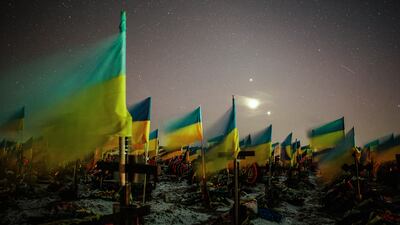
Ukrainian national flags waving over the graves of fallen Ukrainian soldiers in a military cemetery in Kharkiv in 2023. EPA -
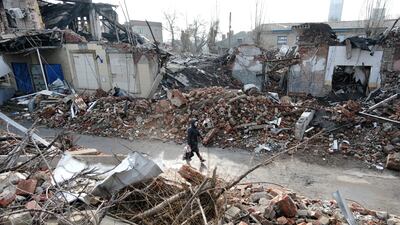
A woman walks by destroyed buildings 20 miles west from the front lines of fighting in the Donetsk Region in 2023. Getty Images -
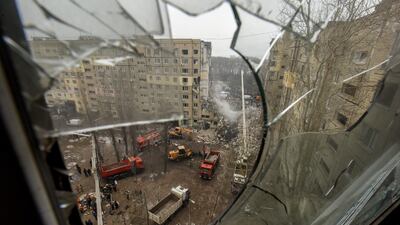
A view taken through the broken glass of a window overlooking the site of a damaged residential building in Dnipro in 2023. EPA -
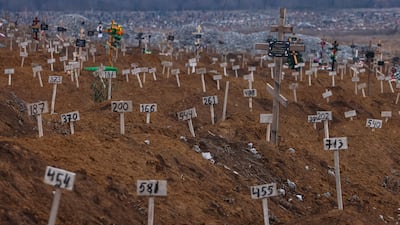
Numbers mark the graves of unidentified people killed during fighting at the cemetery in Mariupol in 2022. EPA -
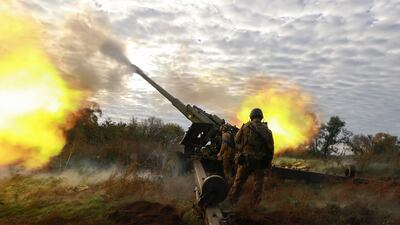
Ukrainian servicemen shoot from a captured Russian 152, 4mm howitzer Msta-B on a front line near Kupyansk city in 2022. EPA -

A prothesis is adjusted on an Azov Regiment serviceman at a rehabilitation centre in Kyiv in 2022. EPA -
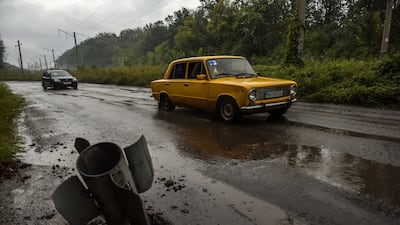
Cars drive past the shell of a rocket in Shevchenkove, Kharkiv region, in 2022. EPA -

A Ukrainian serviceman rests while travelling with a team of humanitarian volunteers in the Kherson area in 2022. EPA -
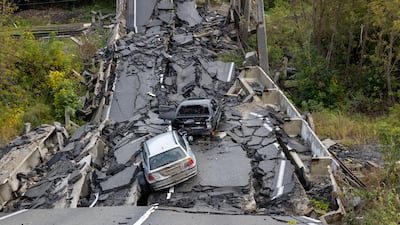
A destroyed bridge in Kupiansk in 2022. Getty Images -

A girl arrives at an evacuation point for people fleeing Mariupol, Melitopol and the surrounding towns under Russian control in 2022. Getty Images -
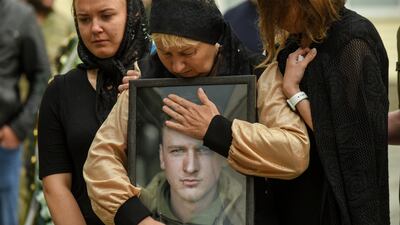
The mother of Ukrainian serviceman Andrii Verkhoglyad holds her son's portrait during his funeral ceremony at St. Michael's Golden-Domed Monastery in Kyiv in 2022. EPA -
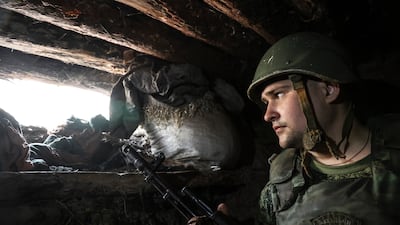
Self-proclaimed Donetsk People's Republic militia monitors a section of the road near Avdiivka, Donetsk region, in 2022. EPA -

Firefighters work to extinguish a fire at a warehouse after it was hit by Russian shelling in Kharkiv in 2022. Getty Images -
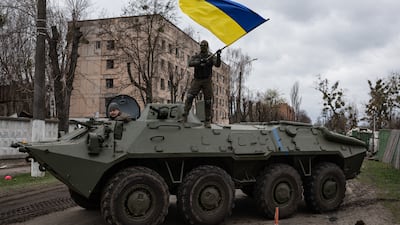
A Ukrainian soldier waves the Ukrainian national flag while standing on top of an armoured personnel carrier in Hostomel in 2022. Getty Images -
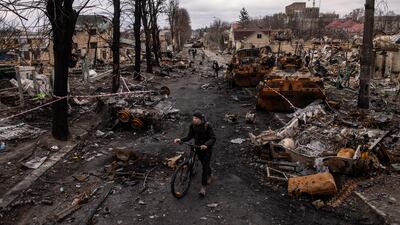
A man pushes his bike through debris and destroyed Russian military vehicles in Bucha in 2022. Getty Images -
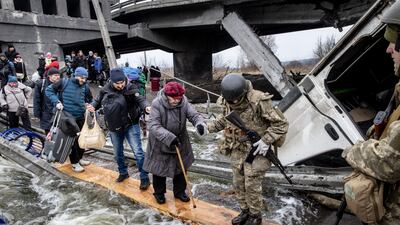
Residents of Irpin flee heavy fighting in 2022. Getty Images -
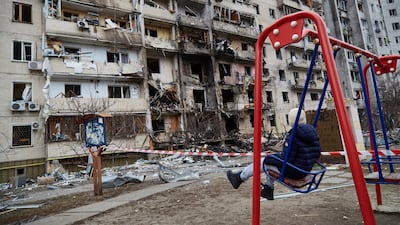
A child on a swing outside a residential building damaged by a missile in Kyiv in 2022. Getty Images


Refinery barrage?
Drones, too, are making a significant impact on both sides, but for the Ukrainians they provide the greatest hope of defeating Russia by damaging its oil industry to the extent it can no longer fund its war.
“It could be game-changing if you destroy Russia’s refining capacity. Then the Russians have a significant problem,” Mr Seely said.
Ukraine is also assembling a range of its own F5 Flamingo cruise missiles that, allied to drones and potentially Tomahawks, could have a massive impact in the coming months.
But Mr Ledwidge’s contacts with Russian economists claim that despite the “petrol station difficulties” the Ukraine refinery campaign “has not constituted a strategic danger” and that Russia can repair the damage.

Tomahawk turnaround?
Ukraine's request for Tomahawks, denied for now, would form part of its strategy of targeting Russian oil refineries that have cumulatively recorded a 20 per cent drop in production in recent months.
Sam Cranny-Evans, an associate at the Rusi think tank, said that while the missiles, that can travel largely undetected through Russia’s air defences, “would not be a game-changer” on their own, as part of a package of drones and other missiles they could “add a high-end complement that gets through and really damages the target”.
But the Tomahawks' capability is disputed, with the military analyst highlighting the 59 missiles that hit the Sharyat airbase in Syria in 2017 caused only limited damage.
“If they’re supplied in the hundreds, it could be a real boost for Ukraine’s long-range strike campaign but tens will be a lot more limited,” Mr Cranny-Evans added.
Mr Seely was also “wary of this magic weapon scenario that we keep falling for” and that “Tomahawks aren't going to change the battle any more than warplanes, tanks or missiles have done”.
There is also a genuine fear of escalation, said Mr Ledwidge, that Tomahawks, which are nuclear capable and carry a 310kg warhead, will be viewed by Russia as “a policy demonstration of a nuclear strike”, which has not been said of the UK-supplied Storm Shadow or US ATACMS missiles.
Unlike his current success in Gaza, Mr Trump has hit the stubborn wall of Mr Putin’s uncompromising war aims that for now even his unique diplomacy appears unable to surmount.

