
The principal of a government school in flood-hit Nepal has set up tents to ensure hundreds of children he guided to safety two months ago can continue their education.
Rajendra Dawadi, head of Tribhuvan Trishuli Secondary School in Nuwakot, one of the areas hit hardest by the flash floods, was hailed as a hero when his swift actions helped to save the lives of 900 children, before a torrent of water crashed into the school compound on August 26.
He has made it his mission to enable classes to continue, using 20 tents and the shaded sections of a local sports academy. His goal is to provide some normality to families who lost their homes and livelihoods in the flooding that killed at least 1,455 people, with 5,285 listed as missing.
“People lost everything. But the children are still eager to study,” Mr Dawadi told The National. “There was a big celebration on the first day – I thought most children would not come back to the school, but more than 95 per cent came back, they cheered, they exchanged happiness.
"I was very happy. My school family, the teachers, students, their smiling faces made me more happy.”
A video from September 21 shows children cheering as classes resume in tents set up on higher ground. Mr Dawadi, 47, said it could take at least two years to rebuild the school.
As thousands across Nepal look to pick up the pieces after the disaster – which was caused by glacial ice and rock collapsing into a Himalayan river – the UN has said funding is urgently needed.
Fractured lives
The raging waters that cut through the school compound have since receded. Only the roof of a three-storey building is still visible, with the rest submerged in thick mud. Other buildings were swept away.
The devastation across six districts has left deep scars in the school. One child became an orphan and 12 pupils lost one parent.
“Many children need our support. They lost their father, some their mother,” Mr Dawadi said.
-
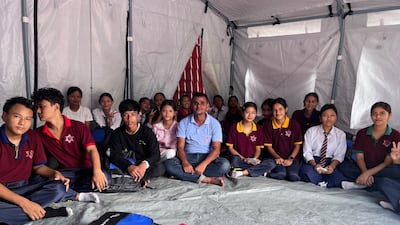
Pupils remember the computer and science laboratories in their old school washed away in the floods but are grateful that classes have begun in a temporary facility. Photo: Rajendra Dawadi -
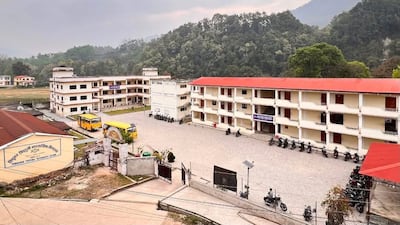
The old Tribhuvan Trishuli secondary school in Nuwakot was the largest government secondary school in the district. A photo before the floods. Photo: Rajendra Dawadi -

Pupils say they are happy to meet their friends in school as most have lost their homes and belongings in the devastating August floods. Photo: Rajendra Dawadi -
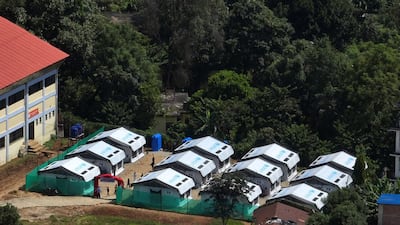
Twenty tents provided by Unicef serve as a temporary school for more than 1,600 pupils of a Nepal secondary school that was washed away in the country's worst floods in August this year. Photo: Rajendra Dawadi -
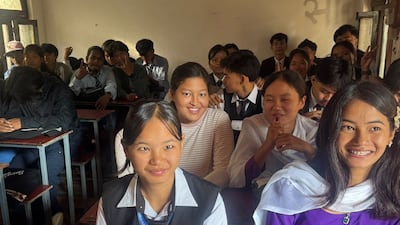
Pupils express their happiness at heading back to school after the floods killed family and friends and destroyed their homes. Photo: Rajendra Dawadi -
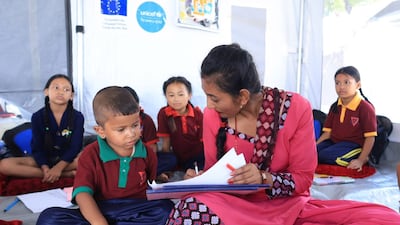
Children sit on the floor as classes are conducted at the makeshift Tribhuvan Trishuli secondary school in Nuwakot, Nepal. Photo: Rajendra Dawadi -
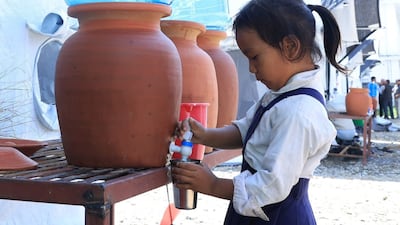
The temporary facilities were provided by private donors so school could resume. Photo: Rajendra Dawadi -
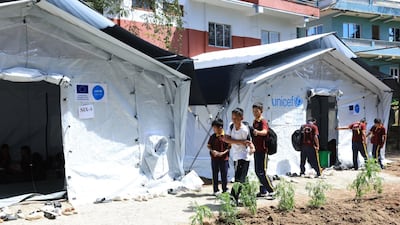
The tents have been placed on higher ground in Nuwakot district away from the river that tore through the town on August 26 leaving a trail of destruction and death. Photo: Rajendra Dawadi -
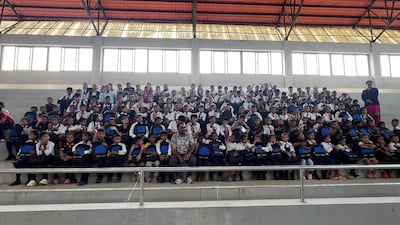
Children cheer and clap when classes resumed on September 21 in a sports academy and in tents. Photo: Rajendra Dawadi -
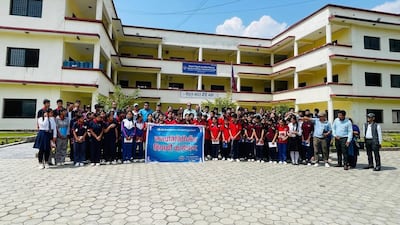
More than 1,600 pupils studied at Tribhuvan Trishuli secondary school in Nuwakot - this photo was taken before one of Nepal's worst floods. Photo: Rajendra Dawadi -
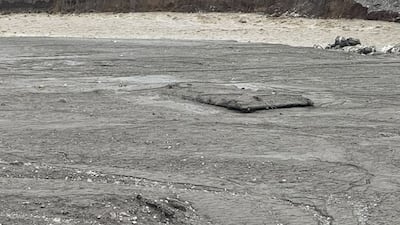
The top of the roof of one building is all that is left of the old school. Photo: Rajendra Dawadi -
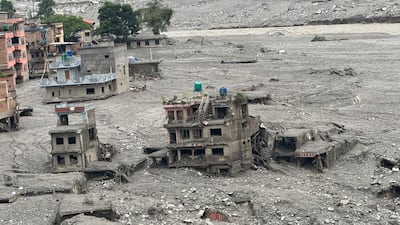
The force of the flash floods swept away the school buildings and surrounding homes. Photo: Rajendra Dawadi -
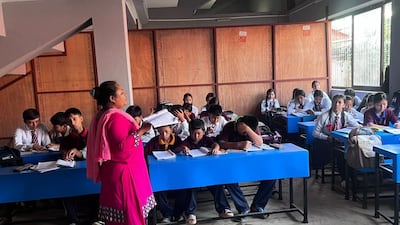
The community hopes authorities will set aside land for the new school building so they can move out of temporary classrooms set up in stairwells. Photo: Rajendra Dawadi -
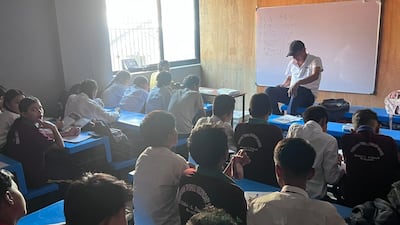
Pupils say studying is tough in the new makeshift facilities but they are grateful to go back to school. Photo: Rajendra Dawadi -
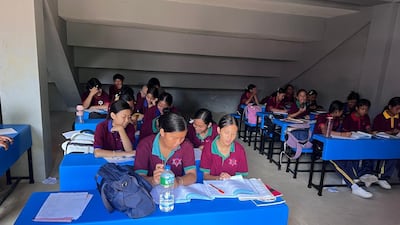
Classes are being held in stairwells of a sports academy until a new facility is built. Photo: Rajendra Dawadi -
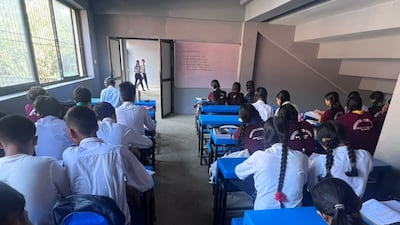
School is held in morning and afternoon shifts and classes are conducted inside stairwells of a sports academy located on higher ground away from the river. Photo: Rajendra Dawadi -

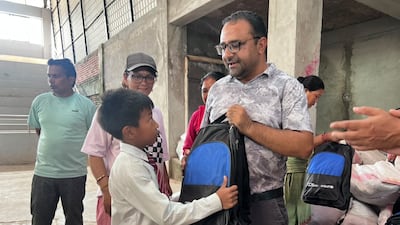
Principal Rajendra Dawadi (far right behind) with pupils from the Tribhuvan Trishuli secondary school who were provided with books, bags and tents to resume school. Photo: Rajendra Dawadi -
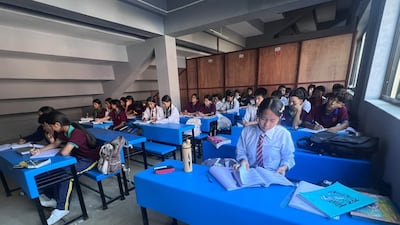
Classes are conducted near staircases in a sports academy and in tents. Photo: Rajendra Dawadi -
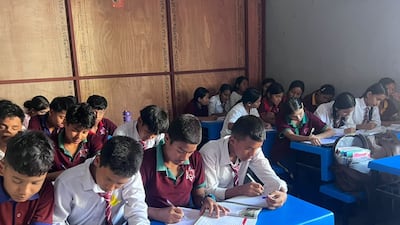
Pupils share benches and desks in temporary school facilities. Photo: Rajendra Dawadi -
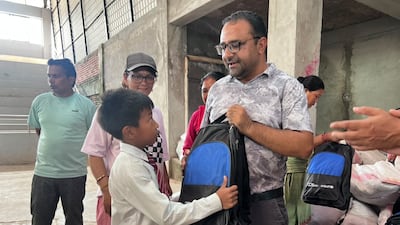
Principal Rajendra Dawadi estimates it will take two years to build a new school after land is assigned. Photo: Rajendra Dawadi -
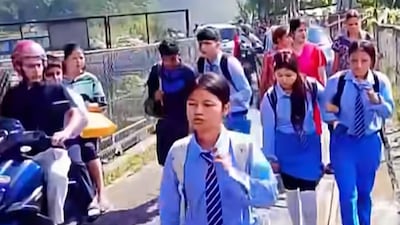
Pupils flee after floodwaters crashed into the school on August 26. Harisharan Gajurel / Facebook -
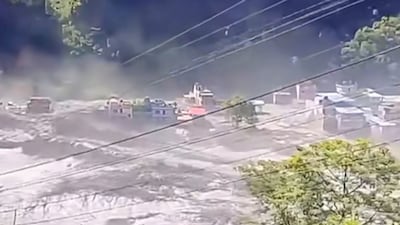
The swollen river water sweeps away homes and buildings as people run to safety in Nuwakot, one of Nepal’s worst-hit flood districts, on August 26. Harisharan Gajurel / Facebook


“The students had counselling sessions, music classes. We try to motivate them, we make it like a family environment in school. I tell them it was a black day but we saved our lives and had a rebirth for me, my colleagues, my students. It was a rebirth from the great disaster.”
Attendance is strong, with 1,621 pupils showing up for class. They sit on the floor in tents and share benches and desks under the stairwell of a sports centre. The tents, books and furniture were provided by Unicef and private foundations.
School authorities await a decision on new land where they can rebuild. Until then, there are other pressing matters – pupils will need a library and science labs. Two more buses are also required to help children get to lessons at the tent site.
Parents whose children had attended private schools are now sending them to free government institutions. “People are in trauma but they are doing their work, they are trying to be normal,” Mr Dawadi said. “Parents are worried about studies so they send children here, even if it’s in tents.”
Critical moments
It took only 11 minutes from the time Mr Dawadi first raised the alarm to when floodwater crashed into the school. Two school staff were killed in the flood.
Mr Dawadi was teaching when he heard two staff members shouting about heavy flooding in the nearby Rasuwa district.

He quickly told teachers to take pupils from each class to higher ground, urging them not to panic. Mr Dawadi turned away a bus with young children that was entering the compound and anther bus was also alerted about the danger.
Older pupils who had motorbikes and bicycles were asked to help take other children to safety. “People were saying, 'Flood, flood,' but the sun was shining here,” he recalled. “But I decided to close the school. First, I told my staff to ring the bell. Then I told class teachers to go to separate classes to say school is off due to the flood, to go to a safer place … three girls fainted. When we left the school, the water had already entered. It was 11 minutes.”
But Mr Dawadi praised his staff. “I am not the real hero,” he said. “My team worked together, this was my duty. For this, I was recognised all over the world.”
Heart of community
The school is a vital part of the community and parents have welcomed the return of classes.
“We had tears in our eyes when school started – all parents felt it,” said Sharmila Shreshtha, 46, whose home and stationery shop were destroyed in the disaster. “We have nothing. Our homes are gone, our shop is gone, we are so tired. But the school makes everyone happy.”

Pupils have appealed for books, computers and lab equipment. Aspiring software engineer Saswot Shah, 14, worries about how a lack of equipment will affect his studies.
"Earlier we had smartboards, computers, maths and science laboratories. Now we are just surviving. We work together but we need a proper computer and maths lab,” he said.
Pradakshina Shreshtha, 16, lost her home and now lives in rented accommodation. She hopes to be a doctor, but worries about exams.
“I’m really happy to study in my own school, meet my friends and learn from my own teachers,” she said. “Before the floods, I thought I would pass the exam and join a science college. My dream is the same but it’s more difficult to study now. We need books. Our study materials are all gone.”