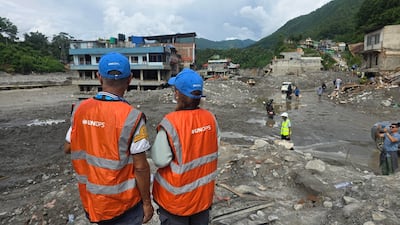

Two weeks after a wall of water, mud and ice swept through the Bhote Koshi and Trishuli valleys along Nepal’s border with China, the country continues to count the dead and search for thousands of missing people.
By Sunday, 1,342 people had been confirmed dead and 4,996 remained unaccounted for, according to the UN. Nepal's government, working through the national disaster authority, is leading a response that has drawn more than 21,000 search and rescue personnel from around the world.
Amid that response, the United Nations Office for Project Services, the UN arm specialising in infrastructure and technical assistance, has taken a foundational role.

Its technical teams have been deployed to Nuwakot district. “UNOPS teams are working with local authorities and UN partners to identify isolated communities and inaccessible areas, and assess the damage to critical infrastructure, providing important data and information to help make sure assistance reaches where it is most needed,” the organisation told The National.
The UN and humanitarian partners had launched a $49.6 million flash appeal for four months of life-saving assistance to more than 84,000 people affected by the disaster, with Rasuwa, Nuwakot and Dhading among the priority districts as winter approaches.
-
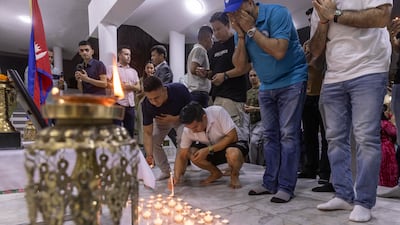
The Nepali community in the UAE gathers on September 4 to offer prayers for those affected by the flash flood. All photos: Antonie Robertson / The National -

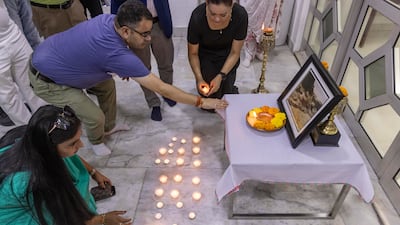
People light lamps and candles at the vigil -

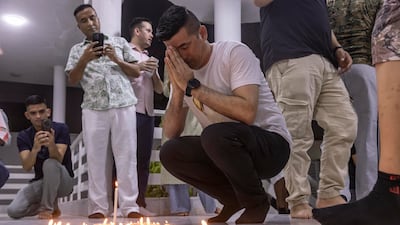
People bow their heads in prayer for the victims -

The vigil is held in remembrance of those who have died, those injured and the thousands still missing in Nepal's border region with China -

The disaster on August 26 killed more than 1,300 people -
The UAE has flown more than 100 tonnes of food supplies, shelter materials, essential goods and power generators to Nepal -
The incident has been described as a 'Himalayan tsunami' -

Nepali residents say the vigil is an opportunity to gather to pay respects and pray for the victims


The response is broad. UN agencies including OCHA, the WHO, WFP, Unicef, UNDP and UN Women, alongside the International Federation of Red Cross and Red Crescent Societies and other humanitarian partners, are working under the government-led framework to deliver medical care, food, shelter, water, sanitation and psychosocial support to survivors.
The UN Development Programme estimates that the floods generated about 2.2 million tonnes of debris across the areas assessed.
OCHA has said access is the single biggest obstacle to the response, with roads being passable only as far as Nuwakot. Sections of the highway linking Kathmandu to the worst-hit valleys remain blocked.

The disaster began on August 26, when a section of glacier and bedrock collapsed into the Lhende Khola basin, temporarily damming the river. The debris barrier then failed, unleashing a destructive surge through the valleys.
Nepal’s National Disaster Risk Reduction and Management Authority has declared 15 municipalities disaster-affected for three months. Although the worst destruction was concentrated in the mountainous border region, the floodwaters travelled nearly 100km downstream, damaging communities and infrastructure along the river corridors.
Early assessments in Bidur Municipality in Nuwakot indicate that roughly 11,000 hectares of land and 45km of road have been damaged. Nine schools have been destroyed, and 19 damaged. Six health facilities have been damaged or destroyed, and two more remain out of reach.
For UNOPS staff, the scale of the tragedy is shocking. “Seeing the pain, helplessness and tears of people facing such a tragedy left me deeply shaken,” said Shishir Upadhyay, a project engineer with UNOPS Nepal, about a field assessment in Nuwakot on September 1.
Who will pay for the rebuilding is still an open question. Sara Netzer, UNOPS regional director for Asia and the Pacific, said financing for reconstruction had not yet been determined and could ultimately come from a combination of sources.
“It could come from the government of Nepal, or from loans from the World Bank, or through the Asian Development Bank, or concessional financing,” she told The National.

Ms Netzer described the flood as “a mountain tsunami which devastated and obliterated everything in its wake”. She said the reconstruction had to be shaped by the fact that hundreds of glacial lakes and unstable glaciers sit above populated Nepali valleys.
“We have to think about that as we move forward in terms of how we want to rebuild. There is a lot to learn from this,” she said. “We really have to go back to the drawing board and think about the new technologies that we have and how we can make climate-smart infrastructure going forward.”
The reconstruction needs to anticipate the next glacial collapse rather than simply patching over this one – that is main driving point of the broader debate beginning around Himalayan infrastructure.
Nepal accounts for about 0.1 per cent of global greenhouse gas emissions according to the World Bank. But it is highly vulnerable to climate change, with rising temperatures, melting glaciers, glacial lake outburst floods and increasingly intense rainfall threatening communities and infrastructure.
The response is entering a new phase, from rescue to recovery. But with more than 4,000 people still missing, thousands more without a home to return to, and a mountain system officials warn is far from finished with rearranging itself, that phase may prove the longest.
The UAE has committed a $10 million relief package to the disaster response through the UAE Aid Agency, and has sent several planes carrying food, shelter material, generators and other essentials.
An Emirati search and rescue task force, including disaster relief and medical evacuation specialists, has begun working alongside Nepali authorities.
India and China have sent emergency supplies and specialist personnel, while the US, UK, EU, South Korea and the World Bank have announced financial and technical assistance.

