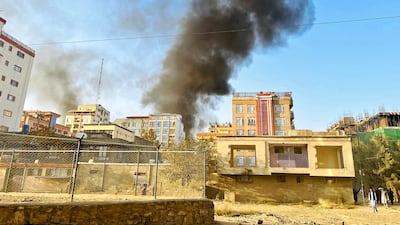
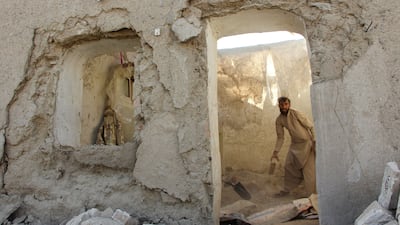
Afghan mourners surround coffins of people killed in aerial strikes by Pakistan at a funeral in the Urgun district of Paktika province. AFP

Pakistan and Afghanistan agree ceasefire at Doha talks to end week of bloodshed


  • English
  • Arabic

Afghanistan and Pakistan, embroiled in more than a week of fighting that has killed dozens of people and injured hundreds, have agreed to an immediate ceasefire, Qatar’s Foreign Ministry said on Sunday.

The violence constitutes the deadliest crisis between the two countries in several years. The two sides agreed to establish mechanisms to consolidate lasting peace and stability, and to hold follow-up talks in the coming days to ensure the sustainability of the truce, the Qatari statement said. Qatar and Turkey mediated the negotiations, it added.

Delegations from the two countries arrived in Doha for talks on Saturday after air strikes and days of clashes fuelled fears of a burgeoning regional war. More than a dozen people have been killed and hundreds wounded on both sides in the latest wave of fighting between the neighbours.

Pakistan accuses Afghanistan of harbouring militants who carry out attacks in border areas, notably the Pakistani Taliban, Tehreek-e-Taliban. The charge is rejected by Kabul. The Pakistani Taliban is ideologically aligned with Afghanistan's ruling Taliban, but a separate entity.

On Friday, a suicide attack near the border killed seven Pakistani soldiers and wounded 13 more, security officials said. Pakistan attacked sites in Afghanistan, killing at least 10 people, including civilians, after an initial 48-hour ceasefire expired. The truce was then extended for the Doha talks.

On Sunday, the Taliban government’s chief spokesman, Zabihullah Mujahid, confirmed that both countries had signed a ceasefire agreement.

“It has been decided that neither country will undertake any hostile actions against the other, nor will they support groups carrying out attacks against Pakistan. Both sides will refrain from targeting each other’s security forces, civilians or critical infrastructure,” he said.

A mechanism will be established in the future “under the mediation of intermediary countries” to ensure the effective implementation of the agreement, he added.

Pakistan's Defence Minister Khawaja Asif posted confirmation of the deal on X.

“Cross-border terrorism from Afghan territory will cease immediately,” he wrote. “Both countries will respect each other’s sovereignty and territorial integrity. A follow-up meeting between the delegations is scheduled to take place in Istanbul on October 25 to discuss the matters in detail.”

Both countries thanked Qatar and Turkey for their role in assisting the talks.

Fierce ground fighting between Pakistan and Afghanistan as well as Pakistani air strikes across their contested 2,600km frontier began after Islamabad demanded that Kabul rein in militants who had increased attacks inside Pakistan, saying they operated from havens in Afghanistan. The administration in Kabul denies this and has accused Pakistan of spreading misinformation.

The Afghan delegation in Doha included the defence minister and head of the national intelligence agency, the ruling Taliban said. Pakistan sent its defence minister and intelligence chief.

Pakistan said before the talks that they would focus on “immediate measures to end cross-border terrorism emanating from Afghanistan and restore peace and stability along the border”.

Regional powers including the UAE, Saudi Arabia and Qatar had called for de-escalation, as the violence threatens to destabilise a region where ISIS and Al Qaeda are among the groups trying to resurface.

Mr Asif had accused Kabul of acting as "a proxy of India" and "plotting" against Islamabad.

Afghanistan's cricket team withdrew from a T20 tri-series, scheduled to take place in Pakistan in November, following the escalating tensions.

Deadly border clashes between Pakistan and Afghanistan – in pictures

Pakistan is grappling with surging militancy, especially in areas bordering Afghanistan. It also accuses its nuclear-armed neighbour and biggest rival India of backing armed groups, without providing any evidence.

Its army chief, Field Marshal Asim Munir, has urged Afghans to choose “mutual security over perpetual violence and progress over hardline obscurantism”.

“The Taliban must rein in the proxies who have sanctuaries in Afghanistan,” he told an audience on Saturday at the Pakistan Military Academy in Kakul, Khyber Pakhtunkhwa.


Sweet%20Tooth
%3Cp%3E%3Cstrong%3ECreator%3A%20%3C%2Fstrong%3EJim%20Mickle%3Cbr%3E%3Cstrong%3EStarring%3A%20%3C%2Fstrong%3EChristian%20Convery%2C%20Nonso%20Anozie%2C%20Adeel%20Akhtar%2C%20Stefania%20LaVie%20Owen%3Cbr%3E%3Cstrong%3ERating%3A%20%3C%2Fstrong%3E2.5%2F5%3C%2Fp%3E%0A
Company profile

Name: Tratok Portal

Founded: 2017

Based: UAE

Sector: Travel & tourism

Size: 36 employees

Funding: Privately funded

In the Restaurant: Society in Four Courses
Christoph Ribbat
Translated by Jamie Searle Romanelli
Pushkin Press 

The%20specs
%3Cp%3E%3Cstrong%3EEngine%3A%20%3C%2Fstrong%3E2.9-litre%20twin-turbo%20V6%0D%3Cbr%3E%3Cstrong%3ETransmission%3A%20%3C%2Fstrong%3E8-speed%20auto%0D%3Cbr%3E%3Cstrong%3EPower%3A%20%3C%2Fstrong%3E536hp%20(including%20138hp%20e-motor)%0D%3Cbr%3E%3Cstrong%3ETorque%3A%20%3C%2Fstrong%3E750Nm%20(including%20400Nm%20e-motor)%0D%3Cbr%3E%3Cstrong%3EPrice%3A%20%3C%2Fstrong%3EFrom%20Dh1%2C380%2C000%0D%3Cbr%3E%3Cstrong%3EOn%20sale%3A%20%3C%2Fstrong%3Enow%3C%2Fp%3E%0A
GAC GS8 Specs

Engine: 2.0-litre 4cyl turbo

Power: 248hp at 5,200rpm

Torque: 400Nm at 1,750-4,000rpm

Transmission: 8-speed auto

Fuel consumption: 9.1L/100km

On sale: Now

Price: From Dh149,900

Who's who in Yemen conflict

Houthis: Iran-backed rebels who occupy Sanaa and run unrecognised government

Yemeni government: Exiled government in Aden led by eight-member Presidential Leadership Council

Southern Transitional Council: Faction in Yemeni government that seeks autonomy for the south

Habrish 'rebels': Tribal-backed forces feuding with STC over control of oil in government territory

Intercontinental Cup

Namibia v UAE Saturday Sep 16-Tuesday Sep 19

Table 1 Ireland, 89 points; 2 Afghanistan, 81; 3 Netherlands, 52; 4 Papua New Guinea, 40; 5 Hong Kong, 39; 6 Scotland, 37; 7 UAE, 27; 8 Namibia, 27

The major Hashd factions linked to Iran:

Badr Organisation: Seen as the most militarily capable faction in the Hashd. Iraqi Shiite exiles opposed to Saddam Hussein set up the group in Tehran in the early 1980s as the Badr Corps under the supervision of the Iran Revolutionary Guards Corps (IRGC). The militia exalts Iran’s Supreme Leader Ali Khamenei but intermittently cooperated with the US military.

Saraya Al Salam (Peace Brigade): Comprised of former members of the officially defunct Mahdi Army, a militia that was commanded by Iraqi cleric Moqtada Al Sadr and fought US and Iraqi government and other forces between 2004 and 2008. As part of a political overhaul aimed as casting Mr Al Sadr as a more nationalist and less sectarian figure, the cleric formed Saraya Al Salam in 2014. The group’s relations with Iran has been volatile.

Kataeb Hezbollah: The group, which is fighting on behalf of the Bashar Al Assad government in Syria, traces its origins to attacks on US forces in Iraq in 2004 and adopts a tough stance against Washington, calling the United States “the enemy of humanity”.

Asaeb Ahl Al Haq: An offshoot of the Mahdi Army active in Syria. Asaeb Ahl Al Haq’s leader Qais al Khazali was a student of Mr Al Moqtada’s late father Mohammed Sadeq Al Sadr, a prominent Shiite cleric who was killed during Saddam Hussein’s rule.

Harakat Hezbollah Al Nujaba: Formed in 2013 to fight alongside Mr Al Assad’s loyalists in Syria before joining the Hashd. The group is seen as among the most ideological and sectarian-driven Hashd militias in Syria and is the major recruiter of foreign fighters to Syria.

Saraya Al Khorasani:  The ICRG formed Saraya Al Khorasani in the mid-1990s and the group is seen as the most ideologically attached to Iran among Tehran’s satellites in Iraq.

(Source: The Wilson Centre, the International Centre for the Study of Radicalisation)

Dubai Bling season three

Cast: Loujain Adada, Zeina Khoury, Farhana Bodi, Ebraheem Al Samadi, Mona Kattan, and couples Safa & Fahad Siddiqui and DJ Bliss & Danya Mohammed 

Rating: 1/5

THE%20SPECS
%3Cp%3EEngine%3A%204.4-litre%20twin-turbo%20V8%20hybrid%0D%3Cbr%3EPower%3A%20653hp%20at%205%2C400rpm%0D%3Cbr%3ETorque%3A%20800Nm%20at%201%2C600-5%2C000rpm%0D%3Cbr%3ETransmission%3A%208-speed%20auto%0D%3Cbr%3E0-100kph%20in%204.3sec%0D%3Cbr%3ETop%20speed%20250kph%0D%3Cbr%3EFuel%20consumption%3A%20NA%0D%3Cbr%3EOn%20sale%3A%20Q2%202023%0D%3Cbr%3EPrice%3A%20From%20Dh750%2C000%0D%3Cbr%3E%3C%2Fp%3E%0A

Mercer, the investment consulting arm of US services company Marsh & McLennan, expects its wealth division to at least double its assets under management (AUM) in the Middle East as wealth in the region continues to grow despite economic headwinds, a company official said.

Mercer Wealth, which globally has $160 billion in AUM, plans to boost its AUM in the region to $2-$3bn in the next 2-3 years from the present $1bn, said Yasir AbuShaban, a Dubai-based principal with Mercer Wealth.

Within the next two to three years, we are looking at reaching $2 to $3 billion as a conservative estimate and we do see an opportunity to do so,” said Mr AbuShaban.

Mercer does not directly make investments, but allocates clients’ money they have discretion to, to professional asset managers. They also provide advice to clients.

“We have buying power. We can negotiate on their (client’s) behalf with asset managers to provide them lower fees than they otherwise would have to get on their own,” he added.

Mercer Wealth’s clients include sovereign wealth funds, family offices, and insurance companies among others.

From its office in Dubai, Mercer also looks after Africa, India and Turkey, where they also see opportunity for growth.

Wealth creation in Middle East and Africa (MEA) grew 8.5 per cent to $8.1 trillion last year from $7.5tn in 2015, higher than last year’s global average of 6 per cent and the second-highest growth in a region after Asia-Pacific which grew 9.9 per cent, according to consultancy Boston Consulting Group (BCG). In the region, where wealth grew just 1.9 per cent in 2015 compared with 2014, a pickup in oil prices has helped in wealth generation.

BCG is forecasting MEA wealth will rise to $12tn by 2021, growing at an annual average of 8 per cent.

Drivers of wealth generation in the region will be split evenly between new wealth creation and growth of performance of existing assets, according to BCG.

Another general trend in the region is clients’ looking for a comprehensive approach to investing, according to Mr AbuShaban.

“Institutional investors or some of the families are seeing a slowdown in the available capital they have to invest and in that sense they are looking at optimizing the way they manage their portfolios and making sure they are not investing haphazardly and different parts of their investment are working together,” said Mr AbuShaban.

Some clients also have a higher appetite for risk, given the low interest-rate environment that does not provide enough yield for some institutional investors. These clients are keen to invest in illiquid assets, such as private equity and infrastructure.

“What we have seen is a desire for higher returns in what has been a low-return environment specifically in various fixed income or bonds,” he said.

“In this environment, we have seen a de facto increase in the risk that clients are taking in things like illiquid investments, private equity investments, infrastructure and private debt, those kind of investments were higher illiquidity results in incrementally higher returns.”

The Abu Dhabi Investment Authority, one of the largest sovereign wealth funds, said in its 2016 report that has gradually increased its exposure in direct private equity and private credit transactions, mainly in Asian markets and especially in China and India. The authority’s private equity department focused on structured equities owing to “their defensive characteristics.”

Boston%20Strangler
%3Cp%3E%3Cstrong%3EDirector%3A%3C%2Fstrong%3E%20Matt%20Ruskin%3Cbr%3E%3Cstrong%3EStarring%3A%20%3C%2Fstrong%3EKeira%20Knightley%2C%20Carrie%20Coon%2C%20Alessandro%20Nivola%3Cbr%3E%3Cstrong%3ERating%3A%3C%2Fstrong%3E%203%2F5%3Cbr%3E%3C%2Fp%3E%0A
What sanctions would be reimposed?

Under ‘snapback’, measures imposed on Iran by the UN Security Council in six resolutions would be restored, including:

  • An arms embargo
  • A ban on uranium enrichment and reprocessing
  • A ban on launches and other activities with ballistic missiles capable of delivering nuclear weapons, as well as ballistic missile technology transfer and technical assistance
  • A targeted global asset freeze and travel ban on Iranian individuals and entities
  • Authorisation for countries to inspect Iran Air Cargo and Islamic Republic of Iran Shipping Lines cargoes for banned goods
Paatal Lok season two

Directors: Avinash Arun, Prosit Roy 

Stars: Jaideep Ahlawat, Ishwak Singh, Lc Sekhose, Merenla Imsong

Rating: 4.5/5

COMPANY PROFILE

Company name: Blah

Started: 2018

Founder: Aliyah Al Abbar and Hend Al Marri

Based: Dubai

Industry: Technology and talent management

Initial investment: Dh20,000

Investors: Self-funded

Total customers: 40

'Nope'
%3Cp%3E%3Cstrong%3EDirector%3A%3C%2Fstrong%3E%20Jordan%20Peele%0D%3Cbr%3E%3Cstrong%3EStars%3A%3C%2Fstrong%3E%20Daniel%20Kaluuya%2C%20Keke%20Palmer%2C%20Brandon%20Perea%2C%20Steven%20Yeun%0D%3Cbr%3E%3Cstrong%3ERating%3A%3C%2Fstrong%3E%203.5%2F5%3C%2Fp%3E%0A
Updated: October 19, 2025, 12:33 PM