
Rima Hassan says she sees her role as a voice for the voiceless. Photo: European Parliament

French politician and 'Freedom Flotilla' activist Rima Hassan rallies support for one-state vision


Sunniva Rose
  • English
  • Arabic

In a sea of political grey suits, Rima Hassan, a 33-year-old migration lawyer and firebrand member of the European Parliament, has come to embody France's pro-Palestinian movement.

Establishment views on her rise have mostly been sharply critical. Few in France's political mainstream are receptive to her post-colonial politics and campaigning for the application of international law to Israeli actions. Interior Minister Bruno Retailleau has filed a complaint accusing her of supporting terrorism. A prominent comedian has derisively called her “Lady Gaza”.

In June, the France Unbowed politician gained international visibility by joining a Gaza flotilla alongside climate activist Greta Thunberg. She was held and then deported after the Israel military boarded the boat off the Palestinian enclave. Days later, this boost in profile saw Ms Hassan ranked 44th in an Ifop-Fiducial poll of France's 50 most popular figures.
In an interview with The National, Ms Hassan said she sees her role as a voice for the voiceless amid a rupture where those in power are not in sync with the new generation.

“I'm indeed very alone in [the European] Parliament, when you look at the average age and career path,” Ms Hassan said. “I come from civil society. I am not shaped by politics. It's really a question of what kind of platform people have access to.”

It's about reframing the struggle
Former Israeli negotiator Daniel Levy

On Instagram, where she is wearing the traditional Palestinian keffiyeh in her profile picture, Ms Hassan has amassed one million followers. That makes the left-wing politician more popular on the platform than 29-year old far-right leader Jordan Bardella, whose National Rally party came first in last year's parliamentary election.

She uses her growing profile to push for a one-state solution that recognises both the Jewish and Palestinian Arab national identities, such as a Swiss-style confederation or a new type of umbrella state for two distinct nationalities.

It is a proposal that is often dismissed. “There is nothing more pragmatic than the one-state solution,” Ms Hassan bats back. “The question of a [one] state is a demand which for me is the most progressive. There is a generational rupture in the understanding of the Palestinian cause.”

Ms Hassan said that the post-Oslo Accords generation, born in the 1990s like her, is rethinking what peace and justice must look like. “There's a lack of understanding about the new generation and its ideals,” Ms Hassan said.

“It goes beyond nationalist causes. It's about equality of rights and freedom of movement.”

Rima Hassan, second right, saw her international profile grow when she joined activist Greta Thunberg on the Gaza flotilla. Getty Images

Before her deportation in June, Ms Hassan cut an olive branch to carry back as a reminder of the land from which her grandparents were expelled during the Nakba, after the formation of Israel in 1948.

Born stateless in a Palestinian refugee camp in Syria, Ms Hassan moved with her mother to France as a child. She is often referred to as Syrian though she only holds French citizenship − a framing some see as an effort to erase her Palestinian identity.

The olive branch memento now represents a personal triumph for Ms Hassan, who shed tears of rage when she failed to gain entry to Israel aged 18 having obtained French citizenship. Israeli security refused to let her board the plane at Charles de Gaulle Airport. She was not prominent at the time, though Israel often bars pro-Palestinians from travel.

From the margins

A one-state solution is an old idea first championed in the 1920s and later resurrected by the Palestine Liberation Organisation.

The concept was seemingly eclipsed by the global recognition of the Oslo Accords in 1993, though even at the time there was criticism that these did not impose the creation of a Palestinian state. While the Palestinian Authority fell short, it was the first recognition by Israeli leadership of the existence of a Palestinian people.

The rapid expansion of Israeli settlements and the increasing encroachment on the territorial integrity of that Palestinian entity, ultimately saw the Second Intifada break out in 2000. Years of stalemate and reverses on the ground, culminating in the Gaza war, have seen a groundswell among intellectuals and the younger Palestinian generation for a one-state pathway.

“I belong to a generation that starts from the observation that Oslo did not work,” says Ms Hassan. “And that there is a new paradigm which is that of apartheid," she added, referring to a notion backed by rights organisations that rules applied to Palestinians and Arab Israelis regarding freedom of movement and treatment by the judiciary amount to systemic discrimination.

Ms Hassan acknowledges that her vision remains marginal in UN and diplomatic circles. French President Emmanuel Macron has promised a boost to a two-state solution with French recognition of a Palestinian state soon. Foreign Ministry spokesman Christophe Lemoine told The National the term “one state” was legally vague and politically impractical.

Behind closed doors, Ms Hassan said, some European diplomats privately concede that the two-state solution is no longer viable. “They tell me: I am obliged to support the two-state solution because it is the policy supported by the EU. But as a diplomat, my personal opinion is that it is not possible,” she said. “We have to get out of this paralysis.”

She points at Jewish organisations around the world that share her vision. Current Israeli cabinet members oppose both a one-state and a two-state solution, and a number have called for the expulsion of Gazans to unspecified destinations. The country is negotiating a Gaza ceasefire, but it has not meaningfully engaged with the Palestinian authority in Prime Minister Benjamin Netanyahu's current term. Ms Hassan believes in severe international pressure in response. An arms embargo and an end to privileged trade relations between the EU and Israel are among her main demands.

Former Israeli negotiator Daniel Levy argued that Ms Hassan's self-proclaimed radical approach is essential to change power dynamics and become a worthy adversary to Israel – even if it takes a long time.

“It's about reframing the struggle,” Mr Levy told The National. “This is not about a solution that gets implemented tomorrow, because tomorrow you're not going to have two states. You're not going to have one state.

“You frame the conflict in the way that Israel has now framed it, which is to create an apartheid state. And you challenge that. Then once Israelis realise there's a cost to it, they may change their position.”

We have to get out of this paralysis.
French MEP Rima Hassan

Others are less generous. Mr Bardella has described her as the “Hamas ambassador at the EU”, a label rooted in her assertion that Palestinians have the right to armed resistance under international law.

While she has condemned as war crimes the October 7, 2023 Hamas-led attacks on Israeli communities in which about 1,200 people were killed and 240 abducted, Ms Hassan's output on X is a succession of sharply worded posts describing Israel as a terrorist and genocidal state.

More than 59,029 Palestinians have been killed in Israel's Gaza strikes and ground offensive since the war began.

When asked, Ms Hassan says her focus on Palestinian rights during the explosive post-October 7 period is unapologetic. She has unsettled a political consensus that has seen relative disengagement of French diplomacy in the Middle East since late president Jacques Chirac left power in 2007. She has also been criticised for her muted criticism of the crimes of the former Assad regime.

Historic juncture

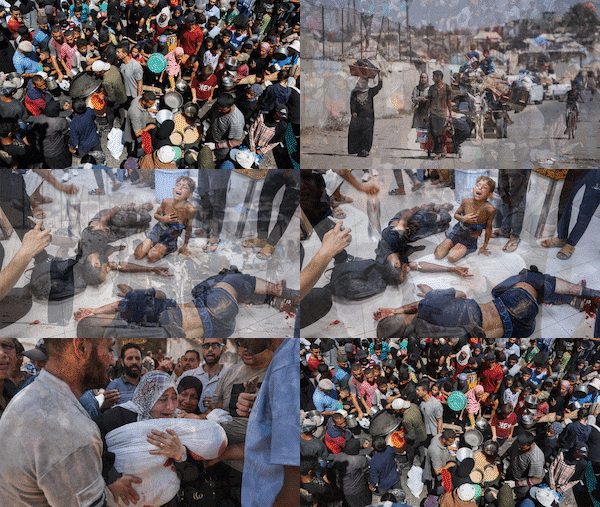
Ms Hassan's voice is part of a broader generational shift, said Leila Farsakh, professor of political science at the University of Massachusetts Boston. The brutal images coming out of Gaza are changing the global narrative. “The one-state solution's moment has arrived,” Ms Farsakh, a specialist on the Palestinian statehood question, told The National.

“We are today at a historic juncture − as important as 1948 or 1967 − and Israel is trying to reassert the supremacy of Jewish rights,” she said. “But Palestinians are much more vocal and present than in 1948 or 1967. They are able to articulate their rights and refuse subjugation.”

Displaced Palestinians flee an Israeli ground offensive, in Khan Younis, southern Gaza. Reuters

In French academia, scepticism is strong. Jean-Paul Chagnollaud, president of the Institute for Mediterranean and Middle East Research and Studies think tank in Paris, called a one-state model an “absurd dream”.

“The nature of a Jewish state entails a Jewish majority,” he said, pointing at demographics of seven million Palestinians, including Arab Israelis, and seven million Jews. “That means that even the most moderate Israelis would reject the idea of a Palestinian majority state.”

The Oslo Accords provided the first recognition by Israeli leadership of the existence of a Palestinian people, experts say. Getty Images

Like Ms Farsakh, Ms Hassan often cites the views of Palestinian intellectual Edward Said that Israeli state policy as “apartheid” was comparable with South Africa's historic racial segregation.

Israel rejects the use of the word apartheid and says separate legal and permitting measures or designations are linked to security concerns. Western countries, including France, resist using the term “apartheid” in relation to Israel.

For Ms Hassan however, it is the fundamental reality that must drive a solution to the conflict in her lifetime. “It is the paradigm of apartheid that really makes us understand demands to put forward a one-state solution,” she said.

“I don't see what's difficult to understand. The Oslo agreements were perhaps relevant at the time they were signed. What is the relevance of still referring to agreements that have constantly shown us that they have failed for the past 30 or 40 years?”


French MEP Rima Hassan says the only way forward is a one-state solution. Photo: European Parliament

Ten tax points to be aware of in 2026

1. Domestic VAT refund amendments: request your refund within five years

If a business does not apply for the refund on time, they lose their credit.

2. E-invoicing in the UAE

Businesses should continue preparing for the implementation of e-invoicing in the UAE, with 2026 a preparation and transition period ahead of phased mandatory adoption. 

3. More tax audits

Tax authorities are increasingly using data already available across multiple filings to identify audit risks. 

4. More beneficial VAT and excise tax penalty regime

Tax disputes are expected to become more frequent and more structured, with clearer administrative objection and appeal processes. The UAE has adopted a new penalty regime for VAT and excise disputes, which now mirrors the penalty regime for corporate tax.

5. Greater emphasis on statutory audit

There is a greater need for the accuracy of financial statements. The International Financial Reporting Standards standards need to be strictly adhered to and, as a result, the quality of the audits will need to increase.

6. Further transfer pricing enforcement

Transfer pricing enforcement, which refers to the practice of establishing prices for internal transactions between related entities, is expected to broaden in scope. The UAE will shortly open the possibility to negotiate advance pricing agreements, or essentially rulings for transfer pricing purposes. 

7. Limited time periods for audits

Recent amendments also introduce a default five-year limitation period for tax audits and assessments, subject to specific statutory exceptions. While the standard audit and assessment period is five years, this may be extended to up to 15 years in cases involving fraud or tax evasion. 

8. Pillar 2 implementation 

Many multinational groups will begin to feel the practical effect of the Domestic Minimum Top-Up Tax (DMTT), the UAE's implementation of the OECD’s global minimum tax under Pillar 2. While the rules apply for financial years starting on or after January 1, 2025, it is 2026 that marks the transition to an operational phase.

9. Reduced compliance obligations for imported goods and services

Businesses that apply the reverse-charge mechanism for VAT purposes in the UAE may benefit from reduced compliance obligations. 

10. Substance and CbC reporting focus

Tax authorities are expected to continue strengthening the enforcement of economic substance and Country-by-Country (CbC) reporting frameworks. In the UAE, these regimes are increasingly being used as risk-assessment tools, providing tax authorities with a comprehensive view of multinational groups’ global footprints and enabling them to assess whether profits are aligned with real economic activity. 

Contributed by Thomas Vanhee and Hend Rashwan, Aurifer

Skoda Superb Specs

Engine: 2-litre TSI petrol

Power: 190hp

Torque: 320Nm

Price: From Dh147,000

Available: Now

Mercer, the investment consulting arm of US services company Marsh & McLennan, expects its wealth division to at least double its assets under management (AUM) in the Middle East as wealth in the region continues to grow despite economic headwinds, a company official said.

Mercer Wealth, which globally has $160 billion in AUM, plans to boost its AUM in the region to $2-$3bn in the next 2-3 years from the present $1bn, said Yasir AbuShaban, a Dubai-based principal with Mercer Wealth.

Within the next two to three years, we are looking at reaching $2 to $3 billion as a conservative estimate and we do see an opportunity to do so,” said Mr AbuShaban.

Mercer does not directly make investments, but allocates clients’ money they have discretion to, to professional asset managers. They also provide advice to clients.

“We have buying power. We can negotiate on their (client’s) behalf with asset managers to provide them lower fees than they otherwise would have to get on their own,” he added.

Mercer Wealth’s clients include sovereign wealth funds, family offices, and insurance companies among others.

From its office in Dubai, Mercer also looks after Africa, India and Turkey, where they also see opportunity for growth.

Wealth creation in Middle East and Africa (MEA) grew 8.5 per cent to $8.1 trillion last year from $7.5tn in 2015, higher than last year’s global average of 6 per cent and the second-highest growth in a region after Asia-Pacific which grew 9.9 per cent, according to consultancy Boston Consulting Group (BCG). In the region, where wealth grew just 1.9 per cent in 2015 compared with 2014, a pickup in oil prices has helped in wealth generation.

BCG is forecasting MEA wealth will rise to $12tn by 2021, growing at an annual average of 8 per cent.

Drivers of wealth generation in the region will be split evenly between new wealth creation and growth of performance of existing assets, according to BCG.

Another general trend in the region is clients’ looking for a comprehensive approach to investing, according to Mr AbuShaban.

“Institutional investors or some of the families are seeing a slowdown in the available capital they have to invest and in that sense they are looking at optimizing the way they manage their portfolios and making sure they are not investing haphazardly and different parts of their investment are working together,” said Mr AbuShaban.

Some clients also have a higher appetite for risk, given the low interest-rate environment that does not provide enough yield for some institutional investors. These clients are keen to invest in illiquid assets, such as private equity and infrastructure.

“What we have seen is a desire for higher returns in what has been a low-return environment specifically in various fixed income or bonds,” he said.

“In this environment, we have seen a de facto increase in the risk that clients are taking in things like illiquid investments, private equity investments, infrastructure and private debt, those kind of investments were higher illiquidity results in incrementally higher returns.”

The Abu Dhabi Investment Authority, one of the largest sovereign wealth funds, said in its 2016 report that has gradually increased its exposure in direct private equity and private credit transactions, mainly in Asian markets and especially in China and India. The authority’s private equity department focused on structured equities owing to “their defensive characteristics.”

The specs
  • Engine: 3.9-litre twin-turbo V8
  • Power: 640hp
  • Torque: 760nm
  • On sale: 2026
  • Price: Not announced yet
The%20specs%20
%3Cp%3E%3Cstrong%3EEngine%3A%20%3C%2Fstrong%3E2.0-litre%204cyl%20turbo%0D%3Cbr%3E%3Cstrong%3EPower%3A%20%3C%2Fstrong%3E261hp%20at%205%2C500rpm%0D%3Cbr%3E%3Cstrong%3ETorque%3A%20%3C%2Fstrong%3E400Nm%20at%201%2C750-4%2C000rpm%0D%3Cbr%3E%3Cstrong%3ETransmission%3A%20%3C%2Fstrong%3E7-speed%20dual-clutch%20auto%0D%3Cbr%3E%3Cstrong%3EFuel%20consumption%3A%20%3C%2Fstrong%3E10.5L%2F100km%0D%3Cbr%3E%3Cstrong%3EOn%20sale%3A%20%3C%2Fstrong%3ENow%0D%3Cbr%3E%3Cstrong%3EPrice%3A%20%3C%2Fstrong%3EFrom%20Dh129%2C999%20(VX%20Luxury)%3B%20from%20Dh149%2C999%20(VX%20Black%20Gold)%3C%2Fp%3E%0A
MATCH INFO

Uefa Champions League semi-final, first leg

Tottenham 0-1 Ajax, Tuesday

Second leg

Ajax v Tottenham, Wednesday, May 8, 11pm

Game is on BeIN Sports

'Shakuntala Devi'

Starring: Vidya Balan, Sanya Malhotra

Director: Anu Menon

Rating: Three out of five stars

COMPANY%20PROFILE
%3Cp%3E%3Cstrong%3ECompany%20name%3A%3C%2Fstrong%3E%20Clinicy%3Cbr%3E%3Cstrong%3EStarted%3A%3C%2Fstrong%3E%202017%3Cbr%3E%3Cstrong%3EFounders%3A%3C%2Fstrong%3E%20Prince%20Mohammed%20Bin%20Abdulrahman%2C%20Abdullah%20bin%20Sulaiman%20Alobaid%20and%20Saud%20bin%20Sulaiman%20Alobaid%3Cbr%3E%3Cstrong%3EBased%3A%3C%2Fstrong%3E%20Riyadh%3Cbr%3E%3Cstrong%3ENumber%20of%20staff%3A%3C%2Fstrong%3E%2025%3Cbr%3E%3Cstrong%3ESector%3A%3C%2Fstrong%3E%20HealthTech%3Cbr%3E%3Cstrong%3ETotal%20funding%20raised%3A%3C%2Fstrong%3E%20More%20than%20%2410%20million%3Cbr%3E%3Cstrong%3EInvestors%3A%3C%2Fstrong%3E%20Middle%20East%20Venture%20Partners%2C%20Gate%20Capital%2C%20Kafou%20Group%20and%20Fadeed%20Investment%3C%2Fp%3E%0A
Updated: July 22, 2025, 4:14 PM
