
Syria has announced an ”immediate and complete halt” to its offensive against the Druze minority, after Israel attacked key symbols of power in Damascus.
The Syrian government said it had agreed to the ceasefire with some but not all representatives of the Druze community, after Israeli strikes were launched to protect the religious sect. A previous truce failed to hold during days of brutal urban warfare in the Druze heartland of Sweida.
There were reports of continued fighting late on Wednesday, according to residents and sources in Jordan. Suwayda24, a network of citizen journalists, reported that government forces and their militias have continued to storm buildings.
Israel widened its aerial campaign in Syria with a series of strikes on the main military compounds in Damascus on Wednesday. A Syrian military official told The National that the Army General Command and Defence Ministry, both adjacent to the city's Ummayad Square, "took several strikes and were badly damaged".
Israel, which says it is acting to defend Syria's Druze minority following clashes with Bedouin tribes that prompted Syrian government intervention, also said it attacked "a military target in the area of the Syrian regime’s presidential palace".
Three people were reported killed and 34 injured, as Israel said its army would be "reinforced with additional troops" near Syria's border.
Gulf countries called for calm after days of unrest, some of the worst since Syria's President Ahmad Al Shara came to power in a rebel offensive last year. The UAE condemned the "dangerous escalation" and Israeli attacks, rejecting any breach of Syria's sovereignty or threats to its security and stability.
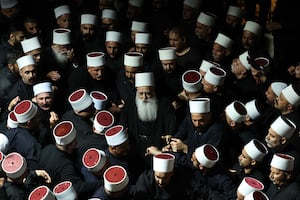
An aide to Druze spiritual leader Sheikh Hikmat Al Hijri, who has led the resistance to government forces in Sweida, said he was not part of the ceasefire deal but will speak after the city is “liberated”.
Israel strikes Damascus - in pictures
-

A picture shows a view of the damage following Israeli strikes on the Syrian army and defence ministry headquarters in Damascus on July 16, 2025. (Photo by LOUAI BESHARA / AFP) -
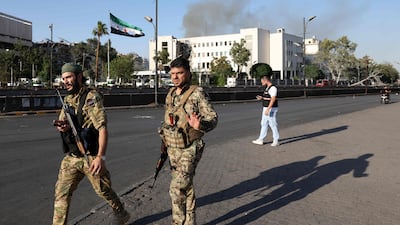
Syrian security troops stand guard in front of the heavily damaged Syrian army and Defence Ministry headquarters. AFP -
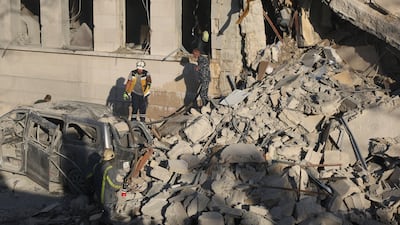
Civil defence workers inspect the damage. AP -
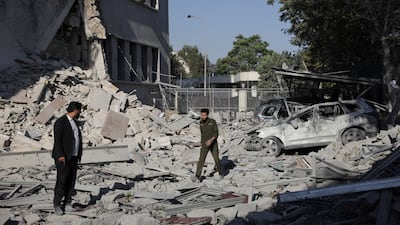
Men walk among the debris in Damascus. Reuters -
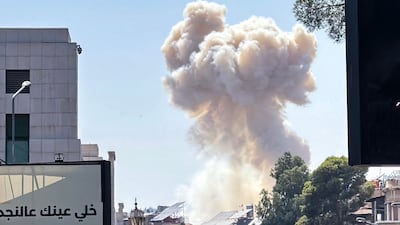
More Israeli strikes in Damascus. AFP -
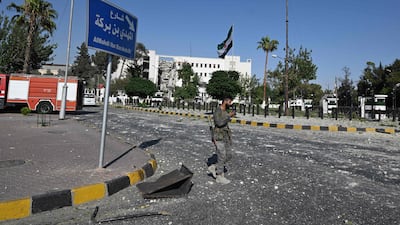
A member of the Syrian security forces near the army headquarters and Defence Ministry. AFP -
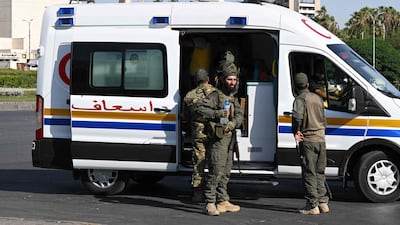
Members of Syrian security forces in front of an ambulance in Damascus. AFP -
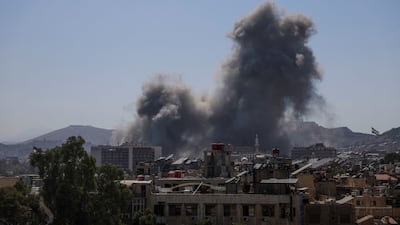
Smoke rises in Damascus. Reuters -
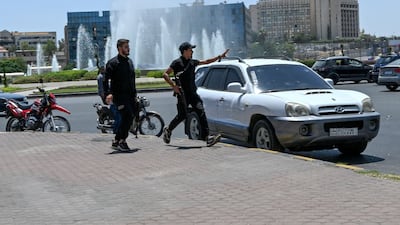
Syrian security forces near the military headquarters in Umayyad Square, Damascus. AFP


The ceasefire deal was reached with the House of the Druze Unifiers, not specifically with the Druze triumvirate headed by Sheikh Al Hijri. But it stipulates that “all parties will cease military escalation" and provides for an "immediate and complete halt" to government military operations.
The agreement also signalled that Syrian security forces deployed in Sweida province will from now be drawn only from its residents, a main Druze demand. At the White House, US Secretary of State Marco Rubio said he hoped to see "real progress to end what you've been seeing", as President Donald Trump nodded.
Mr Rubio blamed "historic longtime rivalries" for the clashes. "It led to an unfortunate situation and a misunderstanding, it looks like, between the Israeli side and the Syrian side," he said.
'Painful blows'
Israeli Defence Minister Israel Katz said "painful blows have begun", as he posted footage of a Syrian TV anchor in panic at an explosion behind her while reading a report on air.
An Israeli statement said its army is monitoring the "regime’s actions against Druze civilians in southern Syria" and is striking in the area, and "remains prepared for various scenarios". Israel's Foreign Minister Gideon Saar said "murder and pogroms" were taking place against minorities in Syria.
Sources in Jordan said Israel struck the Syrian army in Keswa on the outskirts of Damascus and in the southern governorate of Deraa, killing three security commanders.
The Israeli attacks could undermine a US push to end hostilities between Syria and Israel, with the new authorities in Damascus having reportedly engaged in talks with Israel, although the contents of the talks have not been disclosed.
Residents of Sweida contacted by The National said they were afraid for their lives, not just from shelling but also from government snipers and the storming of houses by regular troops and militias allied with Damascus.

"My neighbour was shot dead by a sniper, right there in the street. He had just stepped outside," said one resident. The man had been trying to escape Sweida to a village on the outskirts before he was shot, they added.
Syria on Wednesday called for an emergency meeting of the UN Security Council to "address the consequences of Israeli aggression on Syrian territory", according to a letter seen by The National.
Widening offensive
The Israeli attacks came as Syrian troops and their militia allies widened an offensive against the mostly Druze governorate of Sweida, deploying snipers and firing rockets on residential areas, witnesses said. However, they were facing resistance as Israel mounted its raids in support of the sect.
Tom Barrack, the US envoy to Syria, said Washington "condemns violence against civilians in Sweida", without assigning blame. "All parties must step back and engage in meaningful dialogue," he said.
The Syrian government offensive, in its fourth day, aims to spread government control over the province, where many Druze have resisted the post-Bashar Al Assad order, which is led by former members of Hayat Tahrir Al Sham, a splinter group from Al Qaeda.
Sheikh Hikmat Al Hijri, the Druze spiritual leader, has criticised the HTS government as extremist and anti-democratic.
Israeli Prime Minister Benjamin Netanyahu implored Druze in Israeli-controlled areas near south Syria not to cross into Syria to support their co-religionists. “You are risking your lives; you can be murdered, you can be kidnapped, and you are harming the efforts of the Israeli Defence Forces," Mr Netanyahu said.
Syrian militias forcibly shave men's moustaches in Druze heartland
A Druze politician close to Mr Al Hijri told The National that the 82nd Division of the Syrian army entered Sweida city overnight in an attempt to secure the area, the epicentre of the government attacks.
“About half of Sweida has fallen,” he said, adding that snipers from the 82nd Division had been deployed on Qanawat Road, a commercial thoroughfare. Pitched battles were continuing in many neighbourhoods, he said, including in the centre of city.
A witness in Sweida said government forces fired Grad rockets on the city on Wednesday, in addition to pounding it with artillery rounds since Sunday.
“We have not left our houses. We do not feel secure because the shelling is random,” said the witness, who is a member of Sweida's Christian clergy. The city of 140,000 is overwhelmingly Druze but has a minority of Christian and Sunni inhabitants.
Sources in Jordan say that government forces and allied militias have killed more than 150 Druze, including civilians, since Sunday. Among them are at least a dozen men who were executed after the loyalist forces stormed buildings in Sweida.
The Syrian authorities said 26 of its troops were killed. Sweida is home to most of Syria's registered 800,000 Druze. But many have emigrated, particularly during the country's 13-year civil war, with an estimated 270,000 Druze remaining in the province.
Rima Fleihan, a Druze civil figure who was a leading peaceful opponent of the Assad regime, said that the government's siege is endangering Sweida's hospitals, and that at least one doctor was killed by government snipers.
“The military forces are indiscriminately shelling civilian neighbourhoods,” Ms Fleihan said, adding that “numerous individuals” affiliated with the government have “carried out field executions of civilians, and have detained others in clear violation of international humanitarian law”.
The Druze follow an offshoot of Islam and are also present in Jordan, Lebanon and Israel. Israel intervened militarily in April to halt attacks by government militias on the sect in which dozens of Druze were killed in Damascus and Sweida.

