
Protesters demonstrate in Tehran's Enqelab Square on Friday after Israel's strikes. Getty Images

Fate of Iran nuclear talks in doubt as Israel continues attacks


Thomas Watkins
  • English
  • Arabic

The US hopes that talks with Tehran about its nuclear programme will continue, despite Israel's attacks on Iran that have called into question the merit of negotiations.

Following Friday's strikes, Iran said it was withdrawing from the sixth round of nuclear negotiations that were due to take place in Oman on Sunday with US Special Middle East Envoy Steve Witkoff.

The talks were supposed to forestall military action against Iran by forcing it to give up all uranium enrichment capabilities and abandon its drive to develop a nuclear weapon. For weeks, US President Donald Trump sounded optimistic that a deal could be achieved, while also threatening dire consequences for Iran if it did not reach an agreement.
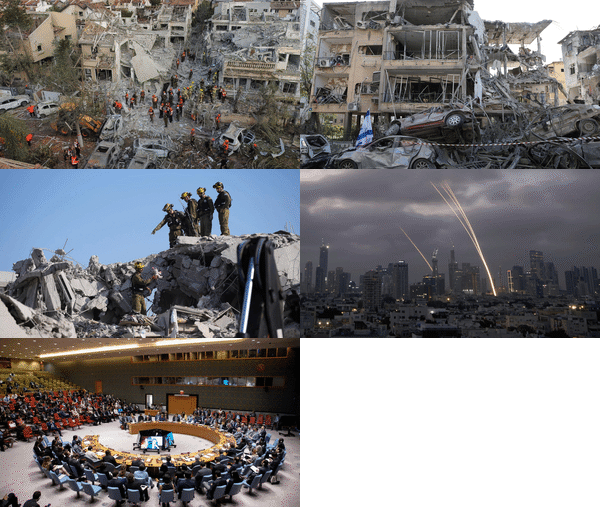
Ultimately, Israel rendered those talks moot by launching a “pre-emptive” strike against Iran's military leaders and its nuclear sites.

Despite those actions, Mr Trump insisted Iran possibly has a “second chance” to come to the negotiating table.

US President Donald Trump posted this message on Truth Social on June 13, 2025

“Iran must make a deal, before there is nothing left, and save what was once known as the Iranian empire. No more death, no more destruction, just do it, before it is too late,” he wrote in a post on Truth Social.

Israel began striking Iranian targets in the early hours of Friday and continued its attacks throughout the day. Iran later responded, unleashing dozens of missiles at Israel.

Israel's strikes were far more extensive than those it conducted against Iran last year, and underscored the country’s growing assertiveness, as well as its military and intelligence capabilities.

Mossad released video that it claims shows its agents deployed in Iran.

Iranian President Masoud Pezeshkian said Iran will make Israel regret its attacks.

“The Iranian nation and the country's officials will not remain silent in the face of this crime, and the legitimate and powerful response of the Islamic Republic of Iran will make the enemy regret its foolish act,” Mr Pezeshkian said in a video statement aired on state TV.

Israel says it killed the Iranian commander of the Islamic Revolutionary Guard Corps' aerospace force Amir Ali Hajizadeh. AFP

Mr Trump later told Reuters that the US still has nuclear talks planned with Iran on Sunday but that he is not sure if they will take place.

“I tried to save Iran humiliation and death,” Mr Trump said, adding he is not concerned about a regional war breaking out as a result of Israel's strikes.

A US official told The National that Washington is planning for talks to continue.

“We still intend to have talks,” the official said, without specifying when these might occur.

Israel said it struck around 100 targets across Iranian cities on Friday morning, using 200 planes. The attacks caused oil prices to surge and investors to buy safe havens such as gold and US Treasuries.

When asked by NBC News why he thinks Iran would still want to hold talks, Mr Trump said Iranian representatives were calling him to suggest they still wanted a deal.

Alex Vatanka, a senior fellow at the Middle East Institute, said Iran might continue talks, provided the country's supreme leader, Ayatollah Ali Khamenei, is willing to do so.

He “has to make a decision” about how much he wants to respond, Mr Vatanka said.

“If he wants to step down, the obvious thing to do is to go back to the negotiations, to look for a way to either give up enrichment, temporarily or for good, or find a compromise somewhere between,” Mr Vatanka said.

“If you can avoid humiliating Ali Khamenei, if you think … he's going to stay in power, then don't humiliate him. Find a way for him to find it easy to come back and negotiate”.


Tamkeen's offering
  • Option 1: 70% in year 1, 50% in year 2, 30% in year 3
  • Option 2: 50% across three years
  • Option 3: 30% across five years 
Iftar programme at the Sheikh Mohammed Centre for Cultural Understanding

Established in 1998, the Sheikh Mohammed Centre for Cultural Understanding was created with a vision to teach residents about the traditions and customs of the UAE. Its motto is ‘open doors, open minds’. All year-round, visitors can sign up for a traditional Emirati breakfast, lunch or dinner meal, as well as a range of walking tours, including ones to sites such as the Jumeirah Mosque or Al Fahidi Historical Neighbourhood.

Every year during Ramadan, an iftar programme is rolled out. This allows guests to break their fast with the centre’s presenters, visit a nearby mosque and observe their guides while they pray. These events last for about two hours and are open to the public, or can be booked for a private event.

Until the end of Ramadan, the iftar events take place from 7pm until 9pm, from Saturday to Thursday. Advanced booking is required.

For more details, email openminds@cultures.ae or visit www.cultures.ae


High profile Al Shabab attacks
  • 2010: A restaurant attack in Kampala Uganda kills 74 people watching a Fifa World Cup final football match.
  • 2013: The Westgate shopping mall attack, 62 civilians, five Kenyan soldiers and four gunmen are killed.
  • 2014: A series of bombings and shootings across Kenya sees scores of civilians killed.
  • 2015: Four gunmen attack Garissa University College in northeastern Kenya and take over 700 students hostage, killing those who identified as Christian; 148 die and 79 more are injured.
  • 2016: An attack on a Kenyan military base in El Adde Somalia kills 180 soldiers.
  • 2017: A suicide truck bombing outside the Safari Hotel in Mogadishu kills 587 people and destroys several city blocks, making it the deadliest attack by the group and the worst in Somalia’s history.

Mercer, the investment consulting arm of US services company Marsh & McLennan, expects its wealth division to at least double its assets under management (AUM) in the Middle East as wealth in the region continues to grow despite economic headwinds, a company official said.

Mercer Wealth, which globally has $160 billion in AUM, plans to boost its AUM in the region to $2-$3bn in the next 2-3 years from the present $1bn, said Yasir AbuShaban, a Dubai-based principal with Mercer Wealth.

Within the next two to three years, we are looking at reaching $2 to $3 billion as a conservative estimate and we do see an opportunity to do so,” said Mr AbuShaban.

Mercer does not directly make investments, but allocates clients’ money they have discretion to, to professional asset managers. They also provide advice to clients.

“We have buying power. We can negotiate on their (client’s) behalf with asset managers to provide them lower fees than they otherwise would have to get on their own,” he added.

Mercer Wealth’s clients include sovereign wealth funds, family offices, and insurance companies among others.

From its office in Dubai, Mercer also looks after Africa, India and Turkey, where they also see opportunity for growth.

Wealth creation in Middle East and Africa (MEA) grew 8.5 per cent to $8.1 trillion last year from $7.5tn in 2015, higher than last year’s global average of 6 per cent and the second-highest growth in a region after Asia-Pacific which grew 9.9 per cent, according to consultancy Boston Consulting Group (BCG). In the region, where wealth grew just 1.9 per cent in 2015 compared with 2014, a pickup in oil prices has helped in wealth generation.

BCG is forecasting MEA wealth will rise to $12tn by 2021, growing at an annual average of 8 per cent.

Drivers of wealth generation in the region will be split evenly between new wealth creation and growth of performance of existing assets, according to BCG.

Another general trend in the region is clients’ looking for a comprehensive approach to investing, according to Mr AbuShaban.

“Institutional investors or some of the families are seeing a slowdown in the available capital they have to invest and in that sense they are looking at optimizing the way they manage their portfolios and making sure they are not investing haphazardly and different parts of their investment are working together,” said Mr AbuShaban.

Some clients also have a higher appetite for risk, given the low interest-rate environment that does not provide enough yield for some institutional investors. These clients are keen to invest in illiquid assets, such as private equity and infrastructure.

“What we have seen is a desire for higher returns in what has been a low-return environment specifically in various fixed income or bonds,” he said.

“In this environment, we have seen a de facto increase in the risk that clients are taking in things like illiquid investments, private equity investments, infrastructure and private debt, those kind of investments were higher illiquidity results in incrementally higher returns.”

The Abu Dhabi Investment Authority, one of the largest sovereign wealth funds, said in its 2016 report that has gradually increased its exposure in direct private equity and private credit transactions, mainly in Asian markets and especially in China and India. The authority’s private equity department focused on structured equities owing to “their defensive characteristics.”

Updated: June 14, 2025, 8:45 AM