


Russia could use nuclear weapons if it was struck with conventional missiles, President Vladimir Putin warned on Wednesday, adding that Moscow would consider any assault supported by a nuclear power to be a joint attack.
The US and Britain are considering whether to give Ukraine permission to fire conventional western missiles into Russia.
Mr Putin said at the opening of a meeting of Russia's Security Council that the decision was in response to a swiftly changing global landscape that presented new threats and risks for Russia.
Weapons wanted by Ukraine - in pictures
-
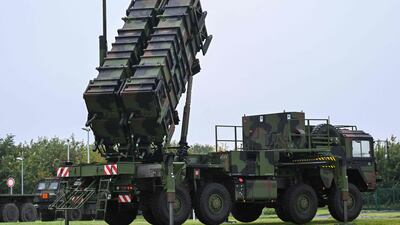
Air defence: Ukraine’s air defence largely depends on the Patriot system. AFP -
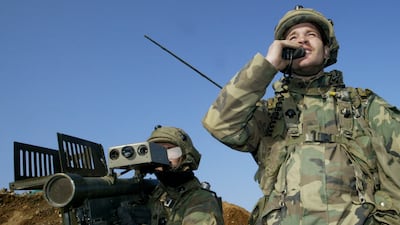
Air: Stinger short-range surface-to-air missile. Reuters -
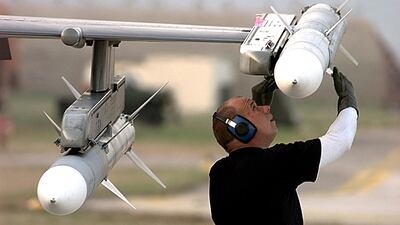
Air: Aim-120 air-to-air missiles. More than 14,000 of the missiles, that have a range exceeding 120km, have been produced with their accuracy so good that they have been nicknamed “Slammer”. Getty Images -
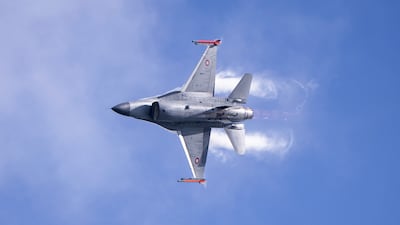
Air: F-16s will provide greater surveillance and the ability to attack high-value targets behind Russian lines in occupied Ukraine. EPA -
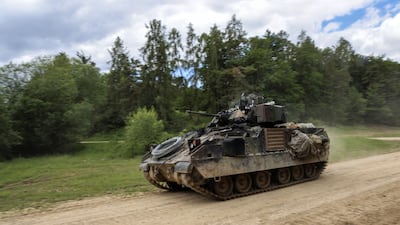
Armour: Bradley IFV. The Ukrainians have found the Bradley infantry fighting vehicle, with its 25mm cannon, very useful in protecting troops and providing decent firepower. Bloomberg -
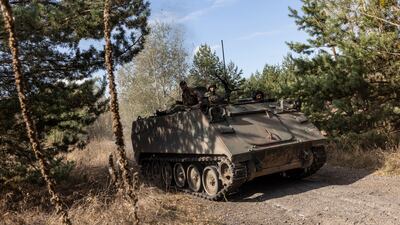
Armour: M113. The 1960s-designed versatile M113 armoured personnel carrier has proven effective in protecting troops against minefields. Getty Images -
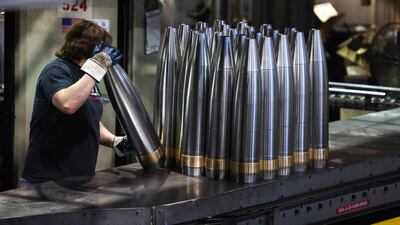
Artillery: 155mm artillery rounds. A massive delivery of 155mm rounds could prove crucial in preventing further Russian advances, particularly in its expected summer offensive. AFP -
Artillery: ATACMs long-range precision missiles. The ATACMS have a range of 300km with the ability to land within a few metres of a target. Getty Images -
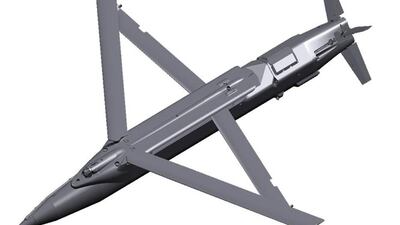
Artillery: Ground-Launched Small Diameter Bomb (GLSDB). It can be fired from the HIMARS system. Photo: Wikimedia Commons -

Artillery: M777 guns and replacement barrels. The Ukrainians need many M777 howitzer barrels to replace those worn down by extensive use. Getty Images


The primary decision-maker on Russia's vast nuclear arsenal, he said he wanted to underscore one key change in nuclear policy.
"It is proposed that aggression against Russia by any non-nuclear state, but with the participation or support of a nuclear state, be considered as their joint attack on the Russian Federation," Mr Putin said. "The conditions for Russia's transition to the use of nuclear weapons are also clearly fixed."
He said Moscow would consider such a move if it detected the start of a massive launch of missiles, aircraft or drones against it. Russia reserved the right to also use nuclear weapons if it or ally Belarus were the subject of aggression, including by conventional weapons, Mr Putin said.
Mr Putin said the clarifications were carefully calibrated and commensurate with the modern military threats facing Russia – confirmation that the nuclear doctrine was changing.
The Ukraine war has led to the most dire confrontation between Russia and the West since the 1962 Cuban Missile Crisis, which is considered to be the time when the two Cold War superpowers came closest to intentional nuclear war.
Ukrainian President Volodymyr Zelenskyy has been urging Kyiv's allies for months to let Ukraine fire western missiles, including long-range US ATACMS and British Storm Shadows, deep into Russia to limit Moscow's ability to launch attacks.
With Ukraine losing key towns to gradually advancing Russian forces in the country's east, the war is entering what Russian officials say is the most dangerous phase to date. Russia controls just under one fifth of Ukrainian territory and has warned the West of the risks of a global war.
Mr Putin, who portrays the West as a decadent aggressor, and US President Joe Biden, who casts Russia as a corrupt autocracy and Mr Putin as a killer, have both warned that a direct Russia-Nato confrontation could escalate into the Third World War.
Russia is the world's largest nuclear power. Together, it and the US control 88 per cent of the world's nuclear warheads.
In his remarks to Russia's Security Council, Mr Putin said that work on amendments on changing the doctrine had been going on for the past year.
"The list of military threats has been supplemented," he said.
Russia, he said, would consider using nuclear weapons "upon receiving reliable information about the massive launch of aerospace attack vehicles and their crossing of our state border, meaning strategic or tactical aircraft, cruise missiles, drones, hypersonic and other aircraft."

