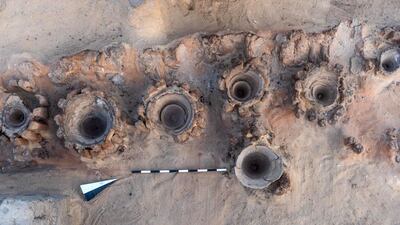
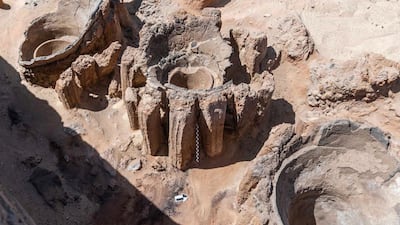
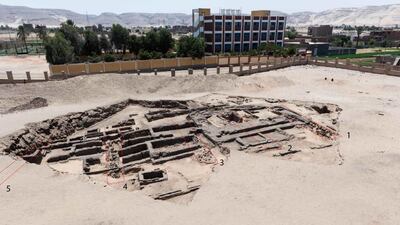
A handout picture released by the Egyptian Ministry of Tourism and Antiquities on February 13, 2021, shows the remains of vats used for beer fermentation, in a complex which may be the world's oldest high-production brewery, uncovered in the Abydos archaeological site near Egypt's southern city of Sohag. AFP
A handout picture released by the Egyptian Ministry of Tourism and Antiquities on February 13, 2021, shows the remains of vats used for beer fermentation, in a complex which may be the world's oldest

Brewery thought to be the world's oldest discovered in Egypt


  • English
  • Arabic

A high-production brewery believed to be the world's oldest was uncovered by a team of archaeologists at the Abydos funerary site in southern Egypt, the tourism ministry said on Saturday.

"The joint Egyptian-American archaeological mission, headed by Dr Matthew Adams of New York University, and Dr Deborah Vischak of Princeton University, working in North Abydos, Sohag, uncovered what is believed to be the oldest high-production brewery in the world," the ministry said on its Facebook page.

It quoted the secretary general of Egypt's Supreme Council of Antiquities, Mostafa Waziry, as saying the brewery probably "dates back to the era of King Narmer".

King Narmer, who ruled more than 5,000 years ago, founded the First Dynasty and unified Upper and Lower Egypt.

British archaeologists first discovered the existence of the brewery at the beginning of the 20th century but its location was never precisely determined, the ministry said.

The joint Egyptian-American team "was able to re-locate and uncover its contents", it said.

According to Mr Waziry, the brewery consisted of eight large areas that were used as "units for beer production".

Each sector contained about 40 earthenware pots arranged in two rows.

A mixture of grains and water used for beer production was heated in the vats, with each basin "held in place by levers made of clay placed vertically in the form of rings".

Dr Adams, who heads the joint archaeological mission, said studies had shown that beer was produced on a large scale, with about 22,400 litres made "at a time".

The brewery "may have been built in this place specifically to supply the royal rituals that were taking place inside the funeral facilities of the kings of Egypt", the ministry quoted him as saying.

"Evidence for the use of beer in sacrificial rites was found during excavations in these facilities," it said.

Evidence of beer-making in ancient Egypt is not new, and past discoveries shed light on such production.

Fragments of pottery used by Egyptians to make beer and dating from 5,000 years ago were discovered on a building site in Tel Aviv, the Israeli Antiquities Authority announced in 2015.

  • The remains of a row of vats used for beer fermentation, in a complex which may be the world's "oldest" high-production brewery, were uncovered in the Abydos archaeological site near Egypt's southern city of Sohag. Egyptian Ministry of Tourism and Antiquities / AFP
    The remains of a row of vats used for beer fermentation, in a complex which may be the world's "oldest" high-production brewery, were uncovered in the Abydos archaeological site near Egypt's southern city of Sohag. Egyptian Ministry of Tourism and Antiquities / AFP
  • The remains of vats used for beer fermentation, in a complex which may be the world's "oldest" high-production brewery, were uncovered in the Abydos archaeological site near Egypt's southern city of Sohag. Egyptian Ministry of Tourism and Antiquities / AFP
    The remains of vats used for beer fermentation, in a complex which may be the world's "oldest" high-production brewery, were uncovered in the Abydos archaeological site near Egypt's southern city of Sohag. Egyptian Ministry of Tourism and Antiquities / AFP
  • The remains of a vat used for beer fermentation, in a complex which may be the world's "oldest" high-production brewery, were uncovered in the Abydos archaeological site near Egypt's southern city of Sohag. Egyptian Ministry of Tourism and Antiquities / AFP
    The remains of a vat used for beer fermentation, in a complex which may be the world's "oldest" high-production brewery, were uncovered in the Abydos archaeological site near Egypt's southern city of Sohag. Egyptian Ministry of Tourism and Antiquities / AFP
  • The remains of what may be the world's "oldest" high-production brewery, were uncovered in the Abydos archaeological site near Egypt's southern city of Sohag. Egyptian Ministry of Tourism and Antiquities / AFP
    The remains of what may be the world's "oldest" high-production brewery, were uncovered in the Abydos archaeological site near Egypt's southern city of Sohag. Egyptian Ministry of Tourism and Antiquities / AFP

Abydos, where the latest discovery was unearthed, has yielded many treasures over the years and is famed for its temples, such as that of Seti I.

In 2000, a team of US archaeologists brought to light in Abydos the earliest known example of an ancient Egyptian solar barge, dating from the first Pharaonic dynasty about 5,000 years ago.

Egypt in recent months announced several major discoveries, which it hopes will spur tourism, a sector that suffered several blows – from a 2011 uprising to the coronavirus pandemic.

Authorities had expected 15 million tourists to visit Egypt in 2020, compared with 13 million the previous year, but the virus has kept holidaymakers away.

What did Ancient Egyptian beer taste like?

When researchers at the British Museum set out to recreate a beer that was as close as possible to what the Ancient Egyptians would have consumed, using the same methods and ingredients, they reported it was "absolutely delicious", as well as being crisp and refreshing.

The beer was made using a two-stage mash process, with an ancient-style grain called emmer. It was then fermented with a yeast culture in a porous terracotta vessel.

Hops were not used in brewing until much later on in the medieval period. However, other ingredients such as spices and dates were often added as a mark of status, which would have resulted in sweet and aromatic brews.

The Ancient Egyptians drunk the beer directly from the brewing vessel, while it was still fermenting, using clay straws.

What did Ancient Egyptians eat?

Beer and bread made from barley and emmer were the two staples consumed by Ancient Egyptians of all classes. A variety of vegetables and fruits were also widely available. The lower classes consumed fish caught in the Nile, while nobles and priests enjoyed meat, dairy products and wine.

The Ancient Egyptian diet

  • Bread

  • Beer, made from emmer

  • Vegetables: onion, garlic, leek, cabbage, papyrus stalk, cucumber, lettuce, turnip, radish, lentils, celery

  • Fruit: dates, figs, pomegranates, melons, grapes

  • Fish, salted and preserved

  • Poultry: duck, goose, quail

  • Meat from cows, pigs, sheep, goats, hippos, gazelles, cranes, hedgehogs

  • Milk and cheese

  • Wine, pressed from grapes 

  • Juice made from grapes and figs

  • Honey

Read more about Ancient Egypt

You can now take virtual tours of historic Egyptian archaeological sites

Curse of the pharaohs in the time of Covid: should Egypt be unearthing mummies?

Huge archaeological find in Egypt includes 50 mummies and a temple

Egyptology isn't just about what we find, but who finds it – and why

Egypt unearths dozens of 2,500-year-old coffins in major discovery

Expert races against time to save Egypt’s 4,600-year-old Bent Pyramid

The%20Killer
%3Cp%3E%3Cstrong%3EDirector%3A%C2%A0%3C%2Fstrong%3EDavid%20Fincher%3C%2Fp%3E%0A%3Cp%3E%3Cstrong%3EStars%3A%C2%A0%3C%2Fstrong%3EMichael%20Fassbender%2C%20Tilda%20Swinton%2C%20Charles%20Parnell%3C%2Fp%3E%0A%3Cp%3E%3Cstrong%3ERating%3A%3C%2Fstrong%3E%204%2F5%C2%A0%3C%2Fp%3E%0A
Joe Root's Test record

Tests: 53; Innings: 98; Not outs: 11; Runs: 4,594; Best score: 254; Average: 52.80; 100s: 11; 50s: 27

RESULTS

5pm Wathba Stallions Cup Maiden (PA) Dh70,000 (Dirt) 1,400m

Winner Munfared, Fernando Jara (jockey), Ahmed Al Mehairbi (trainer)

5.30pm Handicap (PA) Dh70,000 (D) 1,600m

Winner Sawt Assalam, Szczepan Mazur, Ibrahim Al Hadhrami

6pm Maiden (PA) Dh70,000 (D) 1,800m

Winner Dergham Athbah, Pat Dobbs, Mohamed Daggash

6.30pm Handicap (PA) Dh70,000 (D) 1,800m

Winner Rajee, Fernando Jara, Majed Al Jahouri

7pm Conditions (PA) Dh80,000 (D) 1,800m

Winner Kerless Del Roc, Fernando Jara, Ahmed Al Mehairbi

7.30pm Handicap (TB) Dh70,000 (D) 2,000m

Winner Pharoah King, Pat Dobbs, Doug Watson

8pm Conditions (PA) Dh85,000 (D) 2,000m

Winner Sauternes Al Maury, Dane O’Neill, Doug Watson

11 cabbie-recommended restaurants and dishes to try in Abu Dhabi

Iqbal Restaurant behind Wendy’s on Hamdan Street for the chicken karahi (Dh14)

Pathemari in Navy Gate for prawn biryani (from Dh12 to Dh35)

Abu Al Nasar near Abu Dhabi Mall, for biryani (from Dh12 to Dh20)

Bonna Annee at Navy Gate for Ethiopian food (the Bonna Annee special costs Dh42 and comes with a mix of six house stews – key wet, minchet abesh, kekel, meser be sega, tibs fir fir and shiro).

Al Habasha in Tanker Mai for Ethiopian food (tibs, a hearty stew with meat, is a popular dish; here it costs Dh36.75 for lamb and beef versions)

Himalayan Restaurant in Mussaffa for Nepalese (the momos and chowmein noodles are best-selling items, and go for between Dh14 and Dh20)

Makalu in Mussaffa for Nepalese (get the chicken curry or chicken fry for Dh11)

Al Shaheen Cafeteria near Guardian Towers for a quick morning bite, especially the egg sandwich in paratha (Dh3.50)

Pinky Food Restaurant in Tanker Mai for tilapia

Tasty Zone for Nepalese-style noodles (Dh15)

Ibrahimi for Pakistani food (a quarter chicken tikka with roti costs Dh16)

Results

ATP Dubai Championships on Monday (x indicates seed):

First round
Roger Federer (SUI x2) bt Philipp Kohlschreiber (GER) 6-4, 3-6, 6-1
Fernando Verdasco (ESP) bt Thomas Fabbiano (ITA) 3-6, 6-3, 6-2
Marton Fucsovics (HUN) bt Damir Dzumhur (BIH) 6-1, 7-6 (7/5)
Nikoloz Basilashvili (GEO) bt Karen Khachanov (RUS x4) 6-4, 6-1
Jan-Lennard Struff (GER) bt Milos Raonic (CAN x7) 6-4, 5-7, 6-4

UAE squad

Humaira Tasneem (c), Chamani Senevirathne (vc), Subha Srinivasan, NIsha Ali, Udeni Kuruppuarachchi, Chaya Mughal, Roopa Nagraj, Esha Oza, Ishani Senevirathne, Heena Hotchandani, Keveesha Kumari, Judith Cleetus, Chavi Bhatt, Namita D’Souza.

FIXTURES

UAE’s remaining fixtures in World Cup qualification R2
Oct 8: Malaysia (h)
Oct 13: Indonesia (a)
Nov 12: Thailand (h)
Nov 17: Vietnam (h)
 

Mercer, the investment consulting arm of US services company Marsh & McLennan, expects its wealth division to at least double its assets under management (AUM) in the Middle East as wealth in the region continues to grow despite economic headwinds, a company official said.

Mercer Wealth, which globally has $160 billion in AUM, plans to boost its AUM in the region to $2-$3bn in the next 2-3 years from the present $1bn, said Yasir AbuShaban, a Dubai-based principal with Mercer Wealth.

Within the next two to three years, we are looking at reaching $2 to $3 billion as a conservative estimate and we do see an opportunity to do so,” said Mr AbuShaban.

Mercer does not directly make investments, but allocates clients’ money they have discretion to, to professional asset managers. They also provide advice to clients.

“We have buying power. We can negotiate on their (client’s) behalf with asset managers to provide them lower fees than they otherwise would have to get on their own,” he added.

Mercer Wealth’s clients include sovereign wealth funds, family offices, and insurance companies among others.

From its office in Dubai, Mercer also looks after Africa, India and Turkey, where they also see opportunity for growth.

Wealth creation in Middle East and Africa (MEA) grew 8.5 per cent to $8.1 trillion last year from $7.5tn in 2015, higher than last year’s global average of 6 per cent and the second-highest growth in a region after Asia-Pacific which grew 9.9 per cent, according to consultancy Boston Consulting Group (BCG). In the region, where wealth grew just 1.9 per cent in 2015 compared with 2014, a pickup in oil prices has helped in wealth generation.

BCG is forecasting MEA wealth will rise to $12tn by 2021, growing at an annual average of 8 per cent.

Drivers of wealth generation in the region will be split evenly between new wealth creation and growth of performance of existing assets, according to BCG.

Another general trend in the region is clients’ looking for a comprehensive approach to investing, according to Mr AbuShaban.

“Institutional investors or some of the families are seeing a slowdown in the available capital they have to invest and in that sense they are looking at optimizing the way they manage their portfolios and making sure they are not investing haphazardly and different parts of their investment are working together,” said Mr AbuShaban.

Some clients also have a higher appetite for risk, given the low interest-rate environment that does not provide enough yield for some institutional investors. These clients are keen to invest in illiquid assets, such as private equity and infrastructure.

“What we have seen is a desire for higher returns in what has been a low-return environment specifically in various fixed income or bonds,” he said.

“In this environment, we have seen a de facto increase in the risk that clients are taking in things like illiquid investments, private equity investments, infrastructure and private debt, those kind of investments were higher illiquidity results in incrementally higher returns.”

The Abu Dhabi Investment Authority, one of the largest sovereign wealth funds, said in its 2016 report that has gradually increased its exposure in direct private equity and private credit transactions, mainly in Asian markets and especially in China and India. The authority’s private equity department focused on structured equities owing to “their defensive characteristics.”

COMPANY%20PROFILE%20
%3Cp%3EName%3A%20DarDoc%3Cbr%3EBased%3A%20Abu%20Dhabi%3Cbr%3EFounders%3A%20Samer%20Masri%2C%20Keswin%20Suresh%3Cbr%3ESector%3A%20HealthTech%3Cbr%3ETotal%20funding%3A%20%24800%2C000%3Cbr%3EInvestors%3A%20Flat6Labs%2C%20angel%20investors%20%2B%20Incubated%20by%20Hub71%2C%20Abu%20Dhabi's%20Department%20of%20Health%3Cbr%3ENumber%20of%20employees%3A%2010%3C%2Fp%3E%0A
AIR
%3Cp%3E%3Cstrong%3EDirector%3A%20%3C%2Fstrong%3EBen%20Affleck%3Cbr%3E%3Cbr%3E%3Cstrong%3EStars%3A%20%3C%2Fstrong%3EMatt%20Damon%2C%20Jason%20Bateman%2C%20Ben%20Affleck%2C%20Viola%20Davis%3Cbr%3E%3Cbr%3E%3Cstrong%3ERating%3A%3C%2Fstrong%3E%204%2F5%3C%2Fp%3E%0A
Types of fraud

Phishing: Fraudsters send an unsolicited email that appears to be from a financial institution or online retailer. The hoax email requests that you provide sensitive information, often by clicking on to a link leading to a fake website.

Smishing: The SMS equivalent of phishing. Fraudsters falsify the telephone number through “text spoofing,” so that it appears to be a genuine text from the bank.

Vishing: The telephone equivalent of phishing and smishing. Fraudsters may pose as bank staff, police or government officials. They may persuade the consumer to transfer money or divulge personal information.

SIM swap: Fraudsters duplicate the SIM of your mobile number without your knowledge or authorisation, allowing them to conduct financial transactions with your bank.

Identity theft: Someone illegally obtains your confidential information, through various ways, such as theft of your wallet, bank and utility bill statements, computer intrusion and social networks.

Prize scams: Fraudsters claiming to be authorised representatives from well-known organisations (such as Etisalat, du, Dubai Shopping Festival, Expo2020, Lulu Hypermarket etc) contact victims to tell them they have won a cash prize and request them to share confidential banking details to transfer the prize money.

* Nada El Sawy

UPI facts

More than 2.2 million Indian tourists arrived in UAE in 2023
More than 3.5 million Indians reside in UAE
Indian tourists can make purchases in UAE using rupee accounts in India through QR-code-based UPI real-time payment systems
Indian residents in UAE can use their non-resident NRO and NRE accounts held in Indian banks linked to a UAE mobile number for UPI transactions

While you're here

Michael Young: Where is Lebanon headed?

Kareem Shaheen: I owe everything to Beirut

Raghida Dergham: We have to bounce back

The specs

Engine: 4.0-litre V8 twin-turbocharged and three electric motors

Power: Combined output 920hp

Torque: 730Nm at 4,000-7,000rpm

Transmission: 8-speed dual-clutch automatic

Fuel consumption: 11.2L/100km

On sale: Now, deliveries expected later in 2025

Price: expected to start at Dh1,432,000

Women%E2%80%99s%20Asia%20Cup
%3Cp%3E%3Cstrong%3EUAE%20fixtures%3C%2Fstrong%3E%3Cbr%3ESun%20Oct%202%2C%20v%20Sri%20Lanka%3Cbr%3ETue%20Oct%204%2C%20v%20India%3Cbr%3EWed%20Oct%205%2C%20v%20Malaysia%3Cbr%3EFri%20Oct%207%2C%20v%20Thailand%3Cbr%3ESun%20Oct%209%2C%20v%20Pakistan%3Cbr%3ETue%20Oct%2011%2C%20v%20Bangladesh%3Cbr%3E%3Cbr%3E%3Cstrong%3EUAE%20squad%3C%2Fstrong%3E%3Cbr%3EChaya%20Mughal%20(captain)%2C%20Esha%20Oza%2C%20Kavisha%20Kumari%2C%20Khushi%20Sharma%2C%20Theertha%20Satish%2C%20Lavanya%20Keny%2C%20Priyanjali%20Jain%2C%20Suraksha%20Kotte%2C%20Natasha%20Cherriath%2C%20Indhuja%20Nandakumar%2C%20Rishitha%20Rajith%2C%20Vaishnave%20Mahesh%2C%20Siya%20Gokhale%2C%20Samaira%20Dharnidharka%2C%20Mahika%20Gaur%3C%2Fp%3E%0A
Asia%20Cup%202022
%3Cp%3E%3Cstrong%3EWhat%3C%2Fstrong%3E%3Cbr%3EAsia%20Cup%20final%3A%20Sri%20Lanka%20v%20Pakistan%3Cbr%3E%3Cbr%3E%3Cstrong%3EWhen%20%3C%2Fstrong%3E%3Cbr%3ESunday%2C%20September%2011%2C%20from%206pm%3Cbr%3E%3Cbr%3E%3Cstrong%3EWhere%3C%2Fstrong%3E%3Cbr%3EDubai%20International%20Stadium%3Cbr%3E%3Cbr%3E%3Cstrong%3EHow%20to%20watch%3C%2Fstrong%3E%3Cbr%3ECatch%20the%20live%20action%20on%20Starzplay%20across%20Mena%20region.%26nbsp%3B%3C%2Fp%3E%0A
The%20specs
%3Cp%3E%3Cstrong%3EEngine%3A%20%3C%2Fstrong%3E3.5-litre%20twin-turbo%20V6%20%0D%3Cbr%3E%3Cstrong%3EPower%3A%20%3C%2Fstrong%3E456hp%20at%205%2C000rpm%0D%3Cbr%3E%3Cstrong%3ETorque%3A%20%3C%2Fstrong%3E691Nm%20at%203%2C500rpm%0D%3Cbr%3E%3Cstrong%3ETransmission%3A%20%3C%2Fstrong%3E10-speed%20auto%20%0D%3Cbr%3E%3Cstrong%3EFuel%20consumption%3A%20%3C%2Fstrong%3E14.6L%2F100km%0D%3Cbr%3E%3Cstrong%3EPrice%3A%20%3C%2Fstrong%3Efrom%20Dh349%2C545%0D%3Cbr%3E%3Cstrong%3EOn%20sale%3A%20%3C%2Fstrong%3Enow%3C%2Fp%3E%0A
UAE currency: the story behind the money in your pockets
It's up to you to go green

Nils El Accad, chief executive and owner of Organic Foods and Café, says going green is about “lifestyle and attitude” rather than a “money change”; people need to plan ahead to fill water bottles in advance and take their own bags to the supermarket, he says.

“People always want someone else to do the work; it doesn’t work like that,” he adds. “The first step: you have to consciously make that decision and change.”

When he gets a takeaway, says Mr El Accad, he takes his own glass jars instead of accepting disposable aluminium containers, paper napkins and plastic tubs, cutlery and bags from restaurants.

He also plants his own crops and herbs at home and at the Sheikh Zayed store, from basil and rosemary to beans, squashes and papayas. “If you’re going to water anything, better it be tomatoes and cucumbers, something edible, than grass,” he says.

“All this throwaway plastic - cups, bottles, forks - has to go first,” says Mr El Accad, who has banned all disposable straws, whether plastic or even paper, from the café chain.

One of the latest changes he has implemented at his stores is to offer refills of liquid laundry detergent, to save plastic. The two brands Organic Foods stocks, Organic Larder and Sonnett, are both “triple-certified - you could eat the product”.  

The Organic Larder detergent will soon be delivered in 200-litre metal oil drums before being decanted into 20-litre containers in-store.

Customers can refill their bottles at least 30 times before they start to degrade, he says. Organic Larder costs Dh35.75 for one litre and Dh62 for 2.75 litres and refills will cost 15 to 20 per cent less, Mr El Accad says.

But while there are savings to be had, going green tends to come with upfront costs and extra work and planning. Are we ready to refill bottles rather than throw them away? “You have to change,” says Mr El Accad. “I can only make it available.”

COMPANY PROFILE

Name: Lamsa

Founder: Badr Ward

Launched: 2014

Employees: 60

Based: Abu Dhabi

Sector: EdTech

Funding to date: $15 million

Profile box

Company name: baraka
Started: July 2020
Founders: Feras Jalbout and Kunal Taneja
Based: Dubai and Bahrain
Sector: FinTech
Initial investment: $150,000
Current staff: 12
Stage: Pre-seed capital raising of $1 million
Investors: Class 5 Global, FJ Labs, IMO Ventures, The Community Fund, VentureSouq, Fox Ventures, Dr Abdulla Elyas (private investment)

Living in...

This article is part of a guide on where to live in the UAE. Our reporters will profile some of the country’s most desirable districts, provide an estimate of rental prices and introduce you to some of the residents who call each area home.