
Imagine a prized Egyptian discovery and chances are you are thinking of sarcophagi or statues of sphinxes. But the next big thing in Egyptology might be what the creators of these historical items were eating for breakfast.
Some may argue this field of study holds little interest for the general public, but there is one woman in Egypt who begs to differ.
Mennat-Allah El Dorry, a German and British-trained archaeologist, specialises in archaeobotany and the history of food in Egypt.
"I like to call myself a food archaeologist," she told The National. "Archaeobotany is what you make it. I think it's very sexy," Dr El Dorry, who is in her 30s, said with a smile. "When I first explored the field, I think plants ended up choosing me."
Dr El Dorry’s passion has made her a reliable expert in her field; the go-to person for archaeobotanical remains. That passion transcends purely academic work and spills into areas of contemporary interest, such as which food or dish eaten today by Egyptians can be traced back to Pharaonic times or what makes a dish purely Egyptian.
“For something to be Egyptian, it does not have to be 7,000 years old,” she said.
The typically Egyptian dish kushary first appeared in Egypt as recently as 1860 in the Red Sea port city of Suez, she said. The origin of the dish is in India where it is known as khichri, but Egyptians made it their own by adding to the lentil and rice tomato sauce, pasta and a garlic-vinegar sauce.
Another example is fava beans, or what Egyptians call ful medamess. Most Egyptians are under the impression that it is something Egyptians ate since Pharaonic times, but “we have no evidence to back this up”, Dr El Dorry said. Eating ful may have begun in Egypt at its Greco-Roman period in late antiquity.

"The search for 'purity' and authenticity is often a futile one," Dr El Dorry wrote in the latest edition of the Egyptian periodical Rawi, which was entirely devoted to Egypt's culinary history. "Although it sounds like a cliche, the world is really a melting pot."
What did Ancient Egyptians actually eat?
“They had a basic diet of fresh food, did not eat processed food or refined sugar and when they ate preserved food, it was naturally preserved,” she said.
“But they had some of the worst dental health because they often broke their teeth eating bread that contained little bits of the stones used to grind grains into flour.”

But not everything she examines is food.
“We get to see a lot of animal manure in archaeological digs, including the dung used by ancient Egyptians for a steady fire to cook. I also find a lot of sheep or goats’ droppings,” she said.
The animal manure, she said, helps Egyptologists learn about agricultural practices during Pharaonic times because animals were often fed waste from harvesting. Manure can help to determine what people ate and even during which season it was consumed.
One area Dr El Dorry has spent considerable time researching is the wine made in ancient Christian monasteries in Egyptian deserts.
More than a decade ago, it took her a year to identify the remains of just one type of grape remains found in an ancient monastery.
“Now I can identify them in my sleep,” she said.
Dr El Dorry discovered that the grapes were crushed for winemaking purposes in one monastery, but she never found a grape press.
“It was charred after it was apparently used as fuel,” she said. What was used as grape presses, she believes, were straw mats in which the grapes were sandwiched and a screwing device made of wood was used to crush them.
Through her focus on winemaking in monasteries, Dr El Dorry offers a window into one aspect of the relationship between Egypt’s Muslim rulers and its Christian minority, namely the occasional destruction of wine stocks and the banning of the making of or trade in wine.
“It was done either out of religious zeal or economic reasons, but those bans were often rescinded or just neglected.”
Unlike many who dig in search of the acclaim that comes with a great Egyptian discovery, she said she is not interested in glory.
"I just want to enjoy what I do," she said at the Nile-side Cairo Yacht Club across the street from her family home in the Egyptian capital.
“Once I say I study food history, everyone has a question, everyone can relate and has a theory.”
Besides a doctorate from Muenster in Germany, a master’s degree from University College London and an undergraduate degree from the American University in Cairo, Dr El Dorry’s credentials as an Egyptologist extend to her linguistic abilities. Beside her native Arabic, she speaks English and German and can also read Coptic, the language Egyptians spoke in late antiquity.
It is a good time to be an archaeologist in Egypt. In recent years, archaeologists there have made a series of breathtaking discoveries, including dozens of well-preserved coffins that are 2,500 years old and a pair of giant statues of an Egyptian king in Cairo’s eastern Heliopolis suburb in 2017.
-
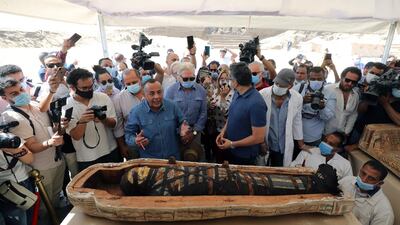
Secretary-general of the Supreme Council of Antiquities of Egypt Mostafa Waziri (C-L) speaks next to a sarcophagus discovered at Saqqara Necropolis, Giza, Egypt. An Egyptian archaeological mission uncovered a total of 59 intact and sealed coffins in three burial shafts dozen of meters deep in the Saqqara necropolis. EPA -
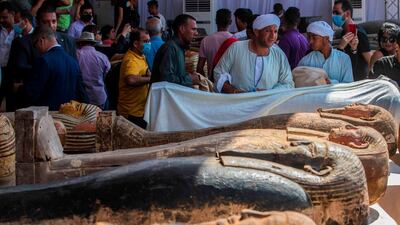
Sarcophaguses, excavated by the Egyptian archaeological mission, displayed during a press conference at the Saqqara necropolis, 30 kms south of the Egyptian capital Cairo, which resulted in the discovery of a deep burial well with more than 59 human coffins closed for more than 2,500 years. AFP -
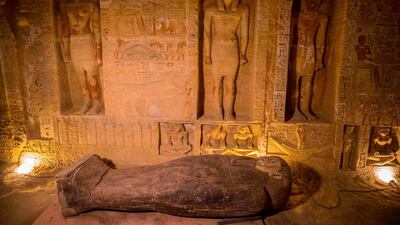
One of the sarcophaguses excavated by the Egyptian archaeological mission which resulted in the discovery of a deep burial well with more than 59 human coffins closed for more than 2,500 years. AFP -
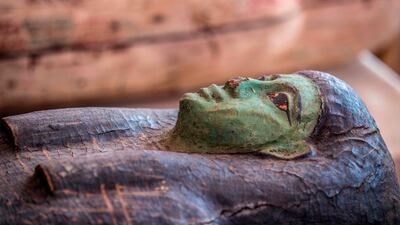
Sarcophaguses, excavated by the Egyptian archaeological mission which resulted in the discovery of a deep burial well with more than 59 human coffins closed for more than 2,500 years. AFP -
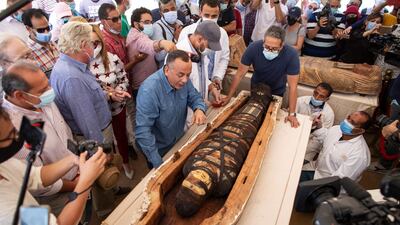
Khaled El-Enaby, Minister of Tourism and Antiquities, right, and Mostafa Waziri, the secretary-general of the Supreme Council of Antiquities, left, react after opening the sarcophagus is around 2500 years old at the Saqqara archaeological site. AP -
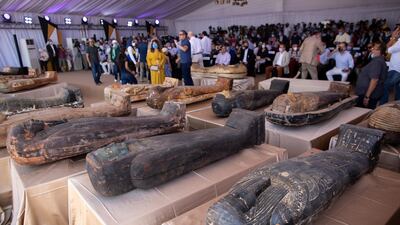
A sarcophagus that is around 2500 years old is displayed at the Saqqara archaeological site, 30 kilometers (19 miles) south of Cairo, Egypt. AP -
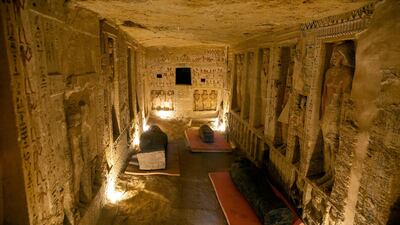
A sarcophagus that is around 2500 years old at the Saqqara archaeological site is shown, 30 kilometers (19 miles) south of Cairo, Egypt. AP -
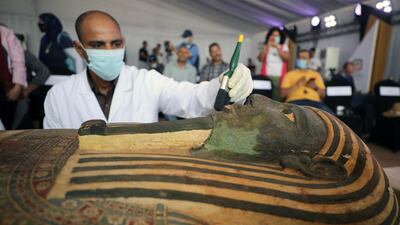
Egyptian archeologists work on one of the sarcophagi discovered at Saqqara Necropolis, Giza, Egypt. An Egyptian archaeological mission uncovered a total of 59 intact and sealed coffins in three burial shafts dozen of meters deep in the Saqqara necropolis.EPA -
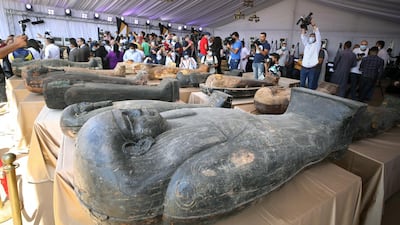
Members of the press gather around sarcophagus on display after they were discovered at Saqqara Necropolis, Giza, Egypt. An Egyptian archaeological mission uncovered a total of 59 intact and sealed coffins in three burial shafts dozen of meters deep in the Saqqara necropolis. EPA -
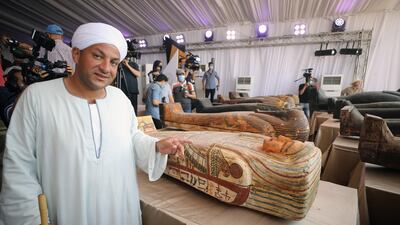
A man stands near sarcophagus on display after they were discovered at Saqqara Necropolis, Giza, Egypt. An Egyptian archaeological mission uncovered a total of 59 intact and sealed coffins in three burial shafts dozen of meters deep in the Saqqara necropolis. EPA -
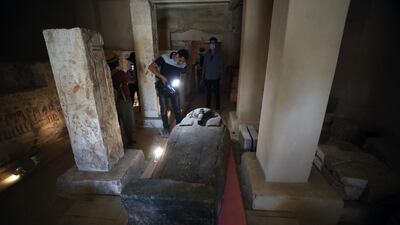
People inspect the sarcophagus on display after they were discovered at Saqqara Necropolis, Giza, Egypt. An Egyptian archaeological mission uncovered a total of 59 intact and sealed coffins in three burial shafts dozen of meters deep in the Saqqara necropolis. EPA -
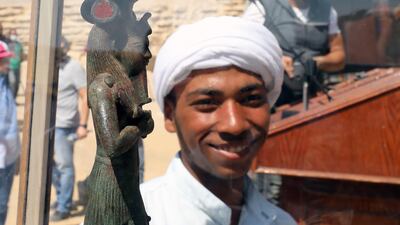
A man looks at one of the statues on display after they were discovered at Saqqara Necropolis, Giza, Egypt. An Egyptian archaeological mission uncovered a total of 59 intact and sealed coffins in three burial shafts dozen of meters deep in the Saqqara necropolis. EPA -
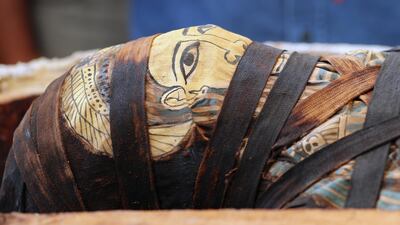
epa08717855 A view of one of the sarcophagi discovered at Saqqara Necropolis, Giza, Egypt, 03 October 2020. An Egyptian archaeological mission uncovered a total of 59 intact and sealed coffins in three burial shafts dozen of meters deep in the Saqqara necropolis. The 2500 years old coffins, believed to be belonging to the 26th Dynasty Priests, are expected to be transferred to the Grand Egyptian Museum. EPA/KHALED ELFIQI -
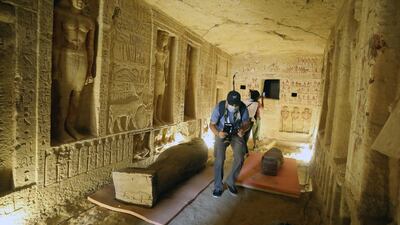
People inspect the sarcophagus on display after they were discovered at Saqqara Necropolis, Giza. EPA -
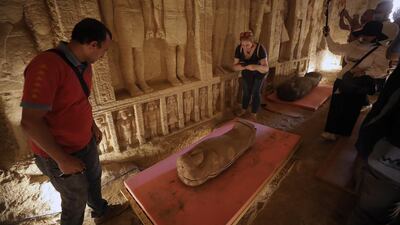
People inspect the sarcophagus on display after they were discovered at Saqqara Necropolis, Giza. EPA


The intensely publicised discoveries fuelled interest in Egypt as a popular tourist destination and, in the case of the coffins recently unearthed from a holy burial site just south-west of Cairo, served as a global reminder of Egypt's treasures at a time when very few tourists were visiting the country because of the coronavirus pandemic.
Dr El Dorry has a book on food in archaeological monasteries in Egypt that is due to be published in 2022.
“Of course not,” she replied when asked whether such a book would be popular. “You’ll be one of three if you decide to buy it,” she said lightheartedly. “My dream book is a people’s book about the history of food in Egypt. That’s the one I intend to write next.”
The Ancient Egyptian diet
- Bread
- Beer, made from emmer
- Vegetables: onion, garlic, leek, cabbage, papyrus stalk, cucumber, lettuce, turnip, radish, lentils, celery
- Fruit: dates, figs, pomegranates, melons, grapes
- Fish, salted and preserved
- Poultry: duck, goose, quail
- Meat from cows, pigs, sheep, goats, hippos, gazelles, cranes, hedgehogs
- Milk and cheese
- Wine, pressed from grapes
- Juice made from grapes and figs
- Honey
Read more about Ancient Egypt:
You can now take virtual tours of historic Egyptian archaeological sites
Curse of the pharaohs in the time of Covid: should Egypt be unearthing mummies?
Huge archaeological find in Egypt includes 50 mummies and a temple
Egyptology isn't just about what we find, but who finds it – and why
Egypt unearths dozens of 2,500-year-old coffins in major discovery
Expert races against time to save Egypt’s 4,600-year-old Bent Pyramid

