


Workers in white coats carefully inserted small wooden wedges into the seam between the top and the bottom of an ancient Egyptian sarcophagus. They then slowly lifted the top, revealing a pristine mummy. The dignitaries gasped in excitement. The camera shutters clicked frantically.
Last week, Egypt shared its latest archaeological discovery with the world in a choreographed ceremony south of Cairo. There, 59 sealed sarcophagi dating back 2,500 years were unearthed near the step pyramid of Saqqara. Media coverage of the event mesmerised viewers, and video of the moment the colourful sarcophagus was opened went viral on social media.
To millions across the world, it was a respite from a grim year. To those who believe in supernatural powers and those who take Hollywood movie plots seriously, digging out pharaonic coffins is an ominous act that could add insult to injury in 2020 when the world is being ravaged by pandemic, wars and disasters.
To the latter group, the words of the Egyptologist who led the excavations must have been chilling.
“We are not going to stop digging,” Mustafa Al Waziri, Egypt’s most senior archaeologist, said at the ceremony in Saqqara on October 3. “We are going to continue and very soon we will find something very special.”
“Great! That’s all 2020 needs? They feed the Scorpion King,” said one of the hundreds of tweets bemoaning the unearthing and opening of the Saqqara coffins.
The Scorpion King reference alludes to the 1999 action-horror blockbuster The Mummy, which is a remake of the 1932 film of the same title.
“Cannot wait to get rock bottomed to death while Covid shuts down my lungs,” continued the tweet. Another tweet echoed a similar sentiment. “We’re all cursed now. Good job, humanity. Way to make 2020 somehow even worse.”
Betraying despair of things improving in the remainder of 2020, another tweet asked: “I mean, why not throw an ancient Egyptian curse into the mix at this point?”
Although a science, Egyptology has long been stalked by mythology that is centered on the curse of pharaohs and by claims that an extraterrestrial civilisation was involved in the building of the Giza Pyramids. Some of these theories and tales found their way into books and even provided the foundation of cults.
A string of events that followed the discovery in 1923 of the tomb of the boy-king Tutankhamun – perhaps the best known pharaonic find of all times – has given the greatest credence to the mythical curse of the pharaohs.
-
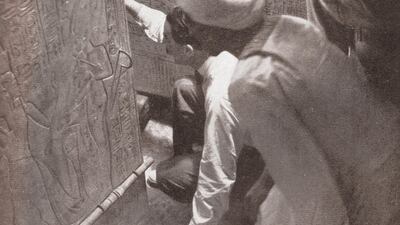
Howard Carter and associates opening the doors of King Tutankhamun's burial shrine in the Valley of the Kings, Egypt; screen print from a photograph, 1923. Getty -
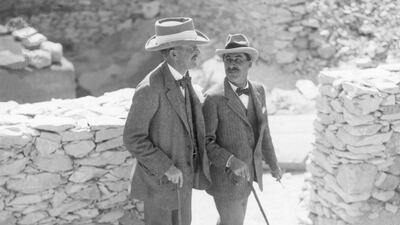
English Egyptologist Howard Carter (1874 - 1939, right) walks with the patron of his research, archaeologist and 5th Earl, Lord Carnarvon George Herbert (1866 - 1923), at the Valley of the Kings excavation site, Egypt. Getty -

American archaeologist Arthur Mace (1874 - 1928) (left) of the Metropolitan Museum and British chemist Alfred Lucas (1867 - 1945) with the Egyptian government inspect a chariot from the tomb of Pharaoh Tutankhamen, better known as King Tut, Valley of the Kings, Thebes, Egypt, 1923. Getty -
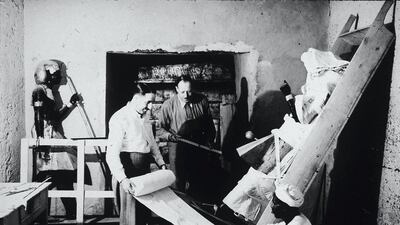
British archaeologists Howard Carter (1874 - 1939) (left) and Arthur Callender (died 1937) carry out the systematic removal of objects from the antechamber of the tomb of Pharaoh Tutankhamen, better known as King Tut, with the assistance of an Egyptian laborer, Valley of the Kings, Thebes, Egypt, 1923. Getty -
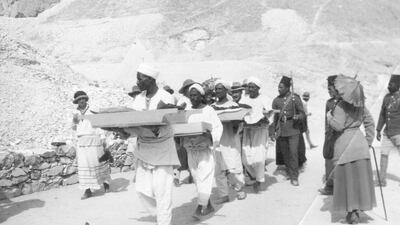
February 1923: Bearers remove objects from the tomb of King Tutankhamen in the Valley of the Kings near Luxor. Getty -

Crates are brought out of the newly-discovered tomb of Tutankhamun in the Valley of the Kings, Luxor, circa 1923. Getty -

Closing the Tomb of Tutankhamun, Valley of the Kings, Egypt, February 1923, The discovery of Tutankhamun's tomb in 1922 by British archaeologist Howard Carter (1874-1939) was one of the most astounding discoveries in archaeology. Getty


The tomb’s discoverer, English archaeologist Howard Carter, died 20 years after he first opened the burial site in the southern Egyptian city of Luxor, but the man who financially supported the dig, George Herbert, the fifth Earl of Carnarvon, died four months later from an infection caused by a mosquito bite.
Three other men associated with the tomb – George Jay Gould, who visited it in 1923, A C Mace, a member of Carter’s team, and Captain Richard Bethell, Carter’s secretary – all died in unusual circumstances between 1923 and 1929.
The Ancient Egyptians themselves have fed the myth of the curse.
Hieroglyphic writings on the walls of many tombs say that death will haunt anyone who disturbs the sleep of the pharaohs. Other writings tell of curses that would pursue those who meddle with the tombs.
“Most foreign tourists talk about the curse of the pharaohs,” said Ahmed Mostafa, an Egyptian tour guide with more than 30 years of experience. “Some talk about it in jest; others do so while actually believing in the curse.”
According to pharaonic beliefs, the idea behind mummification is to preserve the body of the dead so that the soul returns to it in the afterlife. The journey to the afterlife is made in a boat and the dead often fend off attacks by snakes or crocodiles while in transit, with the gods protecting them.
“Tourists have, over the years, spoken to and asked me questions about the curse of the pharaohs, but no one ever raised the question of whether we should or not dig out pharaonic artefacts,” said another veteran tour guide who did not want to be named.
Curse of the pharaohs aside, the discovery in Saqqara was the latest in a series of a finds announced by Egypt over the past few years that appeared, at least in part, carefully timed to create and sustain interest in Egypt’s antique treasures with an eye to attracting more visitors.
-

The Bent pyramid of King Sneferu, the first pharaoh of Egypt's 4th dynasty, in the ancient royal necropolis of Dahshur on the west bank of the Nile River, south of the capital Cairo. AFP -
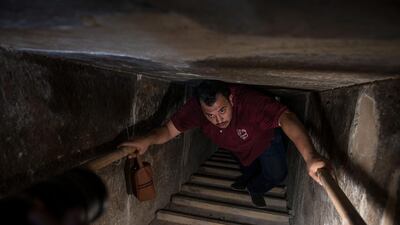
A man walks through a passage inside the Bent Pyramid of Sneferu. EPA -

Women look at recently discovered artefacts at the Bent Pyramid. AP -

A detail of a sarcophagus, part of a new discovery south of King Amenemhat II’s pyramid at Dahshur necropolis. AFP -

A sarcophagus, part of a new discovery south of King Amenemhat II’s pyramid at Dahshur necropolis. AFP -
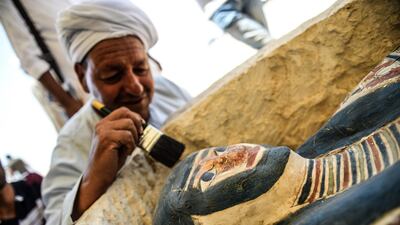
A man brushes off dust from a sarcophagus, part of a new discovery at Dahshur necropolis. AFP -
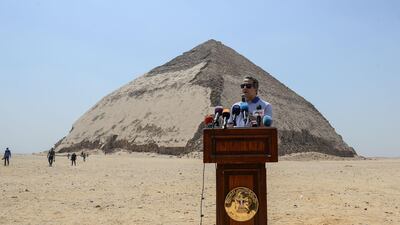
Egypt's Antiquities Minister Khaled El Enany speaks in front of the Bent Pyramid of Sneferu. AFP -

People gather during an inaugural ceremony in front of the Bent pyramid of King Sneferu. AFP -
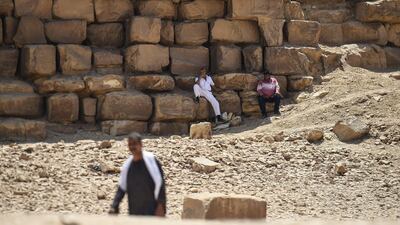
A man walks in front of one the Bent pyramid satellites, in the ancient royal necropolis of Dahshur. AFP -
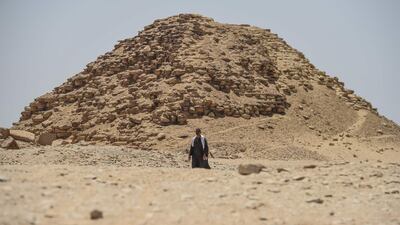
A man walks in front of one the Bent pyramid satellites, in the ancient royal necropolis of Dahshur. AFP -
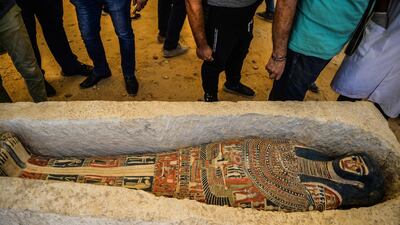
A sarcophagus, part of a new discovery south of King Amenemhat II’s pyramid at Dahshur necropolis. AFP -

A man walks through a passage in the well-known bent pyramid of King Sneferu. AFP


Egypt’s tourism sector was battered in the years of turmoil that followed the 2011 uprising that toppled Hosni Mubarak, significantly contributing to the country’s economic woes. Egypt’s breakout year was 2019, with more than 13 million visitors – an all-time high. Everyone, from top government officials to the 1 million Egyptians who work in tourism, thought the tough days were finally behind them. But they were, sadly, badly mistaken.
The coronavirus pandemic kicked in around February and the country, like almost everywhere else, was forced into lockdown. Airports shut, tourist sites closed and hotels put up the shutters as part of measures to stop the disease from spreading.
The country reopened at the end of June, but only a fraction of the number of tourists in 2019 have so far trickled in and, with a second wave of the pandemic hitting Europe, the numbers may not grow in the foreseeable future.
But who is to blame? The curse of the pharaohs or 2020? A bit of both, perhaps.
“How many times have they said stop opening ancient Egyptian coffins?” asked one Twitter user who goes by the alias Jalabi.
“Y'all wanna be cursed? Haven’t you had enough 2020?”

