Noureddine Taboubi, re-elected secretary-general of the Tunisian General Labour Union, holds significant sway. Photo: AFP

Tunisia's powerful labour union re-elects Noureddine Taboubi as leader


  • English
  • Arabic

Tunisia's UGTT labour union on Saturday re-elected Noureddine Taboubi as its leader as the country approaches a turning point where the organisation may play an important role.

Mr Taboubi, who has been UGTT leader for five years, has been cautious in the months since President Kais Saied seized executive powers in a move his opponents called a coup.

The union's blessing is regarded as vital for the economic reforms sought by foreign donors in return for a financial rescue package to avert a crisis that threatens to bankrupt Tunisia.

Its stance will also be crucial for Mr Saied's plans to remake Tunisian politics after he suspended the elected parliament in July. The president has also in effect suspended the constitution to say he can rule by decree and has seized control of judicial appointments, moves his critics said undermined rule of law.

With more than a million members and the ability to shut down Tunisia's economy with strikes, the UGTT is widely seen as one of the country's most powerful political players and an organisation that might withstand presidential authority.

Mr Saied has so far largely ignored the UGTT's repeated requests to take part in a broad-based political and economic dialogue over the crisis and his plans to rewrite the constitution. After meeting Mr Taboubi in July, Mr Saied did not see him again until January.

Mr Taboubi's re-election was at the union's congress, a meeting held every five years, and its final statement underlined its demand for an inclusive process for the changes that Mr Saied is pushing.

The UGTT's request recalls the role it played after the 2011 revolution that forced the autocratic president Zine El Abidine Ben Ali to flee the country. It won the Nobel Peace Prize in 2015 after joining other civil society groups to avert dangerous polarisation on the street.

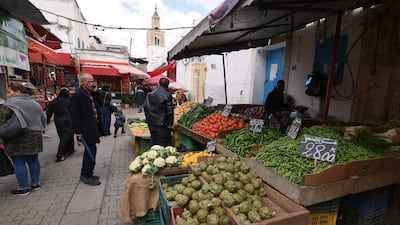
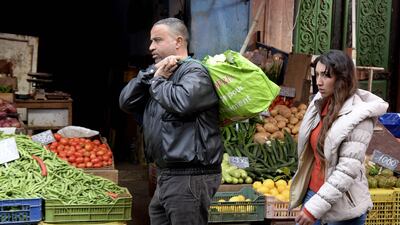
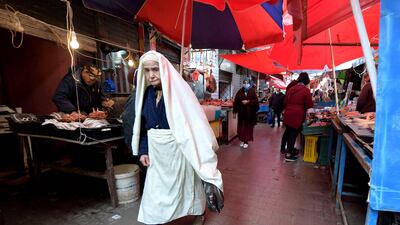
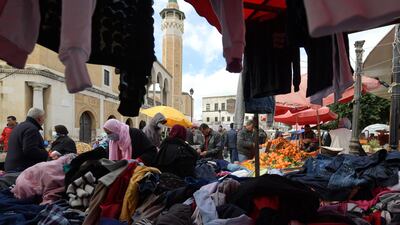
Tunisian families feel brunt of deep recession - in pictures

  • Tunisia, roiled by years of political turmoil that deepened with President Kais Saied's power grab last July, is mired in a deep recession. All photos: AFP
    Tunisia, roiled by years of political turmoil that deepened with President Kais Saied's power grab last July, is mired in a deep recession. All photos: AFP
  • Surging prices and job losses have hurt families that were already struggling before the coronavirus pandemic.
    Surging prices and job losses have hurt families that were already struggling before the coronavirus pandemic.
  • This week, Tunisia started preliminary talks with the International Monetary Fund over a bailout package.
    This week, Tunisia started preliminary talks with the International Monetary Fund over a bailout package.
  • Such a deal would probably mean cuts to subsidies and public sector wages, which many fear would spell more suffering for the most vulnerable.
    Such a deal would probably mean cuts to subsidies and public sector wages, which many fear would spell more suffering for the most vulnerable.
  • That could fuel the same kind of grievances that sparked a revolution a decade ago and brought down Zine El Abidine Ben Ali after 23 years in power.
    That could fuel the same kind of grievances that sparked a revolution a decade ago and brought down Zine El Abidine Ben Ali after 23 years in power.
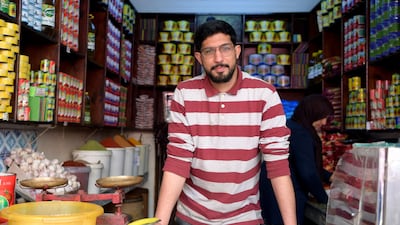
  • Tunisian grocer Bilel Jani sees the reality of a biting economic crisis.
    Tunisian grocer Bilel Jani sees the reality of a biting economic crisis.
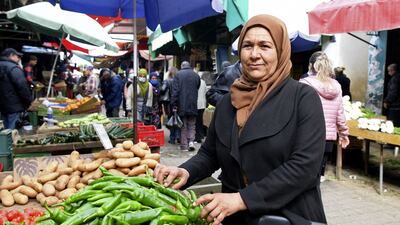
  • Tunisian Delila Dridi said life is a struggle on her salary from the education ministry.
    Tunisian Delila Dridi said life is a struggle on her salary from the education ministry.
The specs
  • Engine: 3.9-litre twin-turbo V8
  • Power: 640hp
  • Torque: 760nm
  • On sale: 2026
  • Price: Not announced yet
The schedule

December 5 - 23: Shooting competition, Al Dhafra Shooting Club

December 9 - 24: Handicrafts competition, from 4pm until 10pm, Heritage Souq

December 11 - 20: Dates competition, from 4pm

December 12 - 20: Sour milk competition

December 13: Falcon beauty competition

December 14 and 20: Saluki races

December 15: Arabian horse races, from 4pm

December 16 - 19: Falconry competition

December 18: Camel milk competition, from 7.30 - 9.30 am

December 20 and 21: Sheep beauty competition, from 10am

December 22: The best herd of 30 camels

Liz%20Truss
%3Cp%3EMinisterial%20experience%3A%20Current%20Foreign%20Secretary.%0D%3Cbr%3E%0DWhat%20did%20she%20do%20before%20politics%3F%20Worked%20as%20an%20economist%20for%20Shell%20and%20Cable%20and%20Wireless%20and%20was%20then%20a%20deputy%20director%20for%20right-of-centre%20think%20tank%20Reform.%0D%3Cbr%3E%0DWhat%20does%20she%20say%20on%20tax%3F%20She%20has%20pledged%20to%20%22start%20cutting%20taxes%20from%20day%20one%22%2C%20reversing%20April's%20rise%20in%20National%20Insurance%20and%20promising%20to%20keep%20%22corporation%20tax%20competitive%22.%3C%2Fp%3E%0A
McIlroy's struggles in 2016/17

European Tour: 6 events, 16 rounds, 5 cuts, 0 wins, 3 top-10s, 4 top-25s, 72,5567 points, ranked 16th

PGA Tour: 8 events, 26 rounds, 6 cuts, 0 wins, 4 top-10s, 5 top-25s, 526 points, ranked 71st

Ten tax points to be aware of in 2026

1. Domestic VAT refund amendments: request your refund within five years

If a business does not apply for the refund on time, they lose their credit.

2. E-invoicing in the UAE

Businesses should continue preparing for the implementation of e-invoicing in the UAE, with 2026 a preparation and transition period ahead of phased mandatory adoption. 

3. More tax audits

Tax authorities are increasingly using data already available across multiple filings to identify audit risks. 

4. More beneficial VAT and excise tax penalty regime

Tax disputes are expected to become more frequent and more structured, with clearer administrative objection and appeal processes. The UAE has adopted a new penalty regime for VAT and excise disputes, which now mirrors the penalty regime for corporate tax.

5. Greater emphasis on statutory audit

There is a greater need for the accuracy of financial statements. The International Financial Reporting Standards standards need to be strictly adhered to and, as a result, the quality of the audits will need to increase.

6. Further transfer pricing enforcement

Transfer pricing enforcement, which refers to the practice of establishing prices for internal transactions between related entities, is expected to broaden in scope. The UAE will shortly open the possibility to negotiate advance pricing agreements, or essentially rulings for transfer pricing purposes. 

7. Limited time periods for audits

Recent amendments also introduce a default five-year limitation period for tax audits and assessments, subject to specific statutory exceptions. While the standard audit and assessment period is five years, this may be extended to up to 15 years in cases involving fraud or tax evasion. 

8. Pillar 2 implementation 

Many multinational groups will begin to feel the practical effect of the Domestic Minimum Top-Up Tax (DMTT), the UAE's implementation of the OECD’s global minimum tax under Pillar 2. While the rules apply for financial years starting on or after January 1, 2025, it is 2026 that marks the transition to an operational phase.

9. Reduced compliance obligations for imported goods and services

Businesses that apply the reverse-charge mechanism for VAT purposes in the UAE may benefit from reduced compliance obligations. 

10. Substance and CbC reporting focus

Tax authorities are expected to continue strengthening the enforcement of economic substance and Country-by-Country (CbC) reporting frameworks. In the UAE, these regimes are increasingly being used as risk-assessment tools, providing tax authorities with a comprehensive view of multinational groups’ global footprints and enabling them to assess whether profits are aligned with real economic activity. 

Contributed by Thomas Vanhee and Hend Rashwan, Aurifer

Updated: February 19, 2022, 2:52 PM