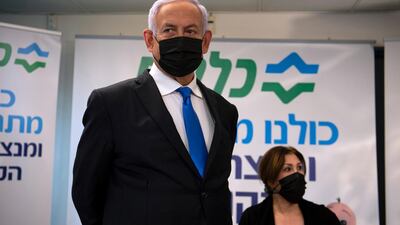
Israeli Prime Minister Benjamin Netanyahu visits a coronavirus vaccination centre in the northern Arab city of Nazareth, Israel. AP, file

Trial of Benjamin Netanyahu explained: Why is the Israeli prime minister on trial?


Mona Farag
  • English
  • Arabic

Prime Minister Benjamin Netanyahu is back in court on Monday as his corruption trial resumes and Israel's longest-serving leader will have to enter his plea to charges of bribery, fraud and breach of trust.

Involving secret recordings, media moguls, gifts of cigars and champagne and aides' betrayals, the three corruption cases have all the makings of a political thriller.

Will it bring Mr Netanyahu down?

Mr Netanyahu is the longest sitting Israeli prime minister in the country’s history and at the age of 71, he has been in office continuously since 2009 and served before that from 1996 to 1999.

He has weathered the ups and downs of office and managed to stay in power throughout the investigation – even with three elections and a fourth due on March 23.

He denies any wrongdoing and a trial is likely to take years.

He will fight to remain prime minister in March and possibly for years afterwards.

If he wins, he could try to secure parliamentary immunity, or pass laws to exempt a serving prime minister from standing trial.

Why hasn’t he stepped down?

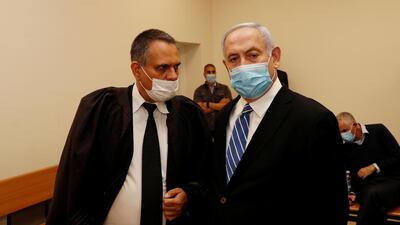
  • Israeli Prime Minister Benjamin Netanyahu, wearing a mask, stands inside the courtroom as his corruption trial opens at the Jerusalem district court. Reuters
    Israeli Prime Minister Benjamin Netanyahu, wearing a mask, stands inside the courtroom as his corruption trial opens at the Jerusalem district court. Reuters
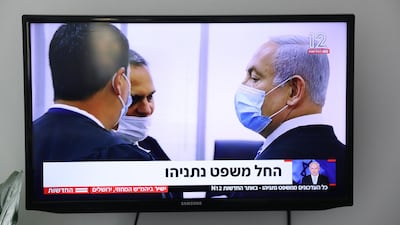
  • A live TV broadcast shows Israeli Prime Minister Benjamin Netanyahu and his lawyers entering the district court where he is facing a trial for alleged corruption crimes in Salah el-Din, East Jerusalem, Israel. EPA
    A live TV broadcast shows Israeli Prime Minister Benjamin Netanyahu and his lawyers entering the district court where he is facing a trial for alleged corruption crimes in Salah el-Din, East Jerusalem, Israel. EPA
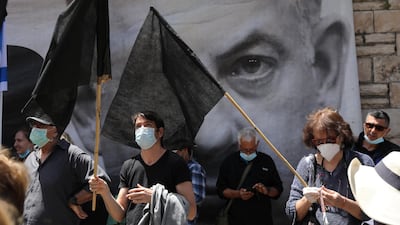
  • Protesters opposed to Israeli Prime Minister Benjamin Netanyahu gather during a demonstration outside his residence in Jerusalem, Israel. EPA
    Protesters opposed to Israeli Prime Minister Benjamin Netanyahu gather during a demonstration outside his residence in Jerusalem, Israel. EPA
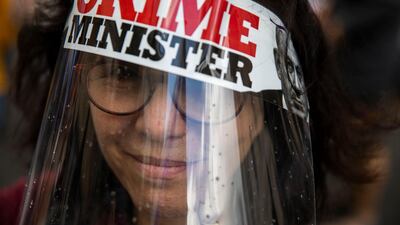
  • A protester against Israel's Prime Minister Benjamin Netanyahu wears a face mask during a protest outside his residence in Jerusalem. AP Photo
    A protester against Israel's Prime Minister Benjamin Netanyahu wears a face mask during a protest outside his residence in Jerusalem. AP Photo
  • Protesters opposed to Israeli Prime Minister Benjamin Netanyahu march while holding a banner during a demonstration outside the prime minister's residence in Jerusalem, Israel. EPA
    Protesters opposed to Israeli Prime Minister Benjamin Netanyahu march while holding a banner during a demonstration outside the prime minister's residence in Jerusalem, Israel. EPA
  • A convoy transporting Israeli Prime Minister Benjamin Netanyahu arrives at the district court of Jerusalem for a long-delayed corruption trial. AFP
    A convoy transporting Israeli Prime Minister Benjamin Netanyahu arrives at the district court of Jerusalem for a long-delayed corruption trial. AFP
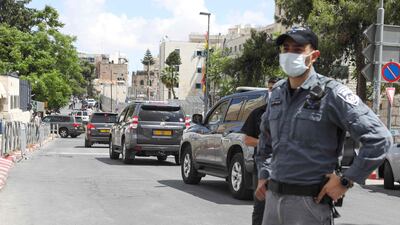
  • Israeli security forces stand guard as a convoy transporting Prime Minister Benjamin Netanyahu arrives at the district court of Jerusalem for a long-delayed corruption trial. AFP
    Israeli security forces stand guard as a convoy transporting Prime Minister Benjamin Netanyahu arrives at the district court of Jerusalem for a long-delayed corruption trial. AFP

Under Israeli law, a sitting prime minister does not have immunity from prosecution, and while he is the first premier to be indicted while in office he has obliged to resign unless convicted.

A convicted prime minister can also theoretically stay in office until all avenues of appeal have been exhausted – a process that could take up to several months or years.

Former Israeli Prime Minister Ehud Olmert stepped down as party leader when he was under investigation for corruption in 2008, but technically remained prime minister until elections the following year – polls which brought Mr Netanyahu to power

Olmert went on trial in 2009, and was convicted. But he only began serving his sentence in 2016, due to the long legal process.

Do Israelis care?

Yes. The corruption case has had a polarising impact on Israelis.

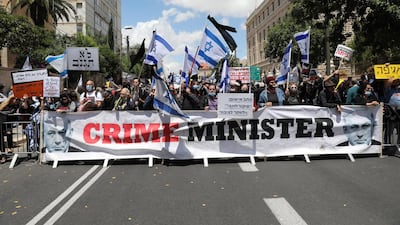
Thousands of demonstrators gather weekly outside his official residence and across Israel under the banner of "Crime Minister", demanding he quit. This continued during the Covid-19 pandemic and orders barring people travelling more than a short distance from their homes to contain the virus.

But, his right-wing voter base has stayed loyal and he continues to come out top in elections despite the scandal. Supporters see the man they call King Bibi as strong on security and an influential voice for Israel abroad.

What are the charges?

Case 1000, including charges of fraud and breach of trust

Mr Netanyahu and his wife Sara have been accused of illicitly accepting around $200,000 in gifts including cigars and bottles of champagne from two billionaires – Hollywood-based Israeli movie mogul Arnon Milchan and Australian magnate James Packer.

Mr Netanyahu has claimed that they were tokens of friendship and that he did not act inappropriately in exchange for them. Prosecutors allege they curried favour with the prime minister to help Mr Milchan with his business interests and to gain Mr Packer favours over a decade.

Mr Milkman and Mr Packer are not facing any charges and have denied any wrongdoing.

Case 2000, including charges of fraud and breach of trust

Mr Netanyahu is accused of striking a deal with Israeli media mogul Arnon Mozes – who owns Yedioth Ahronoth, the country's biggest newspaper by circulation. The deal allegedly secured the prime minister better coverage in return for legislation that would slow the growth of a rival newspaper to Yedioth Ahronoth.

Mr Mozes was also charged with bribery in this case but also denies wrongdoing.

Case 4000, including charges of bribery, fraud and breach of trust

Case 4000 is the big one.

In addition to his position as premier, Mr Netanyahu held the post of communications minister from 2014 to 2017, and prosecutors allege he agreed a "reciprocal arrangement" with Shaul Elovitch, the controlling shareholder in Israel's biggest telecoms company "Bezeq," which owned the news website Walla.

Mr Netanyahu is accused of promoting regulatory decisions favourable to Mr Elovitch in exchange for positive coverage by Walla.

In this case, Mr Netanyahu has been charged with bribery, fraud and breach of trust. Mr Elovitch and his wife, Iris, have been charged with bribery and obstruction of justice. The couple denies wrongdoing.

What are the cases built on?

So far, the prosecution has assembled more than 300 witnesses to support these allegations.

Mr Netanyahu’s lawyers have tried to both delay and discredit the proceedings, by filing complaints against the prosecution, and claiming that police investigators used illegitimate means to secure evidence, in an attempt to get the charges disqualified.

What is the hold up?

The trial began last year with Mr Netanyahu attending the first hearing on May 24, 2020, speaking only to identify himself and confirm he had read and understood the charges.

Mr Netanyahu was granted an exemption from appearing at later, more procedural stages of the trial.

But the trial, presided over by judges Moshe Bar-Am, Rebecca Friedman-Feldman and Oded Shaham, has been delayed several times due to coronavirus lockdowns. It was supposed to resume in January but a third national lockdown delayed it again.

Last month, the court also ordered the prosecution to amend the charges against Mr Netanyahu to differentiate between him and his family members, who appear in the charges but are not on trial.

What has Mr Netanyahu and his rivals said about the trial?

In a live Facebook broadcast before entering the courtroom on May 24, he criticised what he called the "fabricated and ludicrous" accusations.

He says he is the victim of a politically orchestrated "witch hunt" by the left and media to oust him from office, and that receiving gifts from friends is not against the law.

Rival turned coalition partner Benny Gantz campaigned heavily on Mr Netanyahu’s corruption allegations but when they were in partnership said that, like every citizen, the prime minister was entitled to a fair trial and the presumption of innocence.

Opposition leader Yair Lapid, a former partner of Mr Gantz, said Mr Netanyahu could not lead the country while standing trial and suggested the impact of the lockdown on the court system could be politically motivated.

"There is a true fear he will make decisions based on his personal survival interests, and not the national interest," he tweeted.

Could he go to jail?

Bribery charges carry a jail sentence of up to 10 years and/or a fine. Fraud and breach of trust carry a sentence of up to three years.

Will a verdict come soon?

Unlikely. The trial could take years. But, proceedings could be cut short if Mr Netanyahu seeks a plea deal. – Additional reporting by Reuters

Ferrari 12Cilindri specs

Engine: naturally aspirated 6.5-liter V12

Power: 819hp

Torque: 678Nm at 7,250rpm

Price: From Dh1,700,000

Available: Now

How to wear a kandura

Dos

  • Wear the right fabric for the right season and occasion 
  • Always ask for the dress code if you don’t know
  • Wear a white kandura, white ghutra / shemagh (headwear) and black shoes for work 
  • Wear 100 per cent cotton under the kandura as most fabrics are polyester

Don’ts 

  • Wear hamdania for work, always wear a ghutra and agal 
  • Buy a kandura only based on how it feels; ask questions about the fabric and understand what you are buying
COMPANY PROFILE
Name: Kumulus Water
 
Started: 2021
 
Founders: Iheb Triki and Mohamed Ali Abid
 
Based: Tunisia 
 
Sector: Water technology 
 
Number of staff: 22 
 
Investment raised: $4 million 
Conflict, drought, famine

Estimates of the number of deaths caused by the famine range from 400,000 to 1 million, according to a document prepared for the UK House of Lords in 2024.
It has been claimed that the policies of the Ethiopian government, which took control after deposing Emperor Haile Selassie in a military-led revolution in 1974, contributed to the scale of the famine.
Dr Miriam Bradley, senior lecturer in humanitarian studies at the University of Manchester, has argued that, by the early 1980s, “several government policies combined to cause, rather than prevent, a famine which lasted from 1983 to 1985. Mengistu’s government imposed Stalinist-model agricultural policies involving forced collectivisation and villagisation [relocation of communities into planned villages].
The West became aware of the catastrophe through a series of BBC News reports by journalist Michael Buerk in October 1984 describing a “biblical famine” and containing graphic images of thousands of people, including children, facing starvation.

Band Aid

Bob Geldof, singer with the Irish rock group The Boomtown Rats, formed Band Aid in response to the horrific images shown in the news broadcasts.
With Midge Ure of the band Ultravox, he wrote the hit charity single Do They Know it’s Christmas in December 1984, featuring a string of high-profile musicians.
Following the single’s success, the idea to stage a rock concert evolved.
Live Aid was a series of simultaneous concerts that took place at Wembley Stadium in London, John F Kennedy Stadium in Philadelphia, the US, and at various other venues across the world.
The combined event was broadcast to an estimated worldwide audience of 1.5 billion.

The%20specs%20
%3Cp%3E%3Cstrong%3EEngine%3A%20%3C%2Fstrong%3E2.0-litre%204cyl%20turbo%0D%3Cbr%3E%3Cstrong%3EPower%3A%20%3C%2Fstrong%3E261hp%20at%205%2C500rpm%0D%3Cbr%3E%3Cstrong%3ETorque%3A%20%3C%2Fstrong%3E400Nm%20at%201%2C750-4%2C000rpm%0D%3Cbr%3E%3Cstrong%3ETransmission%3A%20%3C%2Fstrong%3E7-speed%20dual-clutch%20auto%0D%3Cbr%3E%3Cstrong%3EFuel%20consumption%3A%20%3C%2Fstrong%3E10.5L%2F100km%0D%3Cbr%3E%3Cstrong%3EOn%20sale%3A%20%3C%2Fstrong%3ENow%0D%3Cbr%3E%3Cstrong%3EPrice%3A%20%3C%2Fstrong%3EFrom%20Dh129%2C999%20(VX%20Luxury)%3B%20from%20Dh149%2C999%20(VX%20Black%20Gold)%3C%2Fp%3E%0A
MATCH INFO

Uefa Champions League, last-16 second leg
Paris Saint-Germain (1) v Borussia Dortmund (2)
Kick-off: Midnight, Thursday, March 12
Stadium: Parc des Princes
Live: On beIN Sports HD

What can victims do?

Always use only regulated platforms

Stop all transactions and communication on suspicion

Save all evidence (screenshots, chat logs, transaction IDs)

Report to local authorities

Warn others to prevent further harm

Courtesy: Crystal Intelligence

NYBL PROFILE

Company name: Nybl 

Date started: November 2018

Founder: Noor Alnahhas, Michael LeTan, Hafsa Yazdni, Sufyaan Abdul Haseeb, Waleed Rifaat, Mohammed Shono

Based: Dubai, UAE

Sector: Software Technology / Artificial Intelligence

Initial investment: $500,000

Funding round: Series B (raising $5m)

Partners/Incubators: Dubai Future Accelerators Cohort 4, Dubai Future Accelerators Cohort 6, AI Venture Labs Cohort 1, Microsoft Scale-up 

The specs: 2018 Nissan 370Z Nismo

The specs: 2018 Nissan 370Z Nismo
Price, base / as tested: Dh182,178
Engine: 3.7-litre V6
Power: 350hp @ 7,400rpm
Torque: 374Nm @ 5,200rpm
Transmission: Seven-speed automatic
​​​​​​​Fuel consumption, combined: 10.5L / 100km

Mercer, the investment consulting arm of US services company Marsh & McLennan, expects its wealth division to at least double its assets under management (AUM) in the Middle East as wealth in the region continues to grow despite economic headwinds, a company official said.

Mercer Wealth, which globally has $160 billion in AUM, plans to boost its AUM in the region to $2-$3bn in the next 2-3 years from the present $1bn, said Yasir AbuShaban, a Dubai-based principal with Mercer Wealth.

Within the next two to three years, we are looking at reaching $2 to $3 billion as a conservative estimate and we do see an opportunity to do so,” said Mr AbuShaban.

Mercer does not directly make investments, but allocates clients’ money they have discretion to, to professional asset managers. They also provide advice to clients.

“We have buying power. We can negotiate on their (client’s) behalf with asset managers to provide them lower fees than they otherwise would have to get on their own,” he added.

Mercer Wealth’s clients include sovereign wealth funds, family offices, and insurance companies among others.

From its office in Dubai, Mercer also looks after Africa, India and Turkey, where they also see opportunity for growth.

Wealth creation in Middle East and Africa (MEA) grew 8.5 per cent to $8.1 trillion last year from $7.5tn in 2015, higher than last year’s global average of 6 per cent and the second-highest growth in a region after Asia-Pacific which grew 9.9 per cent, according to consultancy Boston Consulting Group (BCG). In the region, where wealth grew just 1.9 per cent in 2015 compared with 2014, a pickup in oil prices has helped in wealth generation.

BCG is forecasting MEA wealth will rise to $12tn by 2021, growing at an annual average of 8 per cent.

Drivers of wealth generation in the region will be split evenly between new wealth creation and growth of performance of existing assets, according to BCG.

Another general trend in the region is clients’ looking for a comprehensive approach to investing, according to Mr AbuShaban.

“Institutional investors or some of the families are seeing a slowdown in the available capital they have to invest and in that sense they are looking at optimizing the way they manage their portfolios and making sure they are not investing haphazardly and different parts of their investment are working together,” said Mr AbuShaban.

Some clients also have a higher appetite for risk, given the low interest-rate environment that does not provide enough yield for some institutional investors. These clients are keen to invest in illiquid assets, such as private equity and infrastructure.

“What we have seen is a desire for higher returns in what has been a low-return environment specifically in various fixed income or bonds,” he said.

“In this environment, we have seen a de facto increase in the risk that clients are taking in things like illiquid investments, private equity investments, infrastructure and private debt, those kind of investments were higher illiquidity results in incrementally higher returns.”

The Abu Dhabi Investment Authority, one of the largest sovereign wealth funds, said in its 2016 report that has gradually increased its exposure in direct private equity and private credit transactions, mainly in Asian markets and especially in China and India. The authority’s private equity department focused on structured equities owing to “their defensive characteristics.”

Key products and UAE prices

iPhone XS
With a 5.8-inch screen, it will be an advance version of the iPhone X. It will be dual sim and comes with better battery life, a faster processor and better camera. A new gold colour will be available.
Price: Dh4,229

iPhone XS Max
It is expected to be a grander version of the iPhone X with a 6.5-inch screen; an inch bigger than the screen of the iPhone 8 Plus.
Price: Dh4,649

iPhone XR
A low-cost version of the iPhone X with a 6.1-inch screen, it is expected to attract mass attention. According to industry experts, it is likely to have aluminium edges instead of stainless steel.
Price: Dh3,179

Apple Watch Series 4
More comprehensive health device with edge-to-edge displays that are more than 30 per cent bigger than displays on current models.