

Live updates: Follow the latest news on Israel-Gaza
Israeli Prime Minister Benjamin Netanyahu on Wednesday rejected Hamas's demands for a ceasefire and said the military would continue its offensive in Gaza until it achieved “absolute victory”.
“I believe continued military pressure is a necessary condition for releasing the hostages,” Mr Netanyahu told reporters.
“We are advancing step by step to absolute victory, and that requires absolute unity.”
The rejection comes after mediators from the US, Egypt and Qatar hammered out a proposal that would have led to a three-stage truce and the phased release of hostages in return for freeing thousands of Palestinians detained in Israeli jails.
Hamas responded to the initial proposal with a counter proposal in which it called for a phased withdrawal of Israeli troops from the Gaza Strip and a three-stage truce of 45 days each, during which indirect negotiations between the Palestinian militant group and Israel could get under way to reach a permanent cessation of hostilities.
Mr Netanyahu called Hamas's rebuttal "delusional" and vowed to keep fighting.
At a Beirut press conference following Mr Netanyahu's remarks, senior Hamas official Osama Hamdan said the comments proved that the Israeli leader sought to continue conflict in the region.
Mr Hamdan, who said a Hamas delegation would head to Cairo for talks with Qatari and Egyptian officials, told reporters that his group “was ready for all options”.
Mr Netanyahu shut down any possibility of a temporary ceasefire in exchange for the return of hostages, instead doubling down on his country's war efforts.
He praised Israeli soldiers' efforts in the Gaza Strip, claiming they had killed 20,000 “terrorists”.
The truce rejection came as US Secretary of State Antony Blinken was in Israel at the end of a Middle East trip during which he had been working on securing a ceasefire.
Mr Blinken struck a slightly more optimistic tone than the Israeli Prime Minister, acknowledging that there were issues with Hamas's response but suggesting there was “space” for an eventual agreement to be reached.
“There are clearly non-starters in what Hamas put forward,” Mr Blinken told reporters in Tel Aviv.
“But we also see space in what came back to pursue negotiations to see if we can get to an agreement.”
The secretary, who is on his fifth trip to the Middle East and seventh to Israel since October 7, has spent months trying to reel in Israel's military campaign in Gaza, while simultaneously supporting the country's right to defend itself.
He has also reiterated the need to get more aid into Gaza and the importance of creating a “clear and credible pathway to a Palestinian state” – something the Israelis appear uninterested in pursuing.
According to the Gaza Health Ministry more than 27,700 people, the majority of them civilians, have been killed since Israel launched its military campaign in the enclave following Hamas's attack on southern Israel in which militants killed about 1,200 Israelis and kidnapped 240.
Mr Netanyahu, who has long opposed the creation of a Palestinian state, said peace would only be achieved with an Israeli victory.
“They will look good if we win and they won't if we don't win,” he told reporters.
Latest from the Israel-Gaza war – in pictures
-
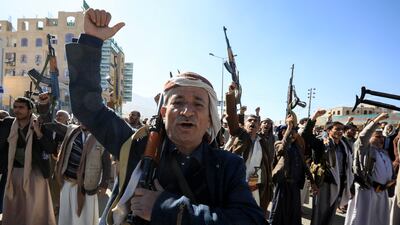
Houthi fighters shout gather in Sanaa. The rebels have launched attacks in the Red Sea in response to the Gaza war. EPA -
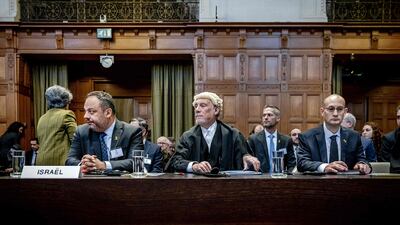
From left, Israeli Foreign Ministry adviser Tal Becker, lawyer Malcolm Shaw and Gilad Noam, deputy attorney general for international affairs, at the International Court of Justice in The Hague. AFP -
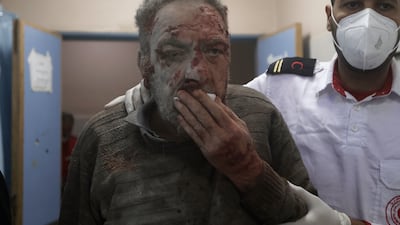
A Palestinian man injured in an Israeli strike receives treatment in Khan Younis, southern Gaza. AP -

Palestinian medics mourn after members of the Palestinian Red Crescent were killed in an Israeli strike in Deir Al Balah. Reuters -
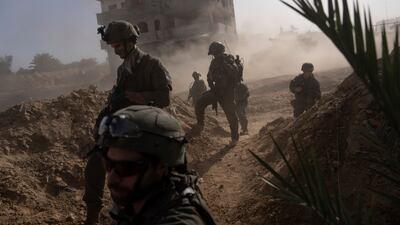
Israeli soldiers take up positions during a ground operation in Khan Younis. AP -
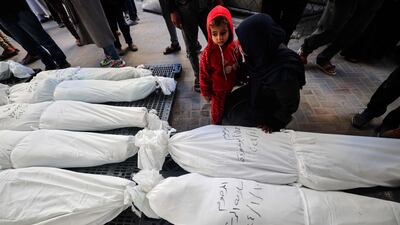
Mourners gather at Al Najar hospital in Rafah, after several relatives of a member of the Hamas general military council were killed in a strike. AFP -
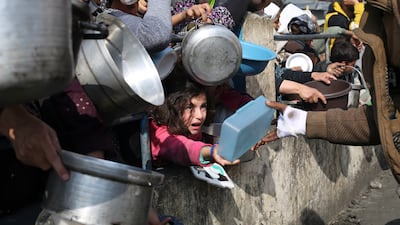
Palestinians wait to receive food aid in Rafah. AP -

A mass grave in Rafah. More than 23,000 people have been killed in Gaza since October 7. AFP -

Palestinians search the rubble of destroyed buildings after an Israeli attack on Rafah. AFP -
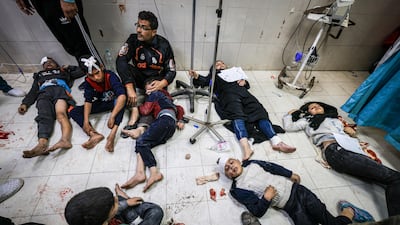
Injured Palestinians receive treatment at Nasser hospital in Khan Younis. AFP -
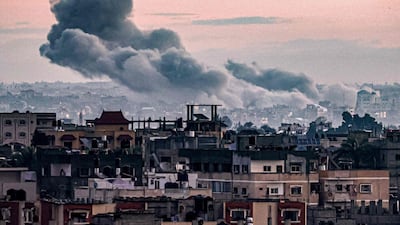
Smoke rises over Khan Younis in the southern Gaza Strip, as seen from Rafah, during sustained Israeli air strikes. AFP -
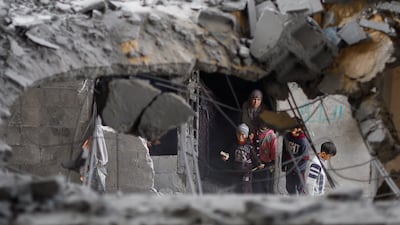
The destruction has spread throughout the Gaza Strip, from the north to Rafah in the south. Reuters -
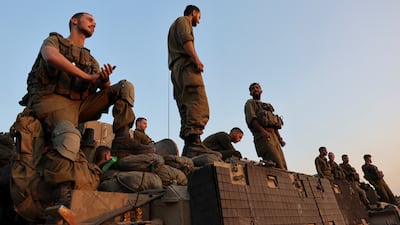
Israeli soldiers stand on an armoured personnel carrier near the Israel-Gaza border, in southern Israel. Reuters -
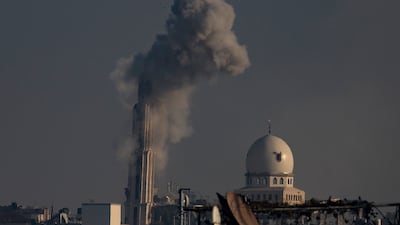
Smoke rises following Israeli air strikes in Khan Younis, the southern Gaza Strip. EPA -
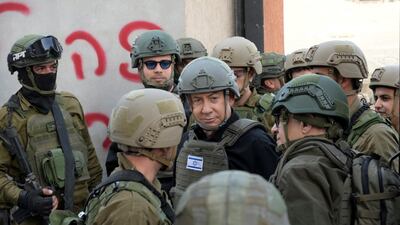
Israeli Prime Minister Benjamin Netanyahu receives a security briefing with commanders and soldiers in the northern Gaza Strip. AP -

Palestinians mourn their relatives killed in an Israeli strike on the Al Maghazi refugee camp. AFP -
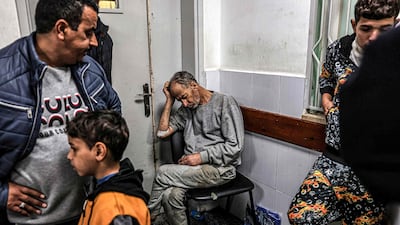
A Palestinian man detained by the Israeli military awaits treatment for his injuries in Rafah. AFP


“We need to understand that everybody's just sitting on the bleachers right now, on the sidelines, our friends, our enemies, neutral countries, everybody's watching and they want to know who's going to win: Israel or Hamas,” Mr Netanyahu said.
While there appears to be a considerable gap between what Washington is pursuing and what the Israelis are willing to do, Mr Blinken has refrained from losing his patience with Israeli leaders in public.
“There has been space between the Biden administration and Netanyahu from the beginning of this effort,” said Aaron David Miller, a former State Department Middle East analyst and current senior fellow at the Carnegie Endowment for International Peace.
“But … instead of accentuating the differences, the President has chosen a different pathway, which is to somehow figure out a way to work within those differences.”
The Israeli Prime Minister, who for months has been under unrelenting pressure from the families of hostages, acknowledged the pain his decision was likely to cause.
“I do understand the pain of the families of the hostages and of the fallen soldiers,” he said.
He also took aim at the US, which recently sanctioned four Israeli settlers for involvement in violence against Palestinians in the occupied West Bank, calling the punitive measures “inappropriate”.
“It harms an entire population, a sector of the settlers who are law-abiding and their sons are a part of the war,” Mr Netanyahu said.

