


Few MPs unaffiliated to Lebanon’s largest and long-standing parties hold as much experience and sway as Fouad Makhzoumi, a 71-year-old businessman and philanthropist who has represented West Beirut in parliament since 2018.
Amid the apparent departure from public life of former Prime Minister Saad Hariri, Mr Makhzoumi remains one of the most prominent Sunni Muslim politicians in Lebanon.
He has also been a part of multiple parliamentary delegations to European capitals, as well as Washington, to meet World Bank and International Monetary Fund officials.
In Lebanon’s unique confessional system, the presidency is reserved for a Maronite Christian, the prime minister has to be a Sunni Muslim, and the speaker of parliament a Shiite Muslim.
Lebanon finds itself with an unprecedented government vacuum and a legislature where no faction holds a majority. There has been no president for six months – with the bitterly divided parliament failing to agree on a successor to Michel Aoun on multiple occasions – while Prime Minister Najib Mikati’s cabinet is in caretaker status and therefore severely stripped of its powers.
All of this comes as the country is grappling with one of the worst economic crises in modern history, blamed on decades of corruption and mismanagement by Lebanon’s ruling elite.
A staff-level deal with the IMF for a $3 billion loan was agreed more than a year ago. But almost none of the reforms requested by the IMF to secure the money have been implemented.
So, with much of the country now plunged into poverty, what is the way forward?
“You need to reconstitute the institutions. And without the president, you cannot do that,” said Mr Makhzoumi, from his office in Beirut.
“So definitely we need a president. But also at the same time we don’t want any president. We’ve seen that process in 2014, 2016, when really the president, he took us disaster,” Mr Makhzoumi said, referring to Mr Aoun and the more than two-year presidential vacuum that finally ended after some of the latter's long-time foes agreed to back him.
Mr Aoun, an ex-army chief, was a close ally of the Iran-backed political party and armed group Hezbollah. Critics of the group, which include Mr Makhzoumi, insist that this time around they will not let a candidate backed by Hezbollah ascend to the presidency. Opponents of Hezbollah accuse it of being a proxy of Iran and having undue influence in Lebanon's affairs.
-
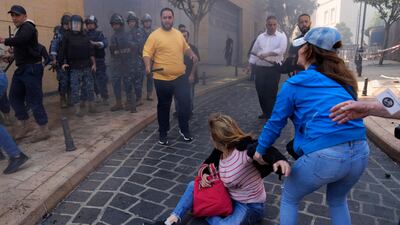
A depositor is help up after a confrontation with bank security personnel, during a protest outside a Bank Audi branch in downtown Beirut. AP -
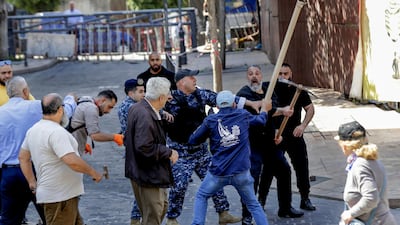
Depositors clash with bank guards in Beirut during a protest demanding access to their accounts. AFP -
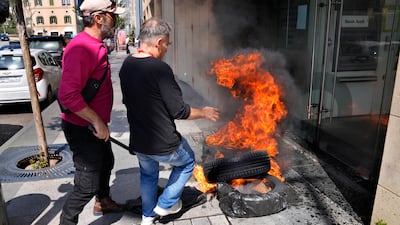
Protesters burn tyres outside the Bank Audi branch. Amid Lebanon's economic meltdown, bank customers have had restrictions on withdrawals since 2019. AP -

A depositor gets her message across with her mobile phone cover, outside the Bank Audi branch. AP -
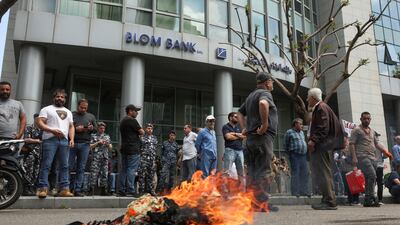
Demonstrators at a protest organised by the Depositors' Outcry campaigning group in front of Blom Bank in Beirut. Reuters -
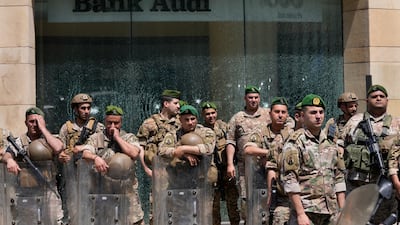
Lebanese soldiers stand guard in front of a Bank Audi branch that has had its windows smashed by customers in downtown Beirut. AP -
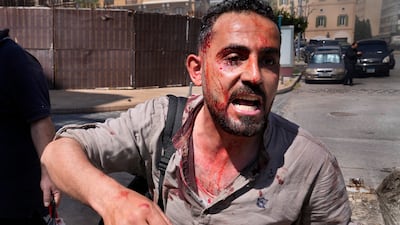
A protester injured in a confrontation with bank security staff outside a Bank Audi branch in Beirut. Lebanon's financial crisis has plunged three-quarters of the six million population into poverty. AP -

A depositor vents his anger outside a Bank Audi branch in downtown Beirut. AP


“We need a president for all, not to be selected by a few to control the majority, which was the case before. The most important criteria is somebody who is not part of the political or financial corruption, somebody who is not nominated by Hezbollah.
“It will be an insult if we cannot find someone like this. After all, there are [more than] 700,000 Maronites. You can’t tell me you cannot find one? Look at all the Lebanese, they succeeded around the world. Now, how can it be that we can succeed elsewhere but for some reason we cannot succeed in our own country?”
Mr Makhzoumi is known for having good relations with Saudi Arabia, regarded as one of the most influential powers in Lebanon. He has met Riyadh’s ambassador to Beirut multiple times amid the recent presidential deadlock.
The Gulf states were once an important financial ally and donor to Lebanon, but relations have strained over the perceived growing influence of Hezbollah when Riyadh-Tehran relations have been particularly poor.
Lebanese-Saudi relations were further worsened by the mass smuggling of the drug Captagon from Lebanon to the kingdom.
The Saudi-led coalition in Yemen's civil war has also accused Hezbollah of providing support to the Houthis.
But last year the Saudi ambassador – who was withdrawn from Lebanon in 2021 – returned to Beirut. Riyadh and Tehran also announced recently the thawing of relations and the reopening of embassies in an apparent detente.
Despite reports that it opposes the candidacy of Hezbollah’s presidential candidate Suleiman Frangieh, Riyadh’s ambassador Walid Bukhari has insisted it would not veto any future head of state.
Mr Makhzoumi believes that Saudi Arabia’s position is currently very clear. It is willing to help countries as long as it is in the interests of Riyadh and not against it.
“The Saudi position is clear – It's your decision. You're a sovereign country. You can decide. But you have to bear the consequences based on what you decide.”
Referring to his meetings with Mr Bukhari, Mr Makhoumi said the message “is very simple”.
“We are not going to get involved in the local Lebanese politics, this is a sovereign decision. We are suggesting who we would like to see in that position as [per their] qualifications – we have no veto against anybody, they never mentioned a name.
“But also, we will not appreciate that somebody interferes to pressure somebody against somebody else.”
Mr Makhzoumi says that good relations with the Gulf states are important because of potential future investments that could help the country's economy recover.
But without an economic and political plan to restructure the country, “you are going nowhere”, he warns.

