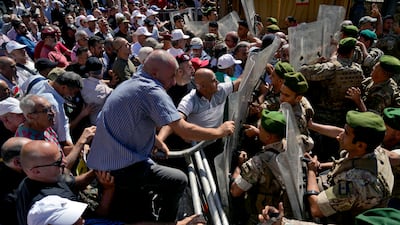
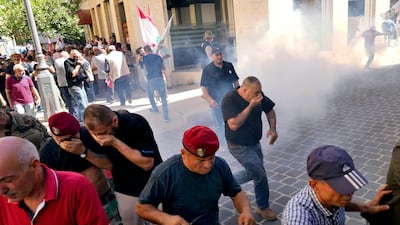
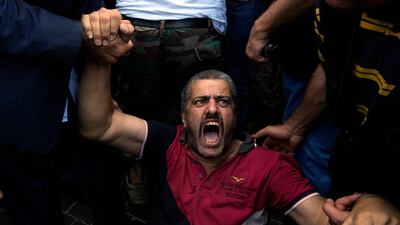
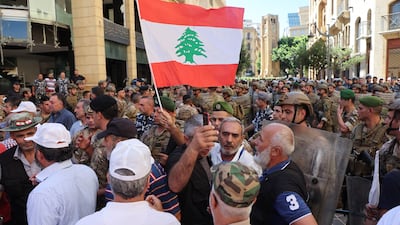
It has been two and a half months since Michel Aoun left the presidential palace in Baabda, and again Lebanon finds itself without a president.
True to form, each of the 10 sessions of the 128-seat parliament since Mr Aoun's departure have failed to elect someone to replace the former army chief in a legislature with no majority bloc.
Voting, unsurprisingly, has not been smooth.
While Michel Moawad is the only candidate to secure a significant chunk of support at each round, it is nowhere near the two-thirds majority required in the first round or the simple majority of 65 votes needed in round two.
Mr Moawad has been outstripped by blank ballots or jokes cast for the late Chilean president Salvador Allende or his South African counterpart Nelson Mandela, among others.
The second rounds of each session have been abandoned because of a lack of quorum as MPs walked out.
The presidential vacuum, although a common occurrence in Lebanon’s deeply divided confessional political scene, comes at a particularly serious time.
The country is embroiled in a devastating economic crisis, with many citizens plunged into poverty. Prime Minister Najib Mikati’s government is in caretaker status and thus largely stripped of its powers.
Mr Moawad, whose father Rene was assassinated in 1989 after serving as president for only 17 days, has consistently been able to count on a core bloc of about 40 MPs. That core is often referred to as the “opposition”, but contains traditional political parties as well as new MPs.
In Lebanon’s confessional power-sharing system, the presidency is reserved for a Maronite Christian.
As with Mr Aoun and others, that person usually ascends after a series of backdoor deals and compromises between factions.
While Mr Moawad has been able to count on the support of a large and vocally anti-Hezbollah bloc, including parliament's largest party, the Lebanese Forces, many see him as too divisive to cross the vote threshold. This is illustrated by the fact he is still regularly coming second to blank or invalid votes.
Those have largely come from the powerful group that had held a parliamentary majority until elections last year — Hezbollah, its Shiite ally Amal, and the Christian Free Patriotic Movement, which was founded by Mr Aoun. They have their own preferred candidates.
So far, Mr Moawad has also been backed by the Kataeb Party, the Druze Progressive Socialist Party and a handful of independent MPs, including some of those closely linked to the 2019 protest movement against Lebanon’s ruling classes that led to the collapse of the government.
“Before we nominated Mr Moawad as our candidate, we screened all the sovereign and reformist personalities within the Maronite community,” George Okais, a Lebanese Forces MP for Zahle, told The National.
“And [the LF] found out that Mr Moawad has exactly the same positioning vis-a-vis all the files, all the topics, all the crises in Lebanon. He has a clear vision about sovereignty and the reform needed in the country,” he added.
Despite the uphill battle in a deeply fractured parliament, Mr Moawad's supporters appear steadfast ― for now.
Sources within the bloc said the current plan is still to lobby other MPs with a like mind to join them and in doing so push Mr Moawad over the threshold.
A separate Lebanese Forces source described these groups as having “one single denominator, which is that they are all against the policies of Hezbollah and of the allies of Hezbollah”, referring to the Iran-backed political party and armed group which, in theory, has an alliance with Amal and the FPM.
They formed the majority bloc in the previous parliament and hold many positions in Mr Mikati’s cabinet.
The "opposition" grouping includes the 13 Change MPs who are closely linked to the 2019 protests that led to the collapse of the government at the time. While a few have begun voting for Mr Moawad, the majority still back names such as Issam Khalifeh, despite te academic never receiving more than 10 votes.
It includes a dozen or so Sunni MPs, formerly of the Future Movement of former prime minister Saad Hariri, who have not shown their hand thus far.
But his backers deny speculation that Mr Moawad's name could be dropped in favour of another.
“Right now, we still believe that MP Moawad is the main candidate, he’s a serious one, and is still on the same page with us and with the majority of the opposition's bloc,” Mr Okais said.
“We are maintaining our nomination of MP Moawad. No other opposition faction is presenting any other competitors to Mr Moawad. So why should we change the formula? There is no other formula to challenge it.”
But the stark reality is this: the three main parties submitting blank ballots — Hezbollah, Amal and the FPM — are opposed to Mr Moawad, even if at the moment they are divided among themselves.
Hezbollah is regarded as being supportive of Marada Movement leader Suleiman Frangieh, who is close to the Syrian regime. Mr Aoun’s son-in-law and FPM president, Gebran Bassil, has long harboured presidential ambitions for himself.
They have all been calling for compromise and dialogue. Mr Bassil told The National in October that his opponents are failing to propose realistic candidates who can bridge the divide in Lebanon's deeply divided political class.
While Mr Moawad's supporters try to convert MPs to their side in the hope of getting the 65 votes in the second round, even getting a second round of the vote without widespread consensus is almost impossible.
Hezbollah MPs and their allies have left most sessions after the first two-thirds majority threshold vote and therefore deny the quorum needed for the simple majority second round.
But a source close to parliament speaker and Amal Movement leader Nabih Berri said the quorum is two thirds of parliament, meaning that Mr Moawad's supporters would need their agreement to even hold a second vote.
Despite this, the pro-Moawad bloc insists that they will continue with him and say a symbolic majority would be enough to change the conversation even without a second-round vote.
The LF source said that if Mr Moawad hits the 65-vote mark it would represent a “major turning point” because he would command a majority of the parliament — a “de facto president” — even if he's unable to assume power.
There have also been calls from some for European sanctions on those obstructing the election of the president.
“Right now, we don't have any plan B, we don't have any other nomination to negotiate about or to think about or discuss with others about any other name. We don't have any other choice than working hard to reach the 65,” Mr Okais said.
So with no other clear name put forward, what are Mr Moawad's opponents hoping will change?
The only other serious name seen as sufficiently unifying to potentially win is army commander Joseph Aoun.
But he is barred from running while in the military and immediately after he stands down, barring a swift resolution ― although historically when it has become apparent that the army commander is the best choice for president, parliament has found a way to get that candidate into the job.
Karim Bitar, professor of international relations at the Saint Joseph University of Beirut, said Mr Frangieh and Gen Aoun were leading contenders for the presidency.
But he said it was likely the bloc supporting Mr Moawad would continue to vote for him, at least in the current weeks.
“What would make them change their position at this stage is the emergence of an international consensus. Historically, Lebanese presidential elections were never a domestic matter,” Prof Bitar said.
Mr Okais insisted his party is not holding out to extract key posts as concessions if another candidate comes forward with a path to a majority.
“We don’t need to manoeuvre. We are the biggest bloc in parliament. We can play this way with any other candidate, we can play this with Frangieh. So many politicians in Lebanon are approaching us with the same mentality. ‘Go make a deal with Frangieh instead of Bassil, and take all the available positions in the government.’ This is not the way we think. We are not doing a bargain,” he said.
Lebanon’s parliament will return on Thursday for its 11th presidential session.
It took 49 sessions, two and a half years, and a series of political deals for Mr Aoun to eventually come to power, suggesting the country could be in for a long ride before the next president is named.

TO A LAND UNKNOWN
Director: Mahdi Fleifel
Starring: Mahmoud Bakri, Aram Sabbah, Mohammad Alsurafa
Rating: 4.5/5
FULL%20FIGHT%20CARD
%3Cp%3EFeatherweight%20Bout%3A%0D%20Abdullah%20Al%20Qahtani%20v%20Taha%20Bendaoud%0D%3Cbr%3EBantamweight%20Bout%3A%0D%20Ali%20Taleb%20v%20Nawras%20Abzakh%0D%3Cbr%3EBantamweight%20Bout%3A%0D%20Xavier%20Alaoui%20v%20Rachid%20El%20Hazoume%0D%3Cbr%3EFeatherweight%20Bout%3A%0D%20Islam%20Reda%20v%20Adam%20Meskini%0D%3Cbr%3EBantamweight%20Bout%3A%0D%20Tariq%20Ismail%20v%20Jalal%20Al%20Daaja%0D%3Cbr%3EBantamweight%20Bout%3A%0D%20Elias%20Boudegzdame%20v%20Hassan%20Mandour%0D%3Cbr%3EAmateur%20Female%20Atomweight%20Bout%3A%0D%20Hattan%20Al%20Saif%20v%20Nada%20Faheem%0D%3Cbr%3EFeatherweight%20Bout%3A%0D%20Maraoune%20Bellagouit%20v%20Motaz%20Askar%0D%3Cbr%3EFeatherweight%20Bout%3A%0D%20Ahmed%20Tarek%20v%20Abdelrahman%20Alhyasat%0D%3Cbr%3EShowcase%20Featherweight%20Bout%3A%0D%20Mido%20Mohamed%20v%20Yazeed%20Hasanain%0D%3Cbr%3EShowcase%20Flyweight%20Bout%3A%0D%20Malik%20Basahel%20v%20Harsh%20Pandya%0D%3C%2Fp%3E%0A
Everton%20Fixtures
%3Cp%3EApril%2015%20-%20Chelsea%20(A)%3Cbr%3EApril%2021%20-%20N.%20Forest%20(H)%3Cbr%3EApril%2024%20-%20Liverpool%20(H)%3Cbr%3EApril%2027%20-%20Brentford%20(H)%3Cbr%3EMay%203%20-%20Luton%20Town%20(A)%3Cbr%3EMay%2011%20-%20Sheff%20Utd%20(H)%3Cbr%3EMay%2019%20-%20Arsenal%20(A)%3C%2Fp%3E%0A
The President's Cake
Director: Hasan Hadi
Starring: Baneen Ahmad Nayyef, Waheed Thabet Khreibat, Sajad Mohamad Qasem
Rating: 4/5
Paatal Lok season two
Directors: Avinash Arun, Prosit Roy
Stars: Jaideep Ahlawat, Ishwak Singh, Lc Sekhose, Merenla Imsong
Rating: 4.5/5
DIVINE%20INTERVENTOIN
%3Cp%3EStarring%3A%20Elia%20Suleiman%2C%20Manal%20Khader%2C%20Amer%20Daher%3C%2Fp%3E%0A%3Cp%3EDirector%3A%20Elia%20Suleiman%3C%2Fp%3E%0A%3Cp%3ERating%3A%204.5%2F5%3C%2Fp%3E%0A
Specs%3A%202024%20McLaren%20Artura%20Spider
%3Cp%3E%3Cstrong%3EEngine%3A%3C%2Fstrong%3E%203.0-litre%20twin-turbo%20V6%20and%20electric%20motor%3Cbr%3E%3Cstrong%3EMax%20power%3A%3C%2Fstrong%3E%20700hp%20at%207%2C500rpm%3Cbr%3E%3Cstrong%3EMax%20torque%3A%3C%2Fstrong%3E%20720Nm%20at%202%2C250rpm%3Cbr%3E%3Cstrong%3ETransmission%3A%3C%2Fstrong%3E%20Eight-speed%20dual-clutch%20auto%3Cbr%3E%3Cstrong%3E0-100km%2Fh%3A%3C%2Fstrong%3E%203.0sec%3Cbr%3E%3Cstrong%3ETop%20speed%3A%20%3C%2Fstrong%3E330kph%3Cbr%3E%3Cstrong%3EPrice%3A%3C%2Fstrong%3E%20From%20Dh1.14%20million%20(%24311%2C000)%3Cbr%3E%3Cstrong%3EOn%20sale%3A%3C%2Fstrong%3E%20Now%3C%2Fp%3E%0A
The specs: 2018 Nissan 370Z Nismo
Price, base / as tested: Dh182,178
Engine: 3.7-litre V6
Power: 350hp @ 7,400rpm
Torque: 374Nm @ 5,200rpm
Transmission: Seven-speed automatic
Fuel consumption, combined: 10.5L / 100km
COMPANY%20PROFILE
%3Cp%3E%3Cstrong%3ECompany%20name%3A%3C%2Fstrong%3E%20Revibe%20%0D%3Cbr%3E%3Cstrong%3EStarted%3A%3C%2Fstrong%3E%202022%0D%3Cbr%3E%3Cstrong%3EFounders%3A%3C%2Fstrong%3E%20Hamza%20Iraqui%20and%20Abdessamad%20Ben%20Zakour%20%0D%3Cbr%3E%3Cstrong%3EBased%3A%3C%2Fstrong%3E%20UAE%20%0D%3Cbr%3E%3Cstrong%3EIndustry%3A%3C%2Fstrong%3E%20Refurbished%20electronics%20%0D%3Cbr%3E%3Cstrong%3EFunds%20raised%20so%20far%3A%3C%2Fstrong%3E%20%2410m%20%0D%3Cbr%3E%3Cstrong%3EInvestors%3A%20%3C%2Fstrong%3EFlat6Labs%2C%20Resonance%20and%20various%20others%0D%3C%2Fp%3E%0A
MATCH INFO
Syria v Australia
2018 World Cup qualifying: Asia fourth round play-off first leg
Venue: Hang Jebat Stadium, Malayisa
Kick-off: Thursday, 4.30pm (UAE)
Watch: beIN Sports HD
* Second leg in Australia on October 10
Getting there
Flydubai flies direct from Dubai to Tbilisi from Dh1,025 return including taxes
PROFILE OF HALAN
Started: November 2017
Founders: Mounir Nakhla, Ahmed Mohsen and Mohamed Aboulnaga
Based: Cairo, Egypt
Sector: transport and logistics
Size: 150 employees
Investment: approximately $8 million
Investors include: Singapore’s Battery Road Digital Holdings, Egypt’s Algebra Ventures, Uber co-founder and former CTO Oscar Salazar
TERMINAL HIGH ALTITUDE AREA DEFENCE (THAAD)
What is THAAD?
It is considered to be the US's most superior missile defence system.
Production:
It was created in 2008.
Speed:
THAAD missiles can travel at over Mach 8, so fast that it is hypersonic.
Abilities:
THAAD is designed to take out ballistic missiles as they are on their downward trajectory towards their target, otherwise known as the "terminal phase".
Purpose:
To protect high-value strategic sites, such as airfields or population centres.
Range:
THAAD can target projectiles inside and outside the Earth's atmosphere, at an altitude of 150 kilometres above the Earth's surface.
Creators:
Lockheed Martin was originally granted the contract to develop the system in 1992. Defence company Raytheon sub-contracts to develop other major parts of the system, such as ground-based radar.
UAE and THAAD:
In 2011, the UAE became the first country outside of the US to buy two THAAD missile defence systems. It then stationed them in 2016, becoming the first Gulf country to do so.
Mercer, the investment consulting arm of US services company Marsh & McLennan, expects its wealth division to at least double its assets under management (AUM) in the Middle East as wealth in the region continues to grow despite economic headwinds, a company official said.
Mercer Wealth, which globally has $160 billion in AUM, plans to boost its AUM in the region to $2-$3bn in the next 2-3 years from the present $1bn, said Yasir AbuShaban, a Dubai-based principal with Mercer Wealth.
“Within the next two to three years, we are looking at reaching $2 to $3 billion as a conservative estimate and we do see an opportunity to do so,” said Mr AbuShaban.
Mercer does not directly make investments, but allocates clients’ money they have discretion to, to professional asset managers. They also provide advice to clients.
“We have buying power. We can negotiate on their (client’s) behalf with asset managers to provide them lower fees than they otherwise would have to get on their own,” he added.
Mercer Wealth’s clients include sovereign wealth funds, family offices, and insurance companies among others.
From its office in Dubai, Mercer also looks after Africa, India and Turkey, where they also see opportunity for growth.
Wealth creation in Middle East and Africa (MEA) grew 8.5 per cent to $8.1 trillion last year from $7.5tn in 2015, higher than last year’s global average of 6 per cent and the second-highest growth in a region after Asia-Pacific which grew 9.9 per cent, according to consultancy Boston Consulting Group (BCG). In the region, where wealth grew just 1.9 per cent in 2015 compared with 2014, a pickup in oil prices has helped in wealth generation.
BCG is forecasting MEA wealth will rise to $12tn by 2021, growing at an annual average of 8 per cent.
Drivers of wealth generation in the region will be split evenly between new wealth creation and growth of performance of existing assets, according to BCG.
Another general trend in the region is clients’ looking for a comprehensive approach to investing, according to Mr AbuShaban.
“Institutional investors or some of the families are seeing a slowdown in the available capital they have to invest and in that sense they are looking at optimizing the way they manage their portfolios and making sure they are not investing haphazardly and different parts of their investment are working together,” said Mr AbuShaban.
Some clients also have a higher appetite for risk, given the low interest-rate environment that does not provide enough yield for some institutional investors. These clients are keen to invest in illiquid assets, such as private equity and infrastructure.
“What we have seen is a desire for higher returns in what has been a low-return environment specifically in various fixed income or bonds,” he said.
“In this environment, we have seen a de facto increase in the risk that clients are taking in things like illiquid investments, private equity investments, infrastructure and private debt, those kind of investments were higher illiquidity results in incrementally higher returns.”
The Abu Dhabi Investment Authority, one of the largest sovereign wealth funds, said in its 2016 report that has gradually increased its exposure in direct private equity and private credit transactions, mainly in Asian markets and especially in China and India. The authority’s private equity department focused on structured equities owing to “their defensive characteristics.”
What is graphene?
Graphene is a single layer of carbon atoms arranged like honeycomb.
It was discovered in 2004, when Russian-born Manchester scientists Andrei Geim and Kostya Novoselov were "playing about" with sticky tape and graphite - the material used as "lead" in pencils.
Placing the tape on the graphite and peeling it, they managed to rip off thin flakes of carbon. In the beginning they got flakes consisting of many layers of graphene. But as they repeated the process many times, the flakes got thinner.
By separating the graphite fragments repeatedly, they managed to create flakes that were just one atom thick. Their experiment had led to graphene being isolated for the very first time.
At the time, many believed it was impossible for such thin crystalline materials to be stable. But examined under a microscope, the material remained stable, and when tested was found to have incredible properties.
It is many times times stronger than steel, yet incredibly lightweight and flexible. It is electrically and thermally conductive but also transparent. The world's first 2D material, it is one million times thinner than the diameter of a single human hair.
But the 'sticky tape' method would not work on an industrial scale. Since then, scientists have been working on manufacturing graphene, to make use of its incredible properties.
In 2010, Geim and Novoselov were awarded the Nobel Prize for Physics. Their discovery meant physicists could study a new class of two-dimensional materials with unique properties.
GAC GS8 Specs
Engine: 2.0-litre 4cyl turbo
Power: 248hp at 5,200rpm
Torque: 400Nm at 1,750-4,000rpm
Transmission: 8-speed auto
Fuel consumption: 9.1L/100km
On sale: Now
Price: From Dh149,900
Springsteen: Deliver Me from Nowhere
Director: Scott Cooper
Starring: Jeremy Allen White, Odessa Young, Jeremy Strong
Rating: 4/5
88 Video's most popular rentals
Avengers 3: Infinity War: an American superhero film released in 2018 and based on the Marvel Comics story.
Sholay: a 1975 Indian action-adventure film. It follows the adventures of two criminals hired by police to catch a vagabond. The film was panned on release but is now considered a classic.
Lucifer: is a 2019 Malayalam-language action film. It dives into the gritty world of Kerala’s politics and has become one of the highest-grossing Malayalam films of all time.
MATCH INFO
Serie A
Juventus v Fiorentina, Saturday, 8pm (UAE)
Match is on BeIN Sports
Our legal consultants
Name: Hassan Mohsen Elhais
Position: legal consultant with Al Rowaad Advocates and Legal Consultants.
Mohammed bin Zayed Majlis
It Was Just an Accident
Director: Jafar Panahi
Stars: Vahid Mobasseri, Mariam Afshari, Ebrahim Azizi, Hadis Pakbaten, Majid Panahi, Mohamad Ali Elyasmehr
Rating: 4/5
Safety 'top priority' for rival hyperloop company
The chief operating officer of Hyperloop Transportation Technologies, Andres de Leon, said his company's hyperloop technology is “ready” and safe.
He said the company prioritised safety throughout its development and, last year, Munich Re, one of the world's largest reinsurance companies, announced it was ready to insure their technology.
“Our levitation, propulsion, and vacuum technology have all been developed [...] over several decades and have been deployed and tested at full scale,” he said in a statement to The National.
“Only once the system has been certified and approved will it move people,” he said.
HyperloopTT has begun designing and engineering processes for its Abu Dhabi projects and hopes to break ground soon.
With no delivery date yet announced, Mr de Leon said timelines had to be considered carefully, as government approval, permits, and regulations could create necessary delays.
The Year Earth Changed
Directed by:Tom Beard
Narrated by: Sir David Attenborough
Stars: 4
Things Heard & Seen
Directed by: Shari Springer Berman, Robert Pulcini
Starring: Amanda Seyfried, James Norton
2/5