Lebanon's former president and Speaker in new war of words


Jamie Prentis
  • English
  • Arabic

Lebanon’s former president Michel Aoun and Speaker Nabih Berri are embroiled in a new war of words, with each accusing the other of obstructionist policies.

Mr Aoun, an 89-year-old former army general whose presidential term finished at the end of October, said in an interview this week that Mr Berri was one of the key obstructers during his six years in office.

“All that I know is that Speaker Berri was against my election as president and he obstructed 18 files that I was working on,” he told the OTV channel, which is close to the Free Patriotic Movement political party founded by Mr Aoun and now led by his son-in-law, Gebran Bassil.

In response, Mr Berri said: “You did not need anyone to obstruct you, seeing as you promised us hell and fully fulfilled your promise.”

Mr Berri, 84, heads the Amal Movement, a major political party, and has served as Speaker for three decades.

“Seventy-four laws were issued without being implemented,” Mr Berri said.

The Lebanese parliament approves laws and then they are signed off before being implemented.

A source close to Mr Berri confirmed to The National that he was referring to the requirement for the president to sign off on laws passed by parliament before they can be implemented.

The Amal Movement was a powerful militia during the 1975-1990 Lebanese Civil War, when Mr Aoun served as the army commander.

In Lebanon’s confessional power sharing system, the president is a Maronite Christian, the parliament speaker a Shiite Muslim, and the prime minister a Sunni Muslim.

Parliament is deeply fractured, with no bloc able to claim a majority after elections earlier this year. The house has met 10 times to elect a new president but has so far failed, with no clear consensus candidate yet to emerge.

And while the cabinet is supposed to take on presidential powers in the event of a vacuum — as has happened many times before — Prime Minister Najib Mikati’s cabinet is in caretaker mode and its powers are therefore severely diminished.

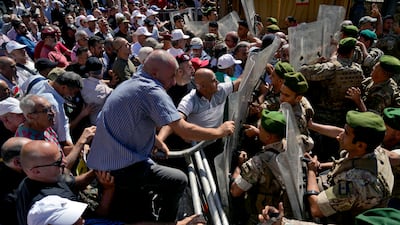
  • Soldiers scuffle with retired army members outside the Beirut parliament building. AP
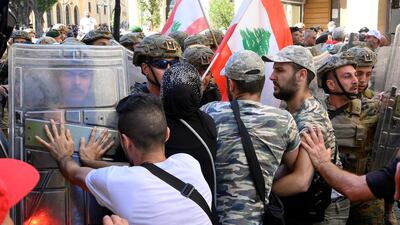
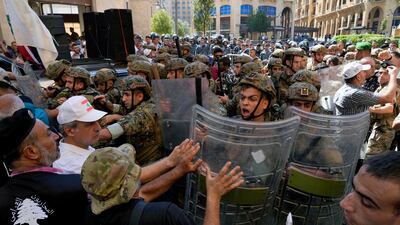
    Soldiers scuffle with retired army members outside the Beirut parliament building. AP
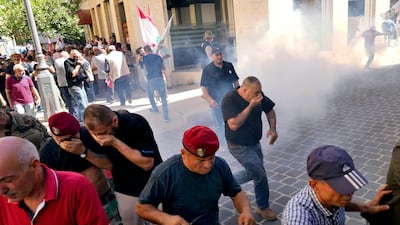
  • Retired army members run from tear gas fired by riot police. AP
    Retired army members run from tear gas fired by riot police. AP
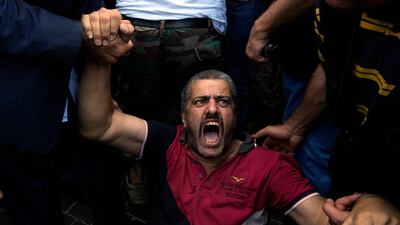
  • A retired army member chants slogans from the ground. AP
    A retired army member chants slogans from the ground. AP
  • A demonstrator holds a Lebanese flag during the protest. Reuters
    A demonstrator holds a Lebanese flag during the protest. Reuters
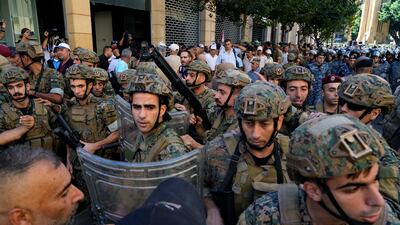
  • The was a heavy army presence. AP
    The was a heavy army presence. AP
  • Emotions run high in central Beirut. EPA
    Emotions run high in central Beirut. EPA
  • Lebanese army soldiers clash with protesters. EPA
    Lebanese army soldiers clash with protesters. EPA
  • Politicians were attending a parliament session to approve the 2022 budget. EPA
    Politicians were attending a parliament session to approve the 2022 budget. EPA
  • Retired army members tried to enter to the parliament building. AP
    Retired army members tried to enter to the parliament building. AP

Mr Aoun and Mr Mikati were at loggerheads for months over the make-up of Lebanon's cabinet, and failed to reach agreement before the former stepped down as head of state.

In an interview with The National in October, Mr Bassil — who has also clashed with Mr Berri — said Mr Mikati “has no right to impose on the president a government of his own, that has no confidence from the parliament, that is not in alignment with the last parliamentary elections”.

The governance vacuum is increasing fears of further political paralysis and that reforms needed to secure a bail-out from the International Monetary Fund will not be implemented.

Lebanon's economic collapse has been described by the World Bank as one of the worst in modern history, with much of the population pushed into poverty.

The financial crisis is being blamed on decades of mismanagement and corruption by Lebanon’s elite.

The local currency has lost more than 95 per cent of its value, inflation is rampant and there are widespread shortages of electricity, clean water, medicines and other basic essentials.


The%20specs
%3Cp%3E%3Cstrong%3EEngine%3A%3C%2Fstrong%3E%201.8-litre%204-cyl%20turbo%0D%3Cbr%3E%3Cstrong%3EPower%3A%20%3C%2Fstrong%3E190hp%20at%205%2C200rpm%0D%3Cbr%3E%3Cstrong%3ETorque%3A%3C%2Fstrong%3E%20320Nm%20from%201%2C800-5%2C000rpm%0D%3Cbr%3E%3Cstrong%3ETransmission%3A%20%3C%2Fstrong%3ESeven-speed%20dual-clutch%20auto%0D%3Cbr%3E%3Cstrong%3EFuel%20consumption%3A%3C%2Fstrong%3E%206.7L%2F100km%0D%3Cbr%3E%3Cstrong%3EPrice%3A%3C%2Fstrong%3E%20From%20Dh111%2C195%0D%3Cbr%3E%3Cstrong%3EOn%20sale%3A%20%3C%2Fstrong%3ENow%3C%2Fp%3E%0A
Singham Again

Director: Rohit Shetty

Stars: Ajay Devgn, Kareena Kapoor Khan, Ranveer Singh, Akshay Kumar, Tiger Shroff, Deepika Padukone

Rating: 3/5

Scoreline

Arsenal 3
Aubameyang (28'), Welbeck (38', 81')
Red cards: El Neny (90' 3)

Southampton 2
Long (17'), Austin (73')
Red cards: Stephens (90' 2)

Ten tax points to be aware of in 2026

1. Domestic VAT refund amendments: request your refund within five years

If a business does not apply for the refund on time, they lose their credit.

2. E-invoicing in the UAE

Businesses should continue preparing for the implementation of e-invoicing in the UAE, with 2026 a preparation and transition period ahead of phased mandatory adoption. 

3. More tax audits

Tax authorities are increasingly using data already available across multiple filings to identify audit risks. 

4. More beneficial VAT and excise tax penalty regime

Tax disputes are expected to become more frequent and more structured, with clearer administrative objection and appeal processes. The UAE has adopted a new penalty regime for VAT and excise disputes, which now mirrors the penalty regime for corporate tax.

5. Greater emphasis on statutory audit

There is a greater need for the accuracy of financial statements. The International Financial Reporting Standards standards need to be strictly adhered to and, as a result, the quality of the audits will need to increase.

6. Further transfer pricing enforcement

Transfer pricing enforcement, which refers to the practice of establishing prices for internal transactions between related entities, is expected to broaden in scope. The UAE will shortly open the possibility to negotiate advance pricing agreements, or essentially rulings for transfer pricing purposes. 

7. Limited time periods for audits

Recent amendments also introduce a default five-year limitation period for tax audits and assessments, subject to specific statutory exceptions. While the standard audit and assessment period is five years, this may be extended to up to 15 years in cases involving fraud or tax evasion. 

8. Pillar 2 implementation 

Many multinational groups will begin to feel the practical effect of the Domestic Minimum Top-Up Tax (DMTT), the UAE's implementation of the OECD’s global minimum tax under Pillar 2. While the rules apply for financial years starting on or after January 1, 2025, it is 2026 that marks the transition to an operational phase.

9. Reduced compliance obligations for imported goods and services

Businesses that apply the reverse-charge mechanism for VAT purposes in the UAE may benefit from reduced compliance obligations. 

10. Substance and CbC reporting focus

Tax authorities are expected to continue strengthening the enforcement of economic substance and Country-by-Country (CbC) reporting frameworks. In the UAE, these regimes are increasingly being used as risk-assessment tools, providing tax authorities with a comprehensive view of multinational groups’ global footprints and enabling them to assess whether profits are aligned with real economic activity. 

Contributed by Thomas Vanhee and Hend Rashwan, Aurifer

Updated: December 30, 2022, 1:56 PM