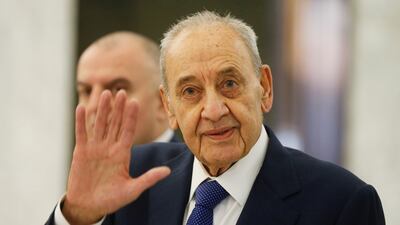
A draft of the US-brokered deal demarcating a disputed maritime border with Israel has been described as positive by Lebanon's Parliament Speaker Nabih Berri. Reuters

Lebanon Speaker Nabih Berri says maritime deal draft is 'positive'


  • English
  • Arabic

Lebanon's Parliament Speaker Nabih Berri has described a draft of the US-brokered deal demarcating a disputed maritime border with Israel as positive.

On Saturday, the Lebanese presidency said Beirut had received a letter from US mediator Amos Hochstein on proposals for demarcation of the boundary.

Mr Hochstein has been attempting to seal a deal that would allow offshore energy exploration and defuse one potential source of conflict between Israel and the Iran-backed Lebanese group Hezbollah.

In a tweet, the US embassy in Beirut said ambassador Dorothy Shea had met President Michel Aoun, Mr Berri and Prime Minister Najib Mikati “to provide the US proposal for a final agreement on the maritime boundary line”.

Mr Berri, a Hezbollah ally and one of Lebanon's most influential politicians, told Asharq Al Awsat newspaper the draft of the final agreement was positive, according a statement circulated by his office.

He said the draft “meets in principle the Lebanese demands”, which reject the maritime boundary deal having any impact on the land border between the two countries, it said.

Mr Berri said the agreement was 10 pages and in English and “would require study before the final response to it is given”.

Hezbollah leader Sayyed Hassan Nasrallah said in a speech on Saturday the receipt of the letter was “a very important step” and the coming days would be crucial.

The heavily armed Hezbollah, which last fought a major war with Israel in 2006, has warned against any Israeli exploration and extraction in the disputed waters.

Israeli Prime Minister Yair Lapid welcomed the US proposal at a Cabinet meeting on Sunday, saying the plan for resolving a long-running dispute would lift Israel’s economy and boost regional security.

Mr Lapid said the proposal, which was delivered to both Israel and Lebanon over the weekend, would strengthen Israel’s northern areas near the Lebanese border, allow Israel to produce additional natural gas and deliver new revenues to the national coffers.

“This is a deal that strengthens Israel’s security and Israel’s economy,” Mr Lapid told his Cabinet.

He also said Israel would not oppose the development of “an additional Lebanese gas field” straddling the maritime border, as long as Israel receives “the share we deserve”.

This would weaken Lebanon’s dependence on Iran, restrain Hezbollah and promote regional stability, Mr Lapid.

He said the deal was being reviewed by legal and defence officials before it is to be voted upon by the government.

Israeli media said a vote could take place Thursday.

— With reporting from AFP.

The President's Cake

Director: Hasan Hadi

Starring: Baneen Ahmad Nayyef, Waheed Thabet Khreibat, Sajad Mohamad Qasem 

Rating: 4/5

Islamophobia definition

A widely accepted definition was made by the All Party Parliamentary Group on British Muslims in 2019: “Islamophobia is rooted in racism and is a type of racism that targets expressions of Muslimness or perceived Muslimness.” It further defines it as “inciting hatred or violence against Muslims”.

The burning issue

The internal combustion engine is facing a watershed moment – major manufacturer Volvo is to stop producing petroleum-powered vehicles by 2021 and countries in Europe, including the UK, have vowed to ban their sale before 2040. The National takes a look at the story of one of the most successful technologies of the last 100 years and how it has impacted life in the UAE.

Read part three: the age of the electric vehicle begins

Read part two: how climate change drove the race for an alternative 

Read part one: how cars came to the UAE

Mercer, the investment consulting arm of US services company Marsh & McLennan, expects its wealth division to at least double its assets under management (AUM) in the Middle East as wealth in the region continues to grow despite economic headwinds, a company official said.

Mercer Wealth, which globally has $160 billion in AUM, plans to boost its AUM in the region to $2-$3bn in the next 2-3 years from the present $1bn, said Yasir AbuShaban, a Dubai-based principal with Mercer Wealth.

Within the next two to three years, we are looking at reaching $2 to $3 billion as a conservative estimate and we do see an opportunity to do so,” said Mr AbuShaban.

Mercer does not directly make investments, but allocates clients’ money they have discretion to, to professional asset managers. They also provide advice to clients.

“We have buying power. We can negotiate on their (client’s) behalf with asset managers to provide them lower fees than they otherwise would have to get on their own,” he added.

Mercer Wealth’s clients include sovereign wealth funds, family offices, and insurance companies among others.

From its office in Dubai, Mercer also looks after Africa, India and Turkey, where they also see opportunity for growth.

Wealth creation in Middle East and Africa (MEA) grew 8.5 per cent to $8.1 trillion last year from $7.5tn in 2015, higher than last year’s global average of 6 per cent and the second-highest growth in a region after Asia-Pacific which grew 9.9 per cent, according to consultancy Boston Consulting Group (BCG). In the region, where wealth grew just 1.9 per cent in 2015 compared with 2014, a pickup in oil prices has helped in wealth generation.

BCG is forecasting MEA wealth will rise to $12tn by 2021, growing at an annual average of 8 per cent.

Drivers of wealth generation in the region will be split evenly between new wealth creation and growth of performance of existing assets, according to BCG.

Another general trend in the region is clients’ looking for a comprehensive approach to investing, according to Mr AbuShaban.

“Institutional investors or some of the families are seeing a slowdown in the available capital they have to invest and in that sense they are looking at optimizing the way they manage their portfolios and making sure they are not investing haphazardly and different parts of their investment are working together,” said Mr AbuShaban.

Some clients also have a higher appetite for risk, given the low interest-rate environment that does not provide enough yield for some institutional investors. These clients are keen to invest in illiquid assets, such as private equity and infrastructure.

“What we have seen is a desire for higher returns in what has been a low-return environment specifically in various fixed income or bonds,” he said.

“In this environment, we have seen a de facto increase in the risk that clients are taking in things like illiquid investments, private equity investments, infrastructure and private debt, those kind of investments were higher illiquidity results in incrementally higher returns.”

The Abu Dhabi Investment Authority, one of the largest sovereign wealth funds, said in its 2016 report that has gradually increased its exposure in direct private equity and private credit transactions, mainly in Asian markets and especially in China and India. The authority’s private equity department focused on structured equities owing to “their defensive characteristics.”

Low turnout
Two months before the first round on April 10, the appetite of voters for the election is low.

Mathieu Gallard, account manager with Ipsos, which conducted the most recent poll, said current forecasts suggested only two-thirds were "very likely" to vote in the first round, compared with a 78 per cent turnout in the 2017 presidential elections.

"It depends on how interesting the campaign is on their main concerns," he told The National. "Just now, it's hard to say who, between Macron and the candidates of the right, would be most affected by a low turnout."

RESULTS

2pm: Handicap (PA) Dh40,000 (Dirt) 1,000m
Winner: AF Mozhell, Saif Al Balushi (jockey), Khalifa Al Neyadi (trainer)

2.30pm: Maiden (PA) Dh40,000 (D) 2,000m
Winner: Majdi, Szczepan Mazur, Abdallah Al Hammadi.

3pm: Handicap (PA) Dh40,000 (D) 1,700m
Winner: AF Athabeh, Tadhg O’Shea, Ernst Oertel.

3.30pm: Handicap (PA) Dh40,000 (D) 1,700m
Winner: AF Eshaar, Bernardo Pinheiro, Khalifa Al Neyadi

4pm: Gulf Cup presented by Longines Prestige (PA) Dh150,000 (D) 1,700m
Winner: Al Roba’a Al Khali, Al Moatasem Al Balushi, Younis Al Kalbani

4.30pm: Handicap (TB) Dh40,000 (D) 1,200m
Winner: Apolo Kid, Antonio Fresu, Musabah Al Muahiri

UAE currency: the story behind the money in your pockets
The burning issue

The internal combustion engine is facing a watershed moment – major manufacturer Volvo is to stop producing petroleum-powered vehicles by 2021 and countries in Europe, including the UK, have vowed to ban their sale before 2040. The National takes a look at the story of one of the most successful technologies of the last 100 years and how it has impacted life in the UAE.

Part three: an affection for classic cars lives on

Read part two: how climate change drove the race for an alternative 

Read part one: how cars came to the UAE

Jetour T1 specs

Engine: 2-litre turbocharged

Power: 254hp

Torque: 390Nm

Price: From Dh126,000

Available: Now

Updated: October 02, 2022, 12:27 PM
