Saudi Arabia's ambassador to Lebanon Walid Bukhari held meetings with religious leaders and politicians on Monday. Reuters

Saudi Arabia's ambassador in Beirut hosts key Lebanese figures for iftar


Jamie Prentis
  • English
  • Arabic

Saudi Arabia’s ambassador to Lebanon hosted an iftar with key Lebanese political figures and western ambassadors on Monday night, only days after Riyadh reinstated its envoy to Beirut.

Saudi Arabia was one of four Arab states that withdrew their ambassadors from Lebanon in October last year after comments by George Kordahi, who was Lebanon’s information minister, about the Saudi-led Arab coalition's intervention in Yemen. The four Arab states also asked their citizens to return home.

Mr Kordahi resigned as a result of the fallout.

On Monday night, after holding meetings with key players in Lebanon, Saudi ambassador Walid Bukhari welcomed prime minister Najib Mikati and other figures, mostly from the now-defunct pro-western, pro-Gulf March 14 political alliance, to the banquet.

Mr Mikati will also reportedly visit Saudi Arabia soon — probably during Ramadan — in another sign that relations are on the mend. Kuwait’s ambassador to Lebanon, who was also reinstated last week, attended the iftar.

Also present were former presidents Amine Gemayel and Michel Suleiman, former prime ministers Fouad Siniora and Tammam Salam. As was the head of the Lebanese Forces party, Samir Geagea, the veteran Druze leader of the Progressive Socialist Party, Walid Joumblatt, and Kataeb Party chief Sami Gemayel and former MP Bahia Hariri.

Amine Gemayel welcomed the return of the Saudi ambassador, while Mr Siniora underlined the importance of restoring and maintaining strong relations with countries including Saudi Arabia.

Saudi Arabia and other Gulf states were once major donors to Lebanon, but relations frayed amid the growing influence of the Iran-backed Hezbollah movement.

Along with withdrawing its ambassador, Saudi Arabia accused Hezbollah of turning Lebanon into “a launching pad for implementing projects of countries that do not wish well for Lebanon and its brotherly people".

Speaking at the iftar, the Saudi Press Agency reported, Mr Mikati said: “This is the significance of the month of Ramadan, the month of mercy and solidarity, the occasion to strengthen the bonds of amicability that bind Lebanon to Saudi Arabia, and the solidarity that the Custodian of the Two Holy Mosques and His Royal Highness the Crown Prince have been experiencing, hoping that it will be a new page towards developing relations between the two countries.”

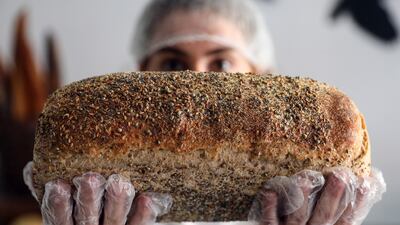
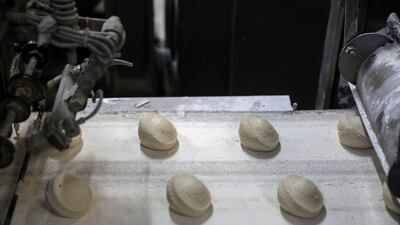
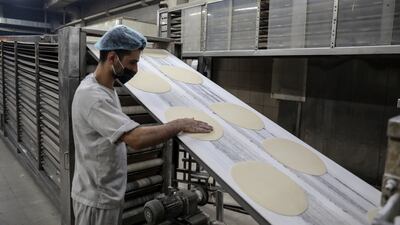
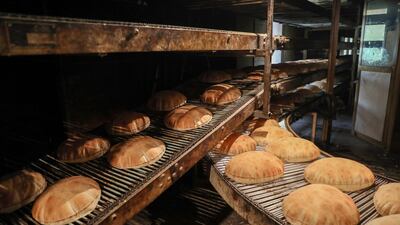
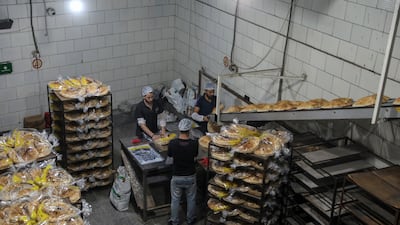
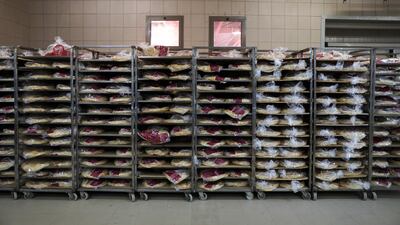
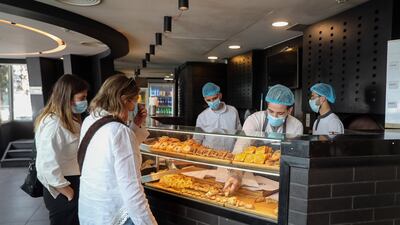
Wheat shortages in Lebanon — in pictures

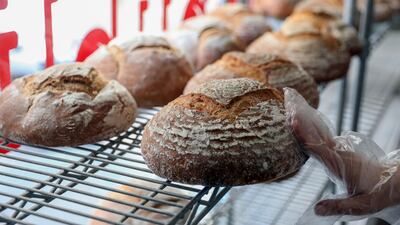
  • A baker holds up a seeded white loaf of bread at a bakery in Beirut, Lebanon, which faces a food crisis because of war in Europe. All photos: Bloomberg
    A baker holds up a seeded white loaf of bread at a bakery in Beirut, Lebanon, which faces a food crisis because of war in Europe. All photos: Bloomberg
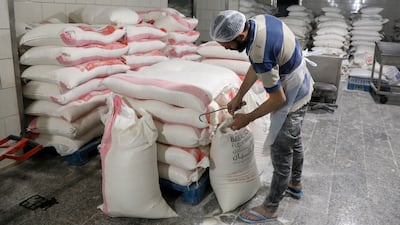
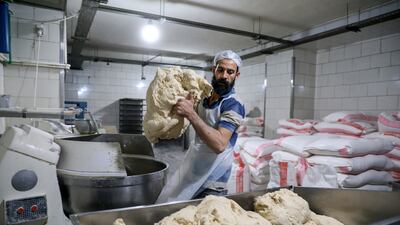
  • A worker opens a sack of flour to prepare bread dough in Beirut. Lebanon's wheat importers are already rationing flour sales to counter panic buying.
    A worker opens a sack of flour to prepare bread dough in Beirut. Lebanon's wheat importers are already rationing flour sales to counter panic buying.
  • Lebanon, already suffering from years of financial crisis, has faced new problems since Russia invaded Ukraine in February.
    Lebanon, already suffering from years of financial crisis, has faced new problems since Russia invaded Ukraine in February.
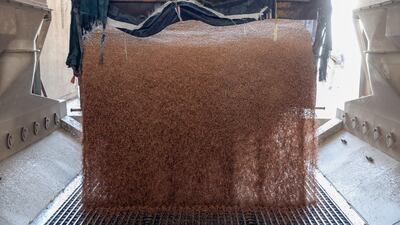
  • Lebanon normally buys 96 per cent of its wheat from Russia and Ukraine.
    Lebanon normally buys 96 per cent of its wheat from Russia and Ukraine.
  • The war between two of the world's biggest wheat exporters has sparked fears of a food crisis in many Middle Eastern countries.
    The war between two of the world's biggest wheat exporters has sparked fears of a food crisis in many Middle Eastern countries.
  • Lebanese importers are struggling to get dollars from a subsidy programme to buy wheat from new suppliers.
    Lebanese importers are struggling to get dollars from a subsidy programme to buy wheat from new suppliers.
  • As countries try to secure new sources of wheat, cash-strapped Lebanon's small market of 6 million people could go without.
    As countries try to secure new sources of wheat, cash-strapped Lebanon's small market of 6 million people could go without.
  • Lebanon lacks grain storage after silos were destroyed in the 2020 Beirut Port blast.
    Lebanon lacks grain storage after silos were destroyed in the 2020 Beirut Port blast.
  • The country needs 50,000 tonnes of wheat to feed its people for a month.
    The country needs 50,000 tonnes of wheat to feed its people for a month.
  • Subsidies keep the price of bread in Lebanon artificially low.
    Subsidies keep the price of bread in Lebanon artificially low.
  • But a loaf now costs on average 10,000 Lebanese pounds, or $0.45, more than six times the price in 2019.
    But a loaf now costs on average 10,000 Lebanese pounds, or $0.45, more than six times the price in 2019.
  • Millers estimate that without subsidies, prices could more than double.
    Millers estimate that without subsidies, prices could more than double.
  • Analysts fear that could cause social unrest in a country where three quarters of the population now live in poverty.
    Analysts fear that could cause social unrest in a country where three quarters of the population now live in poverty.

Mr Bukhari had earlier said “we wish Lebanon and the Lebanese people good fortune” before a meeting with Sheikh Ali Al Khatib, the deputy head of the Supreme Islamic Shiite Council.

Lebanon’s Grand Mufti Abdul Latif Derian welcomed the return of the Saudi ambassador, saying on Monday: “We are interested in relations between the Kingdom and Lebanon, and hope that Lebanese-Arab relations will remain at the highest level of rapprochement and fraternity.

“As long as things are going in the right direction, and as long as we maintain the right path, these relations will be good and there will be no future crises with Saudi Arabia.”

The Saudi ambassador also met top religious leaders from the Maronite and Druze communities.

The ambassadors of France, the UK and US, and the UN's special co-ordinator for Lebanon, Joanna Wronecka, were also at the iftar banquet.

On announcing the return of its ambassador last Thursday, Saudi state media said the kingdom made the decision after the “calls and appeals of the moderate national political forces in Lebanon.”

It also said that Lebanon had agreed to “stop all political, military and security activities affecting” it and other Gulf Arab nations.

Mr Mikati welcomed the move, adding: “We affirm that Lebanon is proud of its Arab affiliation and wants the best relations with the Gulf states, which were and will remain our support.”


Ten tax points to be aware of in 2026

1. Domestic VAT refund amendments: request your refund within five years

If a business does not apply for the refund on time, they lose their credit.

2. E-invoicing in the UAE

Businesses should continue preparing for the implementation of e-invoicing in the UAE, with 2026 a preparation and transition period ahead of phased mandatory adoption. 

3. More tax audits

Tax authorities are increasingly using data already available across multiple filings to identify audit risks. 

4. More beneficial VAT and excise tax penalty regime

Tax disputes are expected to become more frequent and more structured, with clearer administrative objection and appeal processes. The UAE has adopted a new penalty regime for VAT and excise disputes, which now mirrors the penalty regime for corporate tax.

5. Greater emphasis on statutory audit

There is a greater need for the accuracy of financial statements. The International Financial Reporting Standards standards need to be strictly adhered to and, as a result, the quality of the audits will need to increase.

6. Further transfer pricing enforcement

Transfer pricing enforcement, which refers to the practice of establishing prices for internal transactions between related entities, is expected to broaden in scope. The UAE will shortly open the possibility to negotiate advance pricing agreements, or essentially rulings for transfer pricing purposes. 

7. Limited time periods for audits

Recent amendments also introduce a default five-year limitation period for tax audits and assessments, subject to specific statutory exceptions. While the standard audit and assessment period is five years, this may be extended to up to 15 years in cases involving fraud or tax evasion. 

8. Pillar 2 implementation 

Many multinational groups will begin to feel the practical effect of the Domestic Minimum Top-Up Tax (DMTT), the UAE's implementation of the OECD’s global minimum tax under Pillar 2. While the rules apply for financial years starting on or after January 1, 2025, it is 2026 that marks the transition to an operational phase.

9. Reduced compliance obligations for imported goods and services

Businesses that apply the reverse-charge mechanism for VAT purposes in the UAE may benefit from reduced compliance obligations. 

10. Substance and CbC reporting focus

Tax authorities are expected to continue strengthening the enforcement of economic substance and Country-by-Country (CbC) reporting frameworks. In the UAE, these regimes are increasingly being used as risk-assessment tools, providing tax authorities with a comprehensive view of multinational groups’ global footprints and enabling them to assess whether profits are aligned with real economic activity. 

Contributed by Thomas Vanhee and Hend Rashwan, Aurifer

Our legal consultant

Name: Dr Hassan Mohsen Elhais

Position: legal consultant with Al Rowaad Advocates and Legal Consultants.

Formula Middle East Calendar (Formula Regional and Formula 4)
Round 1: January 17-19, Yas Marina Circuit – Abu Dhabi
 
Round 2: January 22-23, Yas Marina Circuit – Abu Dhabi
 
Round 3: February 7-9, Dubai Autodrome – Dubai
 
Round 4: February 14-16, Yas Marina Circuit – Abu Dhabi
 
Round 5: February 25-27, Jeddah Corniche Circuit – Saudi Arabia
INFO
Jetour T1 specs

Engine: 2-litre turbocharged

Power: 254hp

Torque: 390Nm

Price: From Dh126,000

Available: Now

Blue%20Beetle
%3Cp%3E%3Cstrong%3EDirector%3A%3C%2Fstrong%3E%20Angel%20Manuel%20Soto%3Cbr%3E%3Cstrong%3EStars%3A%20%3C%2Fstrong%3EXolo%20Mariduena%2C%20Adriana%20Barraza%2C%20Damian%20Alcazar%2C%20Raoul%20Max%20Trujillo%2C%20Susan%20Sarandon%2C%20George%20Lopez%3Cbr%3E%3Cstrong%3ERating%3A%20%3C%2Fstrong%3E4%2F5%C2%A0%3C%2Fp%3E%0A
Itcan profile

Founders: Mansour Althani and Abdullah Althani

Based: Business Bay, with offices in Saudi Arabia, Egypt and India

Sector: Technology, digital marketing and e-commerce

Size: 70 employees 

Revenue: On track to make Dh100 million in revenue this year since its 2015 launch

Funding: Self-funded to date


Name: Peter Dicce

Title: Assistant dean of students and director of athletics

Favourite sport: soccer

Favourite team: Bayern Munich

Favourite player: Franz Beckenbauer

Favourite activity in Abu Dhabi: scuba diving in the Northern Emirates 


Company: Instabug

Founded: 2013

Based: Egypt, Cairo

Sector: IT

Employees: 100

Stage: Series A

Investors: Flat6Labs, Accel, Y Combinator and angel investors

Frankenstein in Baghdad
Ahmed Saadawi
​​​​​​​Penguin Press

COMPANY PROFILE

Name: Lamsa

Founder: Badr Ward

Launched: 2014

Employees: 60

Based: Abu Dhabi

Sector: EdTech

Funding to date: $15 million

UPI facts

More than 2.2 million Indian tourists arrived in UAE in 2023
More than 3.5 million Indians reside in UAE
Indian tourists can make purchases in UAE using rupee accounts in India through QR-code-based UPI real-time payment systems
Indian residents in UAE can use their non-resident NRO and NRE accounts held in Indian banks linked to a UAE mobile number for UPI transactions

Mercer, the investment consulting arm of US services company Marsh & McLennan, expects its wealth division to at least double its assets under management (AUM) in the Middle East as wealth in the region continues to grow despite economic headwinds, a company official said.

Mercer Wealth, which globally has $160 billion in AUM, plans to boost its AUM in the region to $2-$3bn in the next 2-3 years from the present $1bn, said Yasir AbuShaban, a Dubai-based principal with Mercer Wealth.

Within the next two to three years, we are looking at reaching $2 to $3 billion as a conservative estimate and we do see an opportunity to do so,” said Mr AbuShaban.

Mercer does not directly make investments, but allocates clients’ money they have discretion to, to professional asset managers. They also provide advice to clients.

“We have buying power. We can negotiate on their (client’s) behalf with asset managers to provide them lower fees than they otherwise would have to get on their own,” he added.

Mercer Wealth’s clients include sovereign wealth funds, family offices, and insurance companies among others.

From its office in Dubai, Mercer also looks after Africa, India and Turkey, where they also see opportunity for growth.

Wealth creation in Middle East and Africa (MEA) grew 8.5 per cent to $8.1 trillion last year from $7.5tn in 2015, higher than last year’s global average of 6 per cent and the second-highest growth in a region after Asia-Pacific which grew 9.9 per cent, according to consultancy Boston Consulting Group (BCG). In the region, where wealth grew just 1.9 per cent in 2015 compared with 2014, a pickup in oil prices has helped in wealth generation.

BCG is forecasting MEA wealth will rise to $12tn by 2021, growing at an annual average of 8 per cent.

Drivers of wealth generation in the region will be split evenly between new wealth creation and growth of performance of existing assets, according to BCG.

Another general trend in the region is clients’ looking for a comprehensive approach to investing, according to Mr AbuShaban.

“Institutional investors or some of the families are seeing a slowdown in the available capital they have to invest and in that sense they are looking at optimizing the way they manage their portfolios and making sure they are not investing haphazardly and different parts of their investment are working together,” said Mr AbuShaban.

Some clients also have a higher appetite for risk, given the low interest-rate environment that does not provide enough yield for some institutional investors. These clients are keen to invest in illiquid assets, such as private equity and infrastructure.

“What we have seen is a desire for higher returns in what has been a low-return environment specifically in various fixed income or bonds,” he said.

“In this environment, we have seen a de facto increase in the risk that clients are taking in things like illiquid investments, private equity investments, infrastructure and private debt, those kind of investments were higher illiquidity results in incrementally higher returns.”

The Abu Dhabi Investment Authority, one of the largest sovereign wealth funds, said in its 2016 report that has gradually increased its exposure in direct private equity and private credit transactions, mainly in Asian markets and especially in China and India. The authority’s private equity department focused on structured equities owing to “their defensive characteristics.”

Most sought after workplace benefits in the UAE
  • Flexible work arrangements
  • Pension support
  • Mental well-being assistance
  • Insurance coverage for optical, dental, alternative medicine, cancer screening
  • Financial well-being incentives 
The%20specs
%3Cp%3E%3Cstrong%3EEngine%3A%3C%2Fstrong%3E%201.8-litre%204-cyl%20turbo%0D%3Cbr%3E%3Cstrong%3EPower%3A%20%3C%2Fstrong%3E190hp%20at%205%2C200rpm%0D%3Cbr%3E%3Cstrong%3ETorque%3A%3C%2Fstrong%3E%20320Nm%20from%201%2C800-5%2C000rpm%0D%3Cbr%3E%3Cstrong%3ETransmission%3A%20%3C%2Fstrong%3ESeven-speed%20dual-clutch%20auto%0D%3Cbr%3E%3Cstrong%3EFuel%20consumption%3A%3C%2Fstrong%3E%206.7L%2F100km%0D%3Cbr%3E%3Cstrong%3EPrice%3A%3C%2Fstrong%3E%20From%20Dh111%2C195%0D%3Cbr%3E%3Cstrong%3EOn%20sale%3A%20%3C%2Fstrong%3ENow%3C%2Fp%3E%0A
Thor%3A%20Love%20and%20Thunder%20
%3Cp%3E%3Cstrong%3EDirector%3A%3C%2Fstrong%3E%20Taika%20Waititi%C2%A0%3C%2Fp%3E%0A%3Cp%3E%3Cstrong%3EStars%3A%3C%2Fstrong%3E%20Chris%20Hemsworth%2C%20Natalie%20Portman%2C%20Christian%20Bale%2C%20Russell%20Crowe%2C%20Tessa%20Thompson%2C%20Taika%20Waititi%3C%2Fp%3E%0A%3Cp%3E%3Cstrong%3ERating%3A%3C%2Fstrong%3E%204%2F5%3C%2Fp%3E%0A
The Bio

Favourite holiday destination: Either Kazakhstan or Montenegro. I’ve been involved in events in both countries and they are just stunning.

Favourite book: I am a huge of Robin Cook’s medical thrillers, which I suppose is quite apt right now. My mother introduced me to them back home in New Zealand.

Favourite film or television programme: Forrest Gump is my favourite film, that’s never been up for debate. I love watching repeats of Mash as well.

Inspiration: My late father moulded me into the man I am today. I would also say disappointment and sadness are great motivators. There are times when events have brought me to my knees but it has also made me determined not to let them get the better of me.

At a glance

Fixtures All matches start at 9.30am, at ICC Academy, Dubai. Admission is free

Thursday UAE v Ireland; Saturday UAE v Ireland; Jan 21 UAE v Scotland; Jan 23 UAE v Scotland

UAE squad Rohan Mustafa (c), Ashfaq Ahmed, Ghulam Shabber, Rameez Shahzad, Mohammed Boota, Mohammed Usman, Adnan Mufti, Shaiman Anwar, Ahmed Raza, Imran Haider, Qadeer Ahmed, Mohammed Naveed, Amir Hayat, Zahoor Khan

Updated: April 12, 2022, 2:34 PM