


Lebanon’s Maronite Patriarch urged leaders in Beirut to resolve a diplomatic crisis with the Gulf that has isolated the country further from its historic allies at a time of economic meltdown.
At his Sunday sermon, Patriarch Beshara Al Rahi indirectly criticised Hezbollah and its allies for prolonging the weeks-long crisis, and for paralysing the work of the government and the judiciary.
In recent weeks, Patriarch Al Rahi repeatedly called on officials to resolve the crisis and restore ties with Gulf nations, strained by Hezbollah’s growing influence on Lebanese politics. His calls have had little effect as political inaction prolongs the spat.
“Dragging this crisis will only further the economic hemorrhage Lebanon is going through, and make finding a solution even harder,” he said from Bkerki, a Beirut suburb that is also the seat of the Maronite Church.
The row has dashed hopes of securing much-needed financial support from Arab countries, and sparked concerns for Lebanese workers there whose remittances have been essential to thousands of households two years into economic collapse.
Last month, Information Minister George Kordahi said on television that the Iran-backed Houthis were acting in self-defence against Yemen’s internationally recognised government, which is backed by a Saudi-led Arab coalition.
His comments drew condemnation from Saudi Arabia, the UAE, Bahrain and Kuwait. All four Gulf nations withdrew their ambassadors in Beirut, and all but the Emirates asked for Lebanon's representative to leave their countries. Riyadh has also banned all imports from Lebanon.
Mr Al Rahi met Mr Kordahi at the onset of the crisis. The Iran-backed Hezbollah has expressed support for Mr Kordahi. He is politically backed by the Christian Marada movement, which is close to Hezbollah and the Syrian regime.
“Resolving the Gulf crisis with patriotic courage is not dishonourable,” he said in a remark targeted at supporters of Mr Kordahi.
“But rather, exposing Lebanese to deportation, poverty and Arab isolation hurts Lebanon’s dignity, vigour and its sovereignty,” he said. The spat, he said, hindered the work of “hundreds of thousands” of Lebanese businesspeople and farmers.
Lebanese exports to the Gulf and remittances are a major source of foreign currency for Beirut at a time of economic crunch.
Mr Kordahi has refused to apologise or resign following the spat. The Lebanese president and prime minister have both said his comments do not represent the government but stopped short of asking him to resign, a hesitancy that has further angered Riyadh and Gulf nations.
-

Lebanon's Prime Minister Najib Mikati gestures as he speaks to the press after meeting President Michel Aoun at the presidential palace in Baabda. Reuters -

President Michel Aoun meets Parliament Speaker Nabih Berri and Prime Minister-designate Najib Mikati at the presidential palace in Baabda before the announcement of the formation of a new government under Mr Mikati. Dalati and Nohra / AFP -
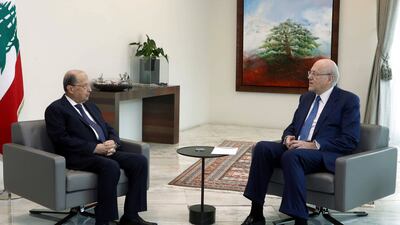
Mr Aoun (L) and Mr Mikati before the announcement of the formation of a new Lebanese government ending a 13-month vacancy. Dalati and Nohra / AFP -
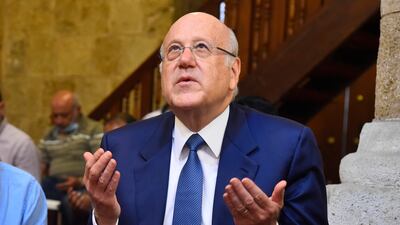
Lebanese Prime Minister Najib Mikat attends Friday prayers at a mosque in downtown Beirut. AP -
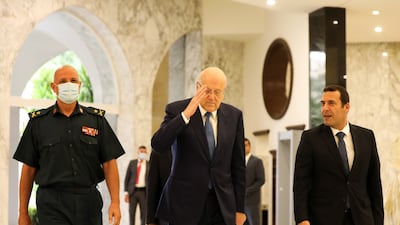
Najib Mikati arriving at the presidential palace in Baabda, Lebanon. Reuters -
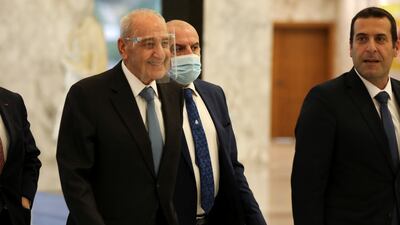
Lebanese Speaker of the Parliament Nabih Berri arrives at the presidential palace in Baabda. Reuters -
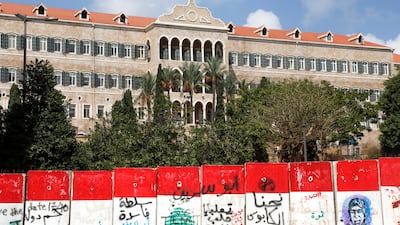
The government palace in Beirut, Lebanon. Reuters -
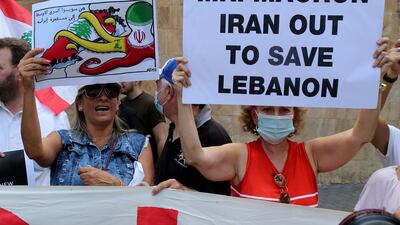
Protesters in Beirut. -
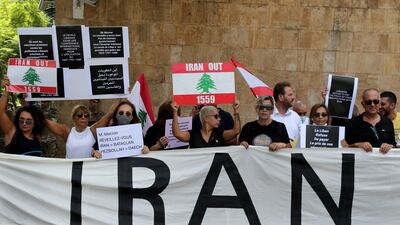
Anti-government protesters during a demonstration outside the French embassy in Beirut, Lebanon. EPA -
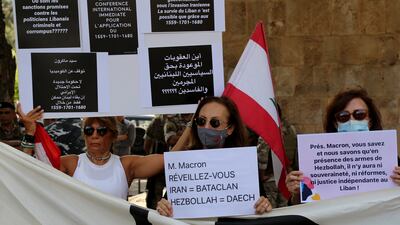
Demonstrators with placards appealing to French President Emmanuel Macron. EPA -
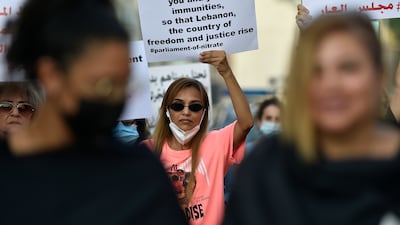
Protesters outside the French embassy in Beirut, Lebanon. EPA


“Officials cannot sit back and watch this happen,” Mr Al Rahi said.
“No party has the right to impose its will on all Lebanese and perturb Lebanon’s relations with the world, hindering the work of the government, paralysing the judiciary, and creating a threatening environment,” he said in a veiled reference to the Iran-backed Hezbollah.
The Lebanese government has not met since October 12 because ministers backed by Hezbollah and their allies have threatened to boycott the meetings if the judge investigating the Beirut port blast is not removed from his post.
Judge Tarek Bitar had summoned politicians close to the group for questioning about last year’s explosion, which killed more than 215 people and destroyed large parts of the capital.
Mr Kordahi’s comments compounded the government paralysis faced by Prime Minister Najib Mikati’s Cabinet, sparking fears that his unity government may resign ahead of next year’s parliamentary and municipal elections.

