

When Lebanese billionaire Najib Mikati was appointed prime minister in 2011, he was forced to resign after a falling out with Hezbollah.
But on Thursday, he secured his fourth term at the helm of the country, gaining the support of 54 of Parliament's 128 members — including those from Hezbollah and its Shiite ally Amal.
Mr Mikati, who returned to the leadership in July 2021 amid hopes that he would help lead Lebanon out of its worst crisis in decades, will continue in a caretaker role until a government is formed, a process that typically goes on for months as political factions divvy up roles in the Cabinet and beyond.
Analysts and politicians expect this Cabinet formation process to be further complicated by a looming struggle over who will replace President Michel Aoun, the Hezbollah-aligned Maronite Christian head of state, when his term ends on October 31.
“The Mikati of 2021 is different from the Mikati of 2011,” Fadi Ahmar, a lecturer in Middle East studies, told The National last year.
He pointed to Mr Mikati’s distance from his former allies the Syrian regime of Bashar Al Assad and Hezbollah. The Iran-backed militia sent its forces to fight alongside Mr Al Assad after the 2011 uprising, without the Lebanese state's permission.
“He is aware that close ties with the Syrian regime and Hezbollah will impede the work of any future government,” Dr Ahmar said.
Lebanon has been in economic meltdown since late 2019 after decades of corruption and financial mismanagement, pushing more than half of the population below the poverty line.
-

Lebanon's Prime Minister Najib Mikati gestures as he speaks to the press after meeting President Michel Aoun at the presidential palace in Baabda. Reuters -

President Michel Aoun meets Parliament Speaker Nabih Berri and Prime Minister-designate Najib Mikati at the presidential palace in Baabda before the announcement of the formation of a new government under Mr Mikati. Dalati and Nohra / AFP -
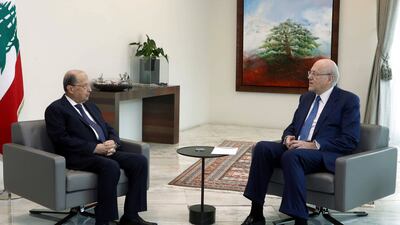
Mr Aoun (L) and Mr Mikati before the announcement of the formation of a new Lebanese government ending a 13-month vacancy. Dalati and Nohra / AFP -
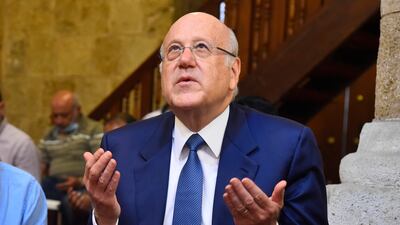
Lebanese Prime Minister Najib Mikat attends Friday prayers at a mosque in downtown Beirut. AP -
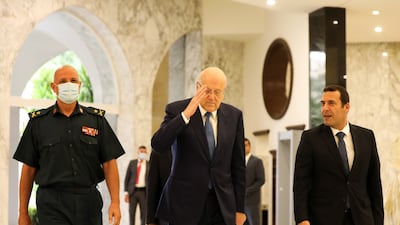
Najib Mikati arriving at the presidential palace in Baabda, Lebanon. Reuters -
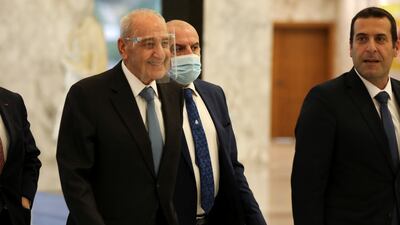
Lebanese Speaker of the Parliament Nabih Berri arrives at the presidential palace in Baabda. Reuters -
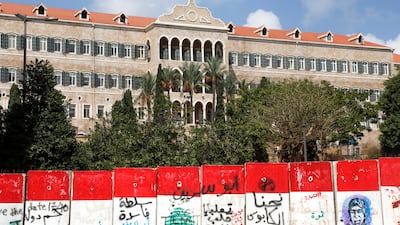
The government palace in Beirut, Lebanon. Reuters -
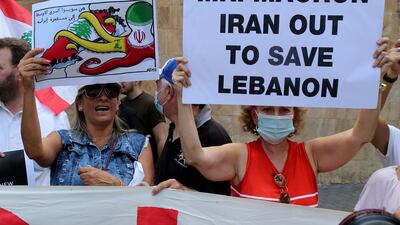
Protesters in Beirut. -
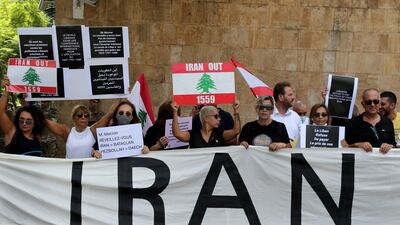
Anti-government protesters during a demonstration outside the French embassy in Beirut, Lebanon. EPA -
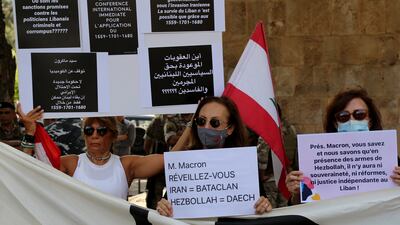
Demonstrators with placards appealing to French President Emmanuel Macron. EPA -
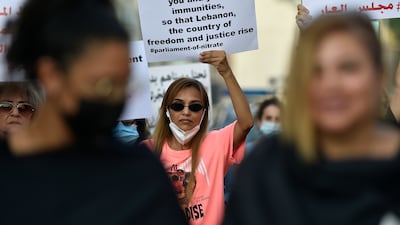
Protesters outside the French embassy in Beirut, Lebanon. EPA


Yet Mr Mikati, one of the richest men in the Arab world, is a member of the entrenched political elite accused by protesters of running Lebanon’s economy into the ground.
He is the latest in a line of business tycoons to assume the premiership since the end of Lebanon’s 15-year civil war in 1990.
Political career
Mr Mikati is a self-made billionaire, twice former prime minister and member of Parliament representing the northern city of Tripoli — one of the poorest on the Mediterranean.
His political career began in the 1990s, when Lebanon was largely under Syrian control. From 1998 until 2004, he was minister of public works and transport.
“His Syria ties helped him get a ministerial portfolio when Lebanon was under Syrian rule,” Dr Ahmar said.
“It was even rumoured he had a personal relationship with Bashar Al Assad.”
lecturer in Middle East studies
Damascus had troops in Lebanon for nearly 30 years until 2005 and still holds influence in Beirut despite a weakening hold since the onset of its civil war in 2011.
Mr Mikati’s Syria ties even secured him a slice of the Syrian mobile phone sector through his company MTN, the smaller of two mobile network operators in Syria, which he later sold.
But his relations with Damascus and its Lebanese ally Hezbollah began to shift after the assassination of former prime minister Rafik Hariri in 2005. An international court found that Hariri was murdered by a Hezbollah operative.
“He changed his stance because his Sunni community could not accept it any more after Rafik Hariri’s killing, and especially after the Syrian revolution against the regime,” Dr Ahmar said.
The Assad regime is unpopular in Lebanon’s Sunni-majority north. Animosity towards Damascus grew further after its security apparatus murdered mostly Sunni peaceful protesters, initiating Syria’s descent into war.
Mr Mikati has also distanced himself from the Syrian regime and Hezbollah to regain the trust of Lebanon’s estranged allies in the West and the Gulf, Dr Ahmar said.
“He never publicly condemned the regime but he is no longer on good terms with the Syrian government.”
In 2000, Mr Mikati was elected to Parliament for the first time as a representative of Tripoli, a seat he has held continuously except from 2005 to 2009.
He first became prime minister in 2005 after the assassination of Hariri, the father of Saad Hariri. His term lasted only a few months and was focused on organising parliamentary elections.
He became prime minister again in 2011 and led a Hezbollah-dominated government for two years before resigning.
Business empire
Together with his brother Taha, Mr Mikati made his fortune in telecoms.
A former employee described his management style as hands-on.
“Mikati is a one-man show. He likes to be in charge of everything,” the former employee said.
The brothers founded Investcom in 1982 and built mobile phone masts in Ghana, Liberia and Benin, Forbes reported.
In 2007, they co-founded the investment company M1 group, which specialises in telecoms, property, aircraft financing, fashion and energy, Mr Mikati’s official website says.
The company recently bought the Myanmar business of Norwegian telecoms company Telenor after the military coup there pushed them to leave.
Forbes Middle East listed Najib and Taha Mikati as two of the richest Arabs in 2020, ranking ninth and seventh, respectively.
Protesters routinely held sit-ins in front of Mr Mikati’s house in Tripoli in the past year, accusing him of amassing wealth while residents of his city slip further into poverty.
Dr Ahmar, who teaches at the Lebanese University, told The National that Mr Mikati “has a non-confrontational personality”.
“He tries to be on good terms with everyone. He never really cut ties with Hezbollah or the Syrians but he is also close to his Arab, Sunni base.”

