
Friends and family initially mocked one Jordanian family's venture to make soap from donkey milk.
But now, a year on, the company is cleaning up, as customers bray for more.
Atan Donkey Milk Soaps produces 100 per cent natural soaps from its farm in Madaba, 35 kilometres south-west of the capital Amman.
It keeps 12 donkeys there and also has a small manufacturing workshop in the Jordanian capital.
Although other regions around the Mediterranean produce soap from donkey milk, this is the first for Jordan.
-

Emad Attiyat, co-founder of Atan Donkey Milk Soaps, at a farm he manages in Madaba, about 35 kilometres south-west of Jordan's capital Amman. All photos: AFP -

A worker milks a donkey at a farm managed by Atan Donkey Milk Soaps in Madaba. Friends and family initially mocked the Jordanian family's new venture making soap from donkey milk. But a year later the company is cleaning up, with customers queuing up for their products. -

Natural ingredients are mixed with donkey milk to produce soap at the company's laboratory in Jordan's capital Amman. -

Emad Attiyat at the company's laboratory in Amman, where Atan Donkey Milk Soaps produces 100 per cent natural soaps with milk from its farm in Madaba. -

Emad Attiyat, left, with his mother and business partner Salma al-Zubi, at the company's laboratory in Amman. The farm in Madaba, 35 kilometres from Amman, is home to 12 donkeys. -

Emad Attiyat pouring a mix of natural ingredients and donkey milk into soap moulds at the company factory in Amman, Jordan.


“At the beginning, many laughed at the idea,” said Emad Attiyat, 32, co-founder of the business – which takes its name from the Arabic for a jenny or female donkey, "atan".
Sceptics scoffed they “would use nothing on their skin related to donkeys,” said Mr Attiyat, who has a degree in management information systems.
“After trying the soap, all that changed, and now we produce more than 4,500 bars of soap per month to meet the demand,” he said.
'Reducing aging'
Donkey milk is said to be rich in minerals and proteins that can help moisturise the skin.
It also has high levels of antioxidants, which protect the skin from sunlight and the effects of ageing, according to beauticians.
One litre of milk produces around 30 bars of soap, but milking each female is a painstaking task done with a hand-held electronic pump.
Each donkey has to be milked three times a day in order to get about a litre of milk, leaving about another litre for her foal.
The milk is frozen and transferred to the company's workshop in Amman to be turned into soap.
Research has shown donkey milk can “help regenerate skin cells, reduce signs of ageing and help cure some skin diseases such as eczema”, said Mr Attiyat's mother and co-founder of the business, Salma Al Zubi.
Ms Al Zubi came up with the idea for the venture.
An environmental activist and retired teacher, she says donkey's milk soap contributes to balancing skin moisture levels and removing wrinkles, not to mention treating spots and acne.
Now in her 60s, Ms Al Zubi helps mix ingredients in the company's Amman workshop, wearing a face mask and gloves to ensure hygiene levels.
Olive oil, almond oil, coconut oil and shea butter are added to the donkey milk to produce the soap, which is then sold through the Atan Donkey Milk Soaps Facebook page.
A 85-gram bar of soap costs 8 Jordanian dinars ($11), while a large 125-gram bar retails at 10 dinars.
By comparison, a litre of donkey's milk in Europe can fetch as much as 60 euros ($70) and is used in making expensive cheeses.
Providing jobs
Mr Attiyat is now hoping to expand production to face and hand creams and lotions.
Donkey milk is “rich in proteins and minerals including magnesium, copper, sodium, manganese, zinc, calcium and iron – all of which are very important for the skin,” said dietitian Susanna Haddad, who works at a beauty centre in Amman.
It contains “higher percentages of whey, which has antimicrobial properties” and can also prevent the growth of viruses and bacteria, she said.
As she poured the mixture into special silicon moulds to shape the bars, Ms Al Zubi said the venture had provided jobs for several family members “including my son Emad, who has suffered from unemployment for many years".
Jordan's already weak economy has been badly hit by the year-long restrictions and closures imposed during the Covid-19 pandemic.
-
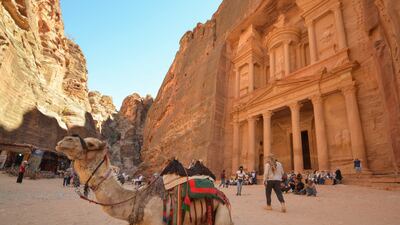
Jordan's once bustling ancient city of Petra has been crippled by Covid-19. -

One of the new seven wonders of the world, it used to attract thousands of tourists a day. -

But during the pandemic visitor numbers dwindled and Jordan's economy suffered its worst contraction in decades. -
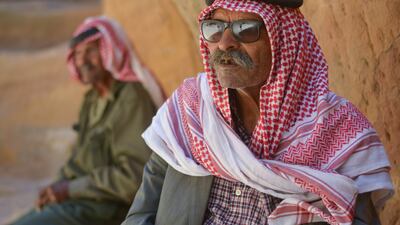
There is a glimmer of hope on the horizon, however, as foreign tourists are starting to return. -
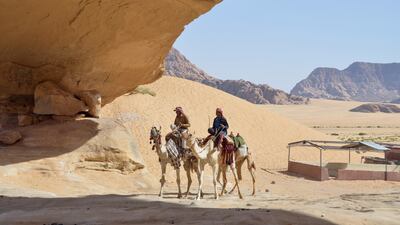
Government efforts to revive the tourism sector appear to be paying off. -
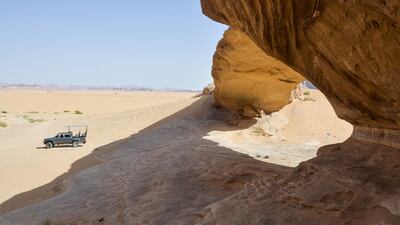
Jordan's 'golden triangle', which includes Petra, Wadi Rum and crusader castles, is now open to tourists that are fully vaccinated. -
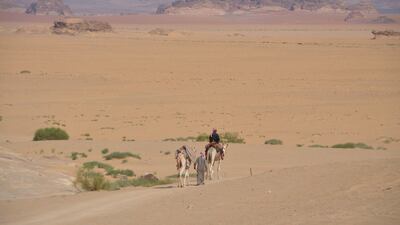
The country also lifted most of its lockdown measures at the start of July, after a sharp drop in infections. -
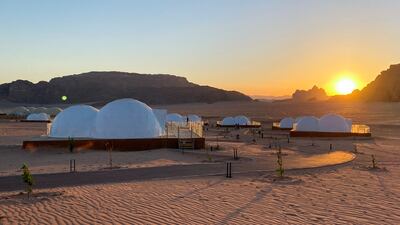
While it will take time to recover, Jordan's tourism industry is hopeful brighter days are ahead.


The poverty rate, according to official figures, rose to 15.7 per cent by late 2020, while it could soar to more than 24 per cent this year, according to some estimates.
Unemployment increased in the first quarter of 2021 to reach 25 per cent – 50 per cent among young people – in a country whose public debt exceeded $48 billion, or more than 108 per cent of the gross domestic product (GDP).
Loyal customer, lawyer Esraa Al Turk, 48, said she had been attracted to the donkey milk soap because it is a natural product.
“I take care of my skin,” she said, adding that although she did not wear much make-up, she had now “become more daring about leave home without any cosmetics on my face".

