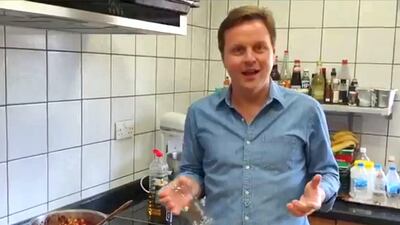
Ambassador Stephen Hickey shares videos of himself cooking Iraqi dishes on social media. Courtesy Stephen Hickey

Delicious diplomacy: Stephen Hickey’s cooking hobby has made him popular with Iraqis


Mina Aldroubi
  • English
  • Arabic

British Ambassador Stephen Hickey’s passion for cooking has made him one of the most popular diplomats in Iraq, as he showcases the country’s rich flavours to the world.

Over the past few months, the British diplomat has uploaded videos of himself cooking at his Baghdad home on social media, to get tips and reactions from Iraqis.

I've been so lucky to get invited to people's houses for dinner and the food is amazing

It was a bold gambit but it appears to have paid off and has brought him closer to the Iraqi public.

Mr Hickey is aiming to master the art of cooking complex dishes that reflect Iraq’s heritage as well as strong regional influences on the country's culinary traditions.

"It helps the public realise that western diplomats are people and are not just here to pursue our country's interest; we are also here to learn about the country and experience it as well," Mr Hickey told The National.

“I found that it builds confidence and trust in people,” he said.

Even with senior Iraqi officials, the British diplomat spends 10 minutes discussing dishes before speaking about issues such as early elections, economic reforms and the public protests that have been a frequent occurrence since October 2019.

“I enjoy talking and learning about food just as an individual, not a diplomat, and I find that Iraqis enjoy talking about it too, especially where each dish comes from, or whether it’s been influenced by neighbouring countries,” Mr Hickey said.

Over the centuries, many empires have passed through Iraq, leaving their mark on the country’s dishes.

Different eras of Iraqi history, culture and cuisine can be threaded together by the influence of these successive invasions.

Showcasing different aspects of Iraqi cuisine also sparks debate on the origin of dishes, which Mr Hickey has experienced.

“There’s always controversy over the dishes I cook, some people say I’m cooking it in the wrong way, it’s an Iraqi dish. For the dolma, people say it’s Turkish or from the Levantine,” he said.

But the diplomat is open to suggestions.

Mr Hickey has attempted to cook dolma, Iraq’s most famous dish, consisting of various stuffed vegetables with rice and minced meat, cooked slowly in lemon, pomegranate and tamarind and also Bamya, a traditional stew of lamb, okra and tomatoes.

“I took the advice I was receiving from comments online; there’s the Iraqi cookbook by Lamees Ibrahim – used her recipe as a basis and used a few small tweaks based on what people said.”

During Ramadan he attempted to make a milk toffee pudding on an Iraqi television show, following a recipe from the famous Iraqi cook, Chef Shaheen.

“I was pleased not to burn down the studio, I think it turned out OK.”

Mr Hickey believes that through food, the world can see Iraq in a different light.

“It’s an aspect of Iraqi culture that’s not well known, especially not in the West, so it's nice to show something positive about Iraq, it improves the picture of what life is like there too.”

But the diplomat has also received criticism for showcasing his hobby to the public.

“Just by being the British ambassador and putting yourself out there on social media there will always be some criticism, it comes with the job and that’s OK,” he said.

A comment he often hears is “why are you spending your time cooking when there are many things you could be doing as the ambassador to Iraq?”

Mr Hickey’s response is simple: he believes that it “is possible for a person to cook occasionally and to also do their job”.

“I spend less than one per cent of my time cooking and the other 99 per cent on human rights issues, economic reforms, early elections, supporting British companies; the two are not mutually exclusive,” he said.

Despite such a keenness to showcase Iraqi cuisine, Mr Hickey was unfamiliar with Iraqi cooking prior to taking up his post in Baghdad in 2019.

“I’ve been so lucky to get invited to people’s houses for dinner and the food is amazing. It’s incredible, the generosity of Iraqi hospitality is striking, and also the flavours.”


Guide to intelligent investing
Investing success often hinges on discipline and perspective. As markets fluctuate, remember these guiding principles:
  • Stay invested: Time in the market, not timing the market, is critical to long-term gains.
  • Rational thinking: Breathe and avoid emotional decision-making; let logic and planning guide your actions.
  • Strategic patience: Understand why you’re investing and allow time for your strategies to unfold.
 
 
Avatar: Fire and Ash

Director: James Cameron

Starring: Sam Worthington, Sigourney Weaver, Zoe Saldana

Rating: 4.5/5

Who's who in Yemen conflict

Houthis: Iran-backed rebels who occupy Sanaa and run unrecognised government

Yemeni government: Exiled government in Aden led by eight-member Presidential Leadership Council

Southern Transitional Council: Faction in Yemeni government that seeks autonomy for the south

Habrish 'rebels': Tribal-backed forces feuding with STC over control of oil in government territory

SPECS

Engine: 4-litre V8 twin-turbo
Power: 630hp
Torque: 850Nm
Transmission: 8-speed Tiptronic automatic
Price: From Dh599,000
On sale: Now

HEADLINE HERE
  • I would recommend writing out the text in the body 
  • And then copy into this box
  • It can be as long as you link
  • But I recommend you use the bullet point function (see red square)
  • Or try to keep the word count down
  • Be wary of other embeds lengthy fact boxes could crash into 
  • That's about it
History's medical milestones

1799 - First small pox vaccine administered

1846 - First public demonstration of anaesthesia in surgery

1861 - Louis Pasteur published his germ theory which proved that bacteria caused diseases

1895 - Discovery of x-rays

1923 - Heart valve surgery performed successfully for first time

1928 - Alexander Fleming discovers penicillin

1953 - Structure of DNA discovered

1952 - First organ transplant - a kidney - takes place 

1954 - Clinical trials of birth control pill

1979 - MRI, or magnetic resonance imaging, scanned used to diagnose illness and injury.

1998 - The first adult live-donor liver transplant is carried out

'Cheb%20Khaled'
%3Cp%3E%3Cstrong%3EArtist%3A%20%3C%2Fstrong%3EKhaled%3Cbr%3E%3Cstrong%3ELabel%3A%20%3C%2Fstrong%3EBelieve%3Cbr%3E%3Cstrong%3ERating%3A%3C%2Fstrong%3E%204%2F5%3C%2Fp%3E%0A
The%20US%20Congress%2C%20explained
%3Cp%3E-%20US%20Congress%20is%20divided%20into%20two%20chambers%3A%20the%20House%20of%20Representatives%20and%20Senate%3C%2Fp%3E%0A%3Cp%3E-%20435%20members%20make%20up%20the%20House%2C%20and%20100%20in%20the%20Senate%3C%2Fp%3E%0A%3Cp%3E-%20A%20party%20needs%20control%20of%20218%20seats%20to%20have%20a%20majority%20in%20the%20House%3C%2Fp%3E%0A%3Cp%3E-%20In%20the%20Senate%2C%20a%20party%20needs%20to%20hold%2051%20seats%20for%20control%3C%2Fp%3E%0A%3Cp%3E-%20In%20the%20event%20of%20a%2050-50%20split%2C%20the%20vice%20president's%20party%20retains%20power%20in%20the%20Senate%3C%2Fp%3E%0A
Ten tax points to be aware of in 2026

1. Domestic VAT refund amendments: request your refund within five years

If a business does not apply for the refund on time, they lose their credit.

2. E-invoicing in the UAE

Businesses should continue preparing for the implementation of e-invoicing in the UAE, with 2026 a preparation and transition period ahead of phased mandatory adoption. 

3. More tax audits

Tax authorities are increasingly using data already available across multiple filings to identify audit risks. 

4. More beneficial VAT and excise tax penalty regime

Tax disputes are expected to become more frequent and more structured, with clearer administrative objection and appeal processes. The UAE has adopted a new penalty regime for VAT and excise disputes, which now mirrors the penalty regime for corporate tax.

5. Greater emphasis on statutory audit

There is a greater need for the accuracy of financial statements. The International Financial Reporting Standards standards need to be strictly adhered to and, as a result, the quality of the audits will need to increase.

6. Further transfer pricing enforcement

Transfer pricing enforcement, which refers to the practice of establishing prices for internal transactions between related entities, is expected to broaden in scope. The UAE will shortly open the possibility to negotiate advance pricing agreements, or essentially rulings for transfer pricing purposes. 

7. Limited time periods for audits

Recent amendments also introduce a default five-year limitation period for tax audits and assessments, subject to specific statutory exceptions. While the standard audit and assessment period is five years, this may be extended to up to 15 years in cases involving fraud or tax evasion. 

8. Pillar 2 implementation 

Many multinational groups will begin to feel the practical effect of the Domestic Minimum Top-Up Tax (DMTT), the UAE's implementation of the OECD’s global minimum tax under Pillar 2. While the rules apply for financial years starting on or after January 1, 2025, it is 2026 that marks the transition to an operational phase.

9. Reduced compliance obligations for imported goods and services

Businesses that apply the reverse-charge mechanism for VAT purposes in the UAE may benefit from reduced compliance obligations. 

10. Substance and CbC reporting focus

Tax authorities are expected to continue strengthening the enforcement of economic substance and Country-by-Country (CbC) reporting frameworks. In the UAE, these regimes are increasingly being used as risk-assessment tools, providing tax authorities with a comprehensive view of multinational groups’ global footprints and enabling them to assess whether profits are aligned with real economic activity. 

Contributed by Thomas Vanhee and Hend Rashwan, Aurifer

Mercer, the investment consulting arm of US services company Marsh & McLennan, expects its wealth division to at least double its assets under management (AUM) in the Middle East as wealth in the region continues to grow despite economic headwinds, a company official said.

Mercer Wealth, which globally has $160 billion in AUM, plans to boost its AUM in the region to $2-$3bn in the next 2-3 years from the present $1bn, said Yasir AbuShaban, a Dubai-based principal with Mercer Wealth.

Within the next two to three years, we are looking at reaching $2 to $3 billion as a conservative estimate and we do see an opportunity to do so,” said Mr AbuShaban.

Mercer does not directly make investments, but allocates clients’ money they have discretion to, to professional asset managers. They also provide advice to clients.

“We have buying power. We can negotiate on their (client’s) behalf with asset managers to provide them lower fees than they otherwise would have to get on their own,” he added.

Mercer Wealth’s clients include sovereign wealth funds, family offices, and insurance companies among others.

From its office in Dubai, Mercer also looks after Africa, India and Turkey, where they also see opportunity for growth.

Wealth creation in Middle East and Africa (MEA) grew 8.5 per cent to $8.1 trillion last year from $7.5tn in 2015, higher than last year’s global average of 6 per cent and the second-highest growth in a region after Asia-Pacific which grew 9.9 per cent, according to consultancy Boston Consulting Group (BCG). In the region, where wealth grew just 1.9 per cent in 2015 compared with 2014, a pickup in oil prices has helped in wealth generation.

BCG is forecasting MEA wealth will rise to $12tn by 2021, growing at an annual average of 8 per cent.

Drivers of wealth generation in the region will be split evenly between new wealth creation and growth of performance of existing assets, according to BCG.

Another general trend in the region is clients’ looking for a comprehensive approach to investing, according to Mr AbuShaban.

“Institutional investors or some of the families are seeing a slowdown in the available capital they have to invest and in that sense they are looking at optimizing the way they manage their portfolios and making sure they are not investing haphazardly and different parts of their investment are working together,” said Mr AbuShaban.

Some clients also have a higher appetite for risk, given the low interest-rate environment that does not provide enough yield for some institutional investors. These clients are keen to invest in illiquid assets, such as private equity and infrastructure.

“What we have seen is a desire for higher returns in what has been a low-return environment specifically in various fixed income or bonds,” he said.

“In this environment, we have seen a de facto increase in the risk that clients are taking in things like illiquid investments, private equity investments, infrastructure and private debt, those kind of investments were higher illiquidity results in incrementally higher returns.”

The Abu Dhabi Investment Authority, one of the largest sovereign wealth funds, said in its 2016 report that has gradually increased its exposure in direct private equity and private credit transactions, mainly in Asian markets and especially in China and India. The authority’s private equity department focused on structured equities owing to “their defensive characteristics.”

Living in...

This article is part of a guide on where to live in the UAE. Our reporters will profile some of the country’s most desirable districts, provide an estimate of rental prices and introduce you to some of the residents who call each area home. 

The biog

From: Upper Egypt

Age: 78

Family: a daughter in Egypt; a son in Dubai and his wife, Nabila

Favourite Abu Dhabi activity: walking near to Emirates Palace

Favourite building in Abu Dhabi: Emirates Palace

The specs

Engine: 2-litre 4-cylinder and 3.6-litre 6-cylinder

Power: 220 and 280 horsepower

Torque: 350 and 360Nm

Transmission: eight-speed automatic

Price: from Dh136,521 VAT and Dh166,464 VAT 

On sale: now

If you go...

Fly from Dubai or Abu Dhabi to Chiang Mai in Thailand, via Bangkok, before taking a five-hour bus ride across the Laos border to Huay Xai. The land border crossing at Huay Xai is a well-trodden route, meaning entry is swift, though travellers should be aware of visa requirements for both countries.

Flights from Dubai start at Dh4,000 return with Emirates, while Etihad flights from Abu Dhabi start at Dh2,000. Local buses can be booked in Chiang Mai from around Dh50

Company Profile

Founders: Tamara Hachem and Yazid Erman
Based: Dubai
Launched: September 2019
Sector: health technology
Stage: seed
Investors: Oman Technology Fund, angel investor and grants from Sharjah's Sheraa and Ma'an Abu Dhabi