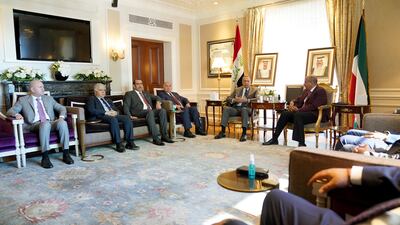
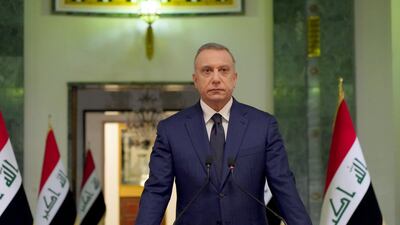
Prime Minister Mustafa Al Kadhimi during an interview with Mina Al-Oraibi, Editor-in-Chief of 'The National', in New York. Photo: Iraq's Prime Minister's Media Office

Elections are our path out of political impasse, Iraqi prime minister says


Mina Al-Oraibi
  • English
  • Arabic

Iraq’s Prime Minister Mustafa Al Kadhimi is facing monumental challenges, not least of which is the need to get the country out of a political deadlock that has left his caretaker government without a budget as it deals with the fallout from armed clashes surrounding the seat of government that occurred only a few weeks ago.

In his first interview since those violent clashes, Mr Al Kadhimi told The National that there was no choice but to pursue dialogue. He said the dialogue he was convening among different political groups was primarily focused on holding new elections, coupled with a new “compact” to ensure all sides respect their results.

In the meantime, his government faces major challenges, with Mr Al Kadhimi saying that “the political forces insist on not giving this government a chance”, including refusing to pass a full budget to enact major projects.

Asked about the solution to the political crisis, Mr Al Kadhimi said one word: “Dialogue”.

He went on to say that there are two options: either “we go towards a clash in a society that has tried all types of violence or an opportunity for dialogue”.

Since taking office more than two years ago, some of the primary concerns for Mr Al Kadhimi have been to limit the role of militias, reinforce security in the country and re-establish an effective state.

But two years in, he is dealing with emboldened militias and complete political gridlock. His critics say he should take a stand against the militias, but that could lead to more bloodshed.

“A thousand years of dialogue is better than one moment of killing,” he said.

He said it was high time to “divorce the violent past and a future built on true democratic values built not just on the ballot box votes”.

But dialogue takes time. Though time is not in Iraq’s favour with all the crises it faces, he said: “What other choice do we have?”

Prime Minister Mustafa Al Kadhimi during an interview with Editor-in-Chief of 'The National' Mina Al-Oraibi in New York. Photo: Iraq's Prime Minister's Media Office

This October marks a year since Iraq held elections but it has since failed to form a new government and the political system has reached a complete impasse.

“Everyone agrees on early elections,” Mr Al Kadhimi said. However, new elections will need a road map.

“New elections need an agreement and building trust between the political elites, with processes that emerge from dialogue,” he continued.

“We need a new social compact that states that when there are elections. We don’t question their results and agree on respecting constitutional deadlines.”

The elections of October 2021 were deemed fair and representative by international observers and the UN, after being held according to a new electoral law that brought independent members of parliament to the legislative body for the first time.

Mr Al Kadhimi had strong words for politicians in his country.

“The political elites are the problem; they believe in the ballot box but don’t believe in the political order, or democratic values. Therefore any new agreement must be about elections with specific conditions and a new social compact that ensures the integrity of the elections and the implementation of their results.”

Despite his efforts, the leading political grouping that emerged from the last elections has withdrawn from the political process.

After his bloc gained 73 seats in the last parliamentary elections but was unable to form a government with his allies, Shiite cleric Moqtada Al Sadr had his MPs resign from parliament and he himself announced his retirement from political life.

However, Mr Al Kadhimi stressed the importance of Mr Al Sadr’s role in political life in Iraq. In response to a question about having Mr Al Sadr re-enter politics, he said: “Iraq has multiple political forces and Mr Al Sadr represents one of these primary forces, and let us be clear that having elections without the Sadrist movement, the elections will have a major deficit and will face a major challenge.”

The “Sadrist movement must be part of any coming elections”, he said.

The Iraqi government announced this week a major rehabilitation project for Sadr City, where many of Mr Al Sadr’s supporters hail from.

Asked if this was part of the efforts to incentivise Mr Al Sadr and his followers to re-enter politics, Mr Al Kadhimi stressed that was not the intention.

“The aim is not to convince one side of the other on political participation, rather as part of a public service, and I have overseen the rehabilitation of several areas in Baghdad,” he said. “The aim is to convince the citizen that the government is capable in delivering.”

Next year, Iraq will mark 20 years since the fall of the regime of Saddam Hussein. Asked about this moment, Mr Al Kadhimi said: “We must reflect on where we made mistakes in the past 20 years, and we must reconcile among ourselves.

“We suffered from the previous regime but when we came to office, we became the victimisers. We should not repeat the mistakes of the past.”

As political leaders forge ahead in their discussions about new elections, the Iraqi public may choose to stay away. Voter turnout has been on the decline, with a little under 40 per cent of citizens participating in the October 2021 elections.

“We will have to convince the Iraqi voter to participate by stressing that the next government will come with full authorities, and that the next government will come to serve the people with news projects and fulfilled promises,” Mr Al Kadhimi said.

“We have to reinstitute the voters’ faith in the political system; the citizen has lost trust in the political system and lost trust in the political blocs.”

The prime minister, who did not participate in the last elections and does not have a political party, emphasised the need to “reconcile with our citizens before we reconcile within the political groups”. He repeated his criticism of most of the political parties in Iraq, saying “they have a mindset fixated on power and status”.

Iraq's Prime Minister Mustafa Al Kadhimi meets leaders in New York - in pictures

  • Iraqi Prime Minister Mustafa Al Kadhimi meets Nato Secretary General Jens Stoltenberg. All photos: Iraqi Prime Minister's Media Office
    Iraqi Prime Minister Mustafa Al Kadhimi meets Nato Secretary General Jens Stoltenberg. All photos: Iraqi Prime Minister's Media Office
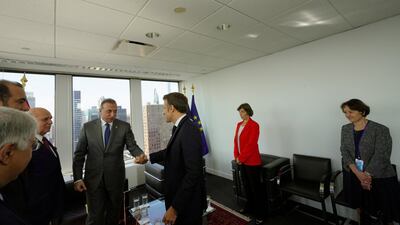
  • Mr Al Kadhimi meets France's President Emmanuel Macron.
    Mr Al Kadhimi meets France's President Emmanuel Macron.
  • Mr Al Kadhimi greets Mr Macron.
    Mr Al Kadhimi greets Mr Macron.
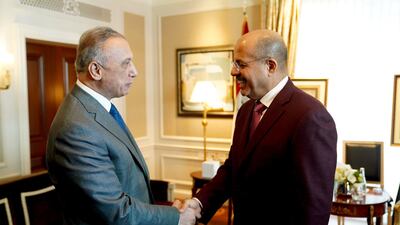
  • Mr Al Kadhimi meets Sheikh Ahmad Nawaf Al Ahmad Al Sabah, Prime Minister of Kuwait.
    Mr Al Kadhimi meets Sheikh Ahmad Nawaf Al Ahmad Al Sabah, Prime Minister of Kuwait.
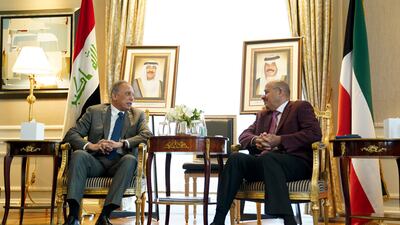
  • Mr Al Kadhimi speaks with Sheikh Ahmad of Kuwait.
    Mr Al Kadhimi speaks with Sheikh Ahmad of Kuwait.
  • Mr Al Kadhimi speaks with Sheikh Ahmad.
    Mr Al Kadhimi speaks with Sheikh Ahmad.
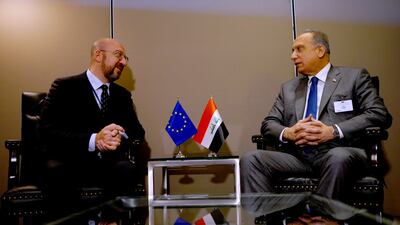
  • Mr Al Kadhimi meets Charles Michel, President of the European Council.
    Mr Al Kadhimi meets Charles Michel, President of the European Council.
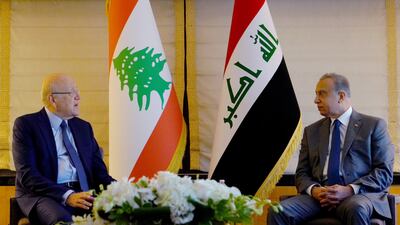
  • Mr Al Kadhimi meets Lebanese Prime Minister Najib Mikati.
    Mr Al Kadhimi meets Lebanese Prime Minister Najib Mikati.
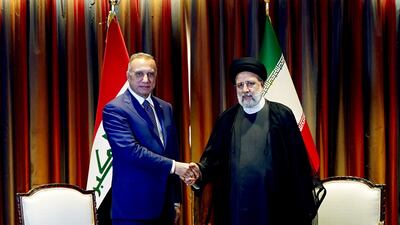
  • Mr Al Kadhimi greets Iran's President Ebrahim Raisi.
    Mr Al Kadhimi greets Iran's President Ebrahim Raisi.
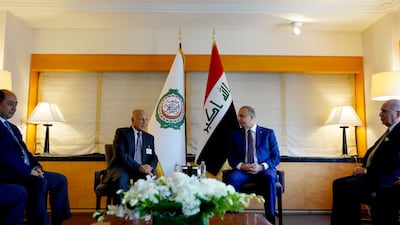
  • Mr Al Kadhimi meets Ahmed Aboul Gheit, Secretary General of the League of Arab States.
    Mr Al Kadhimi meets Ahmed Aboul Gheit, Secretary General of the League of Arab States.
  • Mr Al Kadhimi speaks with Mr Aboul Gheit.
    Mr Al Kadhimi speaks with Mr Aboul Gheit.
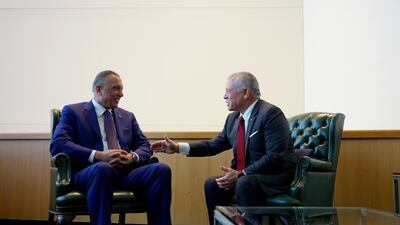
  • Mr Al Kadhimi meets Jordan's King Abdullah II.
    Mr Al Kadhimi meets Jordan's King Abdullah II.
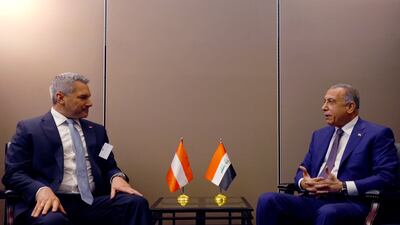
  • Mr Al Kadhimi meets Austrian Chancellor Karl Nehammer.
    Mr Al Kadhimi meets Austrian Chancellor Karl Nehammer.
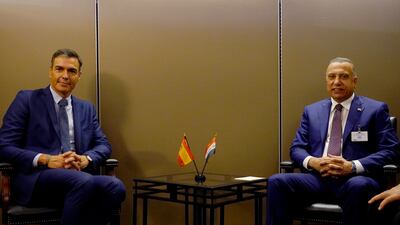
  • Mr Al Kadhimi meets Pedro Sanchez, Prime Minister of Spain.
    Mr Al Kadhimi meets Pedro Sanchez, Prime Minister of Spain.
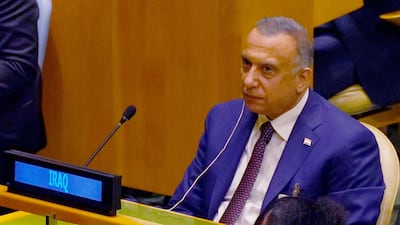
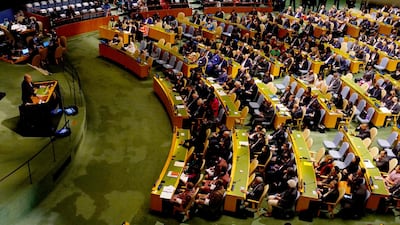
  • Mr Al Kadhimi attends the opening of 77th session of the UN General Assembly in New York.
    Mr Al Kadhimi attends the opening of 77th session of the UN General Assembly in New York.
  • Mr Al Kadhimi attends the UN General Assembly.
    Mr Al Kadhimi attends the UN General Assembly.

In addition to preparing for elections, Mr Al Kadhimi said the current political discussions in Iraq are aimed at dealing with complex files to improve the level of trust between the different sides. One such issue is that of displacement, as some Iraqis are still struggling to return to their homes due to “political roadblocks”.

While the political machinations continue in Baghdad, the spectre of violence is never far.

“We must focus on maintaining arms under the control of the state, and political parties must understand that,” Mr Al Kadhimi said.

“I must confess, we tried to do that for the past 28 months of this government but we did not find receptive political forces and there are those who work at obstructing returning the use of arms under the umbrella of the state.”

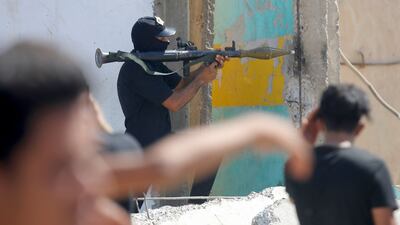
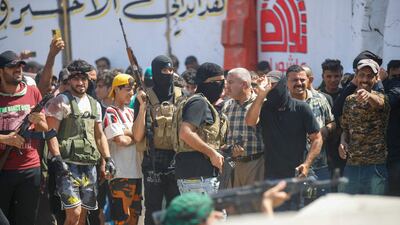
Iraq suffers from the presence of several militia groups who not only refuse to give up their arms, but also have attacked state institutions such as Iraqi army bases.

Mr Kadhimi said that some of these groups “use unrealistic excuses like the presence of an occupation, but we do not have an occupation in Iraq — the presence of foreign forces are based on the request of the Iraqi government”.

“I have tried but the political forces did not help me in achieving that, just like they have obstructed other matters, like that of having a budget; I only have six months' budget at a time,” he said.

Parliament has refused to pass a fully functioning budget, as Mr Al Kadhimi's is a caretaker government since last October’s elections.

“Despite all of this, we have carried out financial reforms, our reserves have gone up from $49 billion to $85bn, in addition to 50 tonnes of gold,” he said.

He stressed the success of his government’s reforms, although these came at a time of historically high oil prices which Iraq, as an oil producer, has benefited from.

“The dependence on oil has reduced from 96 per cent to 80 per cent of our budget,” he said.

With revenue up, particularly from oil, there are increased concerns about corruption and the siphoning off of Iraq’s riches. Iraq is 157th out of 180 countries on Transparency International’s rankings of global corruption.

“Our big challenge is corruption. We have fought corruption and the integrity committee has been accused all sorts of accusations by corrupt mafias working to stop building up this country at any cost,” Mr Al Kadhimi said.

While critics say little has been done to tackle corruption, Mr Al Kadhimi said: “We achieved a lot but there are vested interests that worked to stop the integrity committee.”

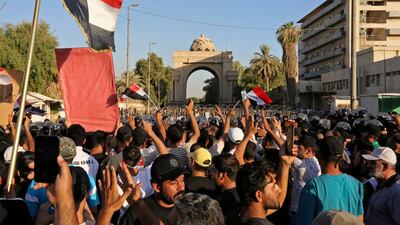
Sadr protests in Baghdad — in pictures

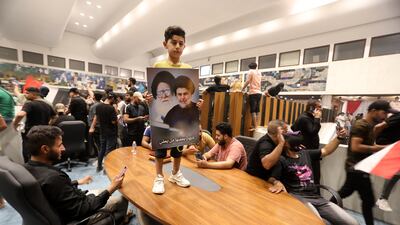
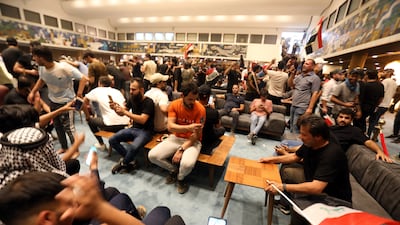
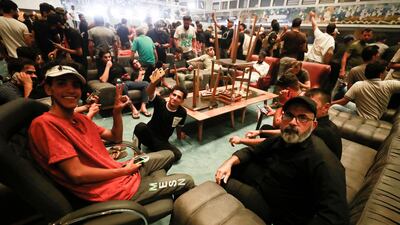
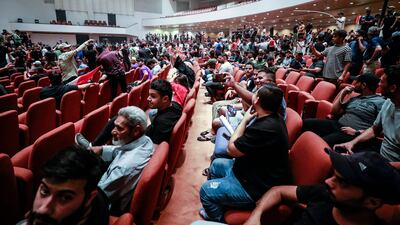
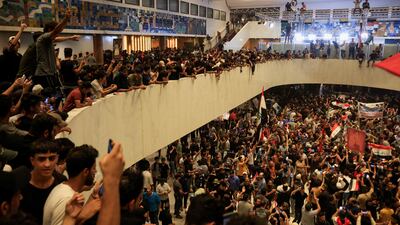
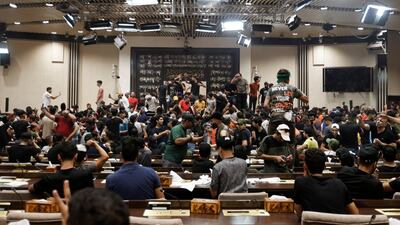
  • Supporters of Iraqi Shiite cleric Moqtada Al Sadr, head of the Sadrist movement, gather inside Iraq's Parliament buliding. EPA
    Supporters of Iraqi Shiite cleric Moqtada Al Sadr, head of the Sadrist movement, gather inside Iraq's Parliament buliding. EPA
  • The cleric's followers enter the Parliament building in a show of force. EPA
    The cleric's followers enter the Parliament building in a show of force. EPA
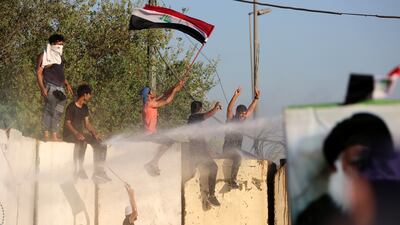
  • Anti-riot policemen use water cannons in a bid to disperse supporters of Mr Al Sadr. EPA
    Anti-riot policemen use water cannons in a bid to disperse supporters of Mr Al Sadr. EPA
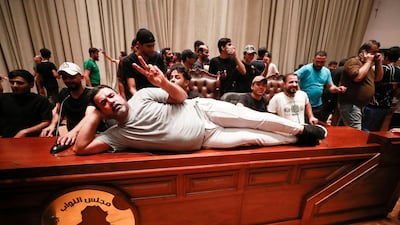
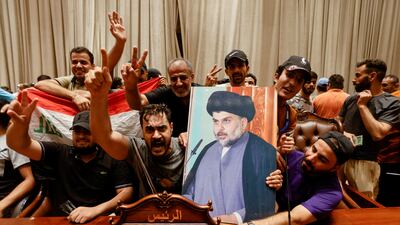
  • A demonstrator lies on the desk of the Speaker of the Iraqi parliament. AFP
    A demonstrator lies on the desk of the Speaker of the Iraqi parliament. AFP
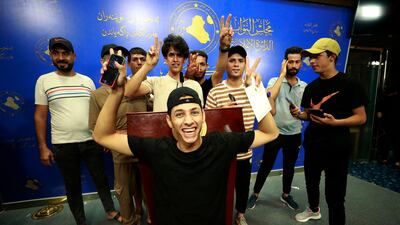
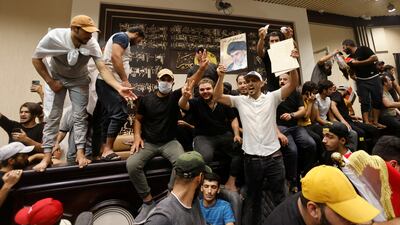
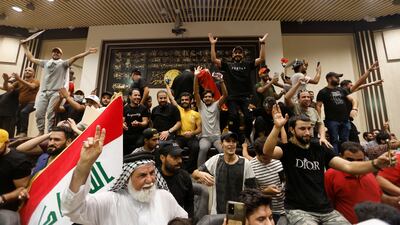
  • Supporters of Mr Al Sadr flash the victory sign as they gather inside the Iraqi Parliament. AFP
    Supporters of Mr Al Sadr flash the victory sign as they gather inside the Iraqi Parliament. AFP
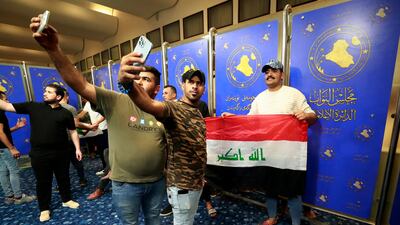
  • There's always time for a selfie. AFP
    There's always time for a selfie. AFP
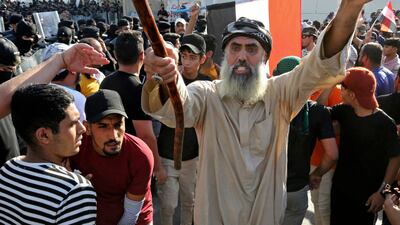
  • The demonstrators are protesting the recent selection of Mohammed Al Sudani as the official nominee of the Co-ordination Framework bloc. AFP
    The demonstrators are protesting the recent selection of Mohammed Al Sudani as the official nominee of the Co-ordination Framework bloc. AFP
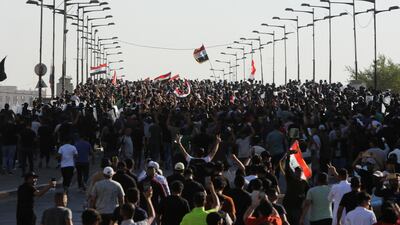
  • It is the largest protest since federal elections were held in October. AFP
    It is the largest protest since federal elections were held in October. AFP
  • The protesters sit in the building, in Baghdad's high-security Green Zone. AFP
    The protesters sit in the building, in Baghdad's high-security Green Zone. AFP
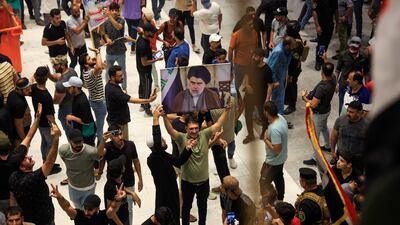
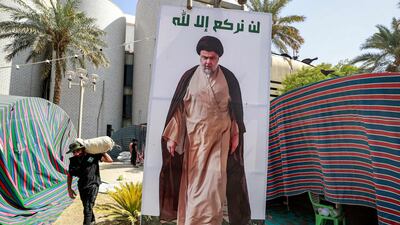
  • A person holds a portrait of Mr Al Sadr. Reuters
    A person holds a portrait of Mr Al Sadr. Reuters
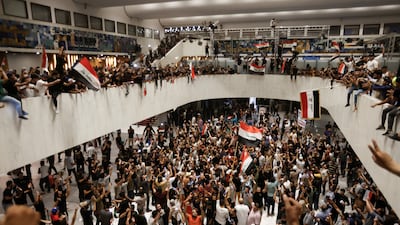
  • Protesters raise flags and a portrait of Mr Al Sadr. Reuters
    Protesters raise flags and a portrait of Mr Al Sadr. Reuters
  • Al Sadr posted a statement on Twitter telling supporters their message had been received. Reuters
    Al Sadr posted a statement on Twitter telling supporters their message had been received. Reuters
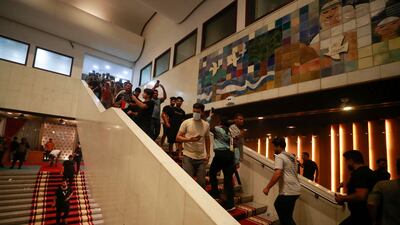
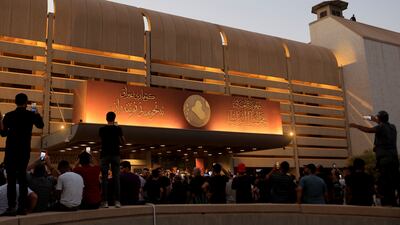
  • People stand outside of the Parliament building during the protest. Reuters
    People stand outside of the Parliament building during the protest. Reuters
  • Supporters of Iraqi Shiite cleric Moqtada Al Sadr protest against corruption inside the Parliament building in Baghdad, Iraq. Reuters
    Supporters of Iraqi Shiite cleric Moqtada Al Sadr protest against corruption inside the Parliament building in Baghdad, Iraq. Reuters
  • Mr Al Sadr's supporters protest against corruption inside the Parliament building in Baghdad. Reuters
    Mr Al Sadr's supporters protest against corruption inside the Parliament building in Baghdad. Reuters
  • Demonstrators protest inside the Parliament building. Reuters
    Demonstrators protest inside the Parliament building. Reuters
  • Protesters demonstrate inside the Parliament building. Reuters
    Protesters demonstrate inside the Parliament building. Reuters
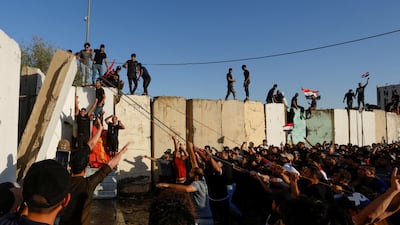
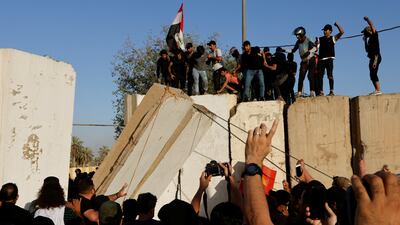
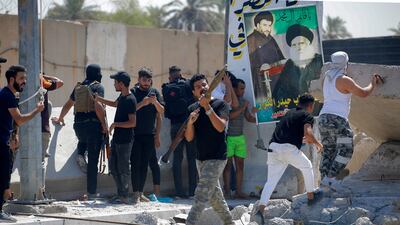
  • Protesters pull down a wall with chains and ropes during a protest against corruption. Reuters
    Protesters pull down a wall with chains and ropes during a protest against corruption. Reuters
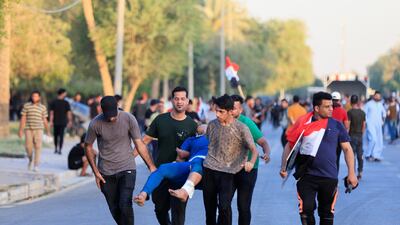
  • Supporters of Mr Al Sadr carry a person during a protest against corruption in the Green Zone in Baghdad. Reuters
    Supporters of Mr Al Sadr carry a person during a protest against corruption in the Green Zone in Baghdad. Reuters
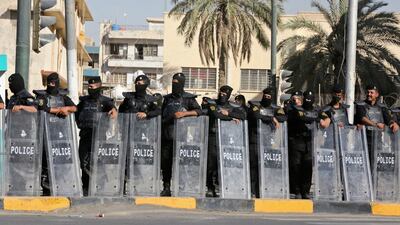
  • Iraqi security forces stand outside the main gate of Baghdad's Green Zone as demonstrators protest against the nomination of Mohammed Shia Al Sudani as prime minister. AFP
    Iraqi security forces stand outside the main gate of Baghdad's Green Zone as demonstrators protest against the nomination of Mohammed Shia Al Sudani as prime minister. AFP
  • Mr Al Sadr's supporters gather outside the main gate of Baghdad's Green Zone. AFP
    Mr Al Sadr's supporters gather outside the main gate of Baghdad's Green Zone. AFP
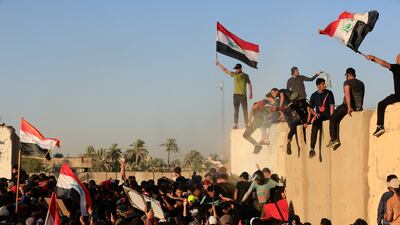
  • Supporters of Mr Al Sadr protest against corruption in Baghdad. Reuters
    Supporters of Mr Al Sadr protest against corruption in Baghdad. Reuters
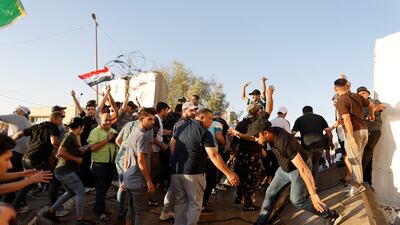
  • Protesters break down barricades in Baghdad. Reuters
    Protesters break down barricades in Baghdad. Reuters
  • Supporters of Mr Al Sadr demonstrate in Baghdad. Reuters
    Supporters of Mr Al Sadr demonstrate in Baghdad. Reuters
  • Iraqi security forces prepare to meet the demonstrators in Baghdad's Tahrir Square. AFP
    Iraqi security forces prepare to meet the demonstrators in Baghdad's Tahrir Square. AFP
  • Supporters of Mr Al Sadr gather in Baghdad's Tahrir Square to protest against the nomination of Mohammed Shia Al Sudani as prime minister. AFP
    Supporters of Mr Al Sadr gather in Baghdad's Tahrir Square to protest against the nomination of Mohammed Shia Al Sudani as prime minister. AFP
  • Protesters demonstrate in Baghdad. AFP
    Protesters demonstrate in Baghdad. AFP
  • Mr Al Sadr's supporters walk across a bridge to the Green Zone during a protest against corruption in Baghdad. Reuters
    Mr Al Sadr's supporters walk across a bridge to the Green Zone during a protest against corruption in Baghdad. Reuters

Another challenge is that of the disappeared in Iraq, some of whom were taken under the pretext of “fighting terrorism” at the height of sectarian tension several years ago, and others who were kidnapped during the protests of October 2019.

“Investigations are ongoing regarding the disappeared … we have been able to find those who took protesters [of October 2019] and last week we arrested a man who worked in one of the government entities and who played a large role in the kidnapping and assassination of protesters,” Mr Al Kadhimi said.

He also said that one of the men responsible for killing analyst Hisham Al Hashimi in the summer of 2020 has been arrested.

As for those who have been kidnapped, particularly from Sunni-majority provinces, Mr Al Kadhimi did not have clear numbers of how many there are.

“This matter has to do with some political parties who are part of the political process … some use this issue for corruption and political aims,” he said.

While refraining from going into detail, Mr Al Kadhimi made clear that there are political forces behind the disappearances of ordinary Iraqi citizens and that it is a matter his government is working to resolve.

Another challenge facing Iraq is that of climate change, which Mr Al Kadhimi sees as a major threat. Iraq’s continued flaring of gas hurts the environment and costs Iraq heavily as it has to import gas from Iran.

Responding to a question on the illogical approach to burning gas, Mr Al Kadhimi said: “This is part of irresponsible policies from past governments.

“My government is serious in dealing with this issue and we have a series of projects for gas capture.”

Mr Al Kadhimi made his anger about this issue clear.

“It is regrettable that Iraq planned on electricity plants running on gas, while burning its own gas and having to import gas which is sometimes used for political pressure or wasting Iraqi money,” he said.

“We need time, we have signed an important contract with Total for carbon capture, we also need to use renewable energy and adopt modern solutions.

“This is an important issue especially as Iraq is one of the world’s most impacted countries from climate change.”

Mustafa Al Kadhimi tours streets of Sadr City — in pictures

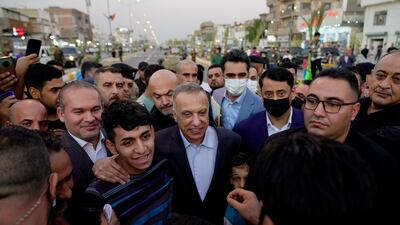
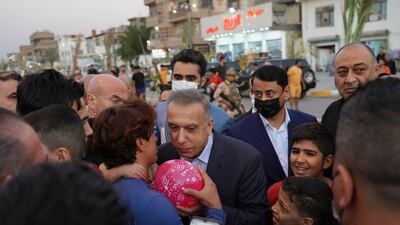
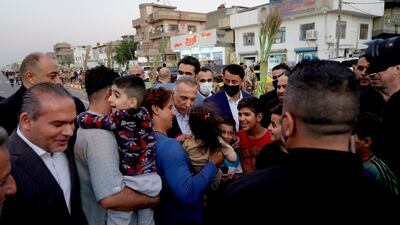
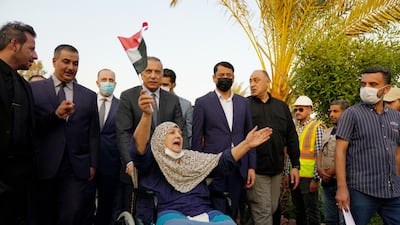
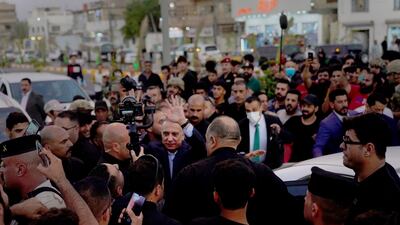
  • Mustafa Al Kadhimi, Iraqi Prime Minister, tours the streets of Sadr City, Baghdad, on foot. All photos: @MAKadhimi Twitter
    Mustafa Al Kadhimi, Iraqi Prime Minister, tours the streets of Sadr City, Baghdad, on foot. All photos: @MAKadhimi Twitter
  • Mr Al Kadhimi met citizens who congratulated him on surviving an assassination attempt.
    Mr Al Kadhimi met citizens who congratulated him on surviving an assassination attempt.
  • The drone attack took place at his home in the Iraqi capital on Sunday.
    The drone attack took place at his home in the Iraqi capital on Sunday.
  • The failed assassination attempt increased tensions after last month’s parliamentary elections, in which Iran-backed militias were the biggest losers.
    The failed assassination attempt increased tensions after last month’s parliamentary elections, in which Iran-backed militias were the biggest losers.
  • Sadr City is a stronghold of influential Shiite cleric Moqtada Al Sadr, whose nationalist movement won the largest number of seats in Parliament, 73 out of 329.
    Sadr City is a stronghold of influential Shiite cleric Moqtada Al Sadr, whose nationalist movement won the largest number of seats in Parliament, 73 out of 329.
  • Mr Al Kadhimi waves during his walkabout.
    Mr Al Kadhimi waves during his walkabout.

Iraq is also working on an electric grid project with neighbouring Arab countries, however some of these projects have been delayed.

“Let me be frank: there are those who are working to obstruct the government’s openness to our brothers in Arab countries; some are calling Gulf investments in Iraq Gulf imperialism,” he said.

However, Mr Al Kadhimi said these projects are vital.

“We are going to launch the power grid interconnection with Jordan within days, while our interconnection with Saudi Arabia is coming up, and the wider Iraq-GCC energy link will see Iraq becoming a transit point for Gulf energy supplies to Europe, within the next two years,” he said.

“This is part of ensuring close ties between Iraq and the Gulf states and maintaining the spirit of these ties.”

There are concerns that the closeness of these ties will be affected if a new government were to reject closer ties to Arab states.

“The loser here would be the Iraqi people … we should invest in the openness of the Arab Gulf countries to investing in Iraq and the opportunities for mutual benefit,” he said.

Speaking exclusively to The National in New York before he addressed the UN General Assembly, Mr Al Kadhimi stressed the importance of maintaining open relations with all sides.

His message to the international community was that “despite the political challenges, Iraq still represents an opportunity for the stability for the region and beyond”.

Mr Al Kadhimi has been integral to establishing strong diplomatic ties in the region and globally and oversaw the Baghdad Conference, which witnessed regional leaders and French President Emmanuel Macron meeting in August 2021. Another Baghdad conference will be held in Jordan soon, he said, and Iraq will continue in its diplomatic efforts.

The Iraqi prime minister met Iranian President Ebrahim Raisi in New York and attended a number of high-level bilateral meetings, including with Mr Macron and Nato Secretary General Jens Stoltenberg.

When asked about Iraq’s relations with Iran, and the call of many Iraqi protesters for a limit on Iran’s influence and interference in the country, Mr Al Kadhimi responded diplomatically.

“Our relations with Iran must be built based on interests. Iraq has its own specific identity and the Iranians should understand that,” he said.

“Iraq has Arab and Muslim depths and we have to find a balance respecting our interests and non-interference in Iraq’s internal matters.”

Baghdad latest — in pictures

  • Iraqi Prime Minister Mustafa Al Kadhimi has threatened to resign if the political stand-off in the country is not resolved. Photo: Iraqi Prime Minister's Media Office
    Iraqi Prime Minister Mustafa Al Kadhimi has threatened to resign if the political stand-off in the country is not resolved. Photo: Iraqi Prime Minister's Media Office
  • An aerial view of Yafa Street in Baghdad after Shiite cleric Moqtada Al Sadr called on his supporters to withdraw from the Iraqi capital's heavily fortified Green Zone. AP
    An aerial view of Yafa Street in Baghdad after Shiite cleric Moqtada Al Sadr called on his supporters to withdraw from the Iraqi capital's heavily fortified Green Zone. AP
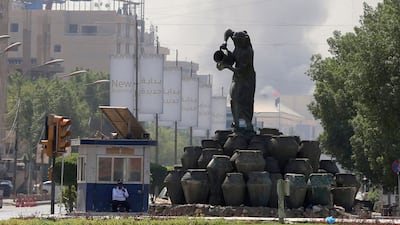
  • Plumes of smoke rise after small fires were lit near the Tomb of the Unknown Soldier and Parliament in Baghdad. AP
    Plumes of smoke rise after small fires were lit near the Tomb of the Unknown Soldier and Parliament in Baghdad. AP
  • Mr Al Sadr's followers heed his call to withdraw from the Green Zone after violent clashes in Baghdad. Reuters
    Mr Al Sadr's followers heed his call to withdraw from the Green Zone after violent clashes in Baghdad. Reuters
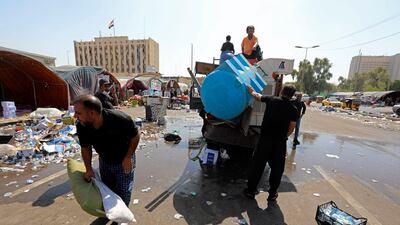
  • A supporter of Mr Al Sadr helps to dismantle the encampment in Baghdad's high-security Green Zone. AFP
    A supporter of Mr Al Sadr helps to dismantle the encampment in Baghdad's high-security Green Zone. AFP
  • Supporters of Mr Al Sadr pack up belongings as they prepare to leave the Green Zone. AP
    Supporters of Mr Al Sadr pack up belongings as they prepare to leave the Green Zone. AP
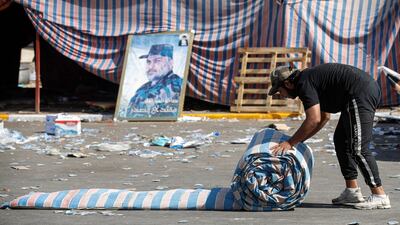
  • A supporter of Mr Al Sadr rolls up a mattress as their encampment in the Green Zone is dismantled. AFP
    A supporter of Mr Al Sadr rolls up a mattress as their encampment in the Green Zone is dismantled. AFP
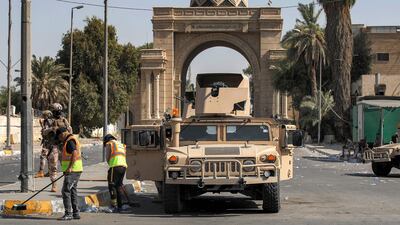
  • Municipality workers clean up while Iraqi army soldiers guard the entrance to the Green Zone. AFP
    Municipality workers clean up while Iraqi army soldiers guard the entrance to the Green Zone. AFP
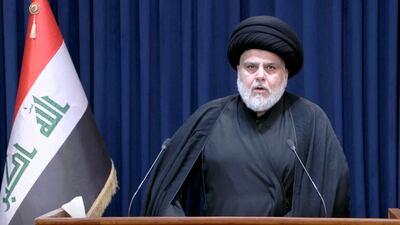
  • Mr Al Sadr addresses a news conference in Najaf, Iraq. Reuters
    Mr Al Sadr addresses a news conference in Najaf, Iraq. Reuters
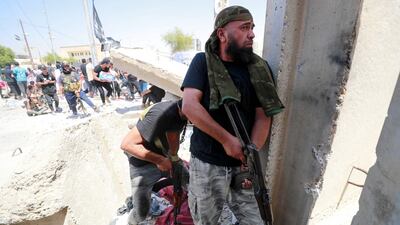
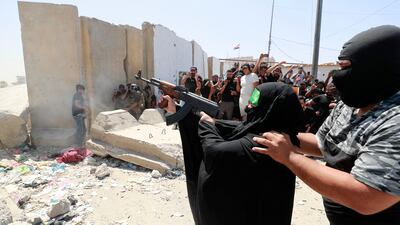
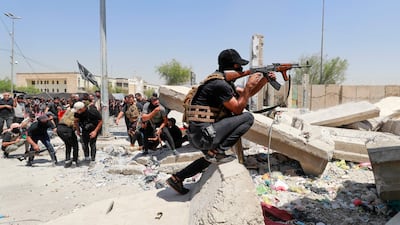
  • Iraqi Shiite gunmen clash with government forces in the Green Zone of central Baghdad. EPA
    Iraqi Shiite gunmen clash with government forces in the Green Zone of central Baghdad. EPA
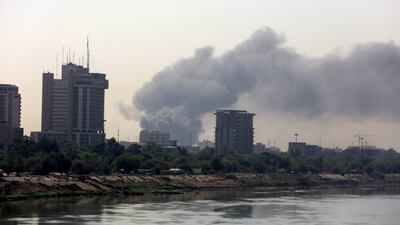
  • Smoke rises from a building in Baghdad. EPA
    Smoke rises from a building in Baghdad. EPA
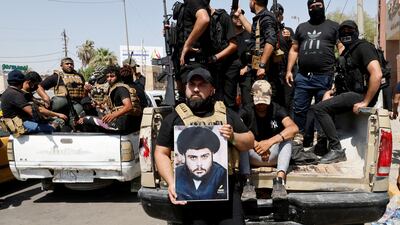
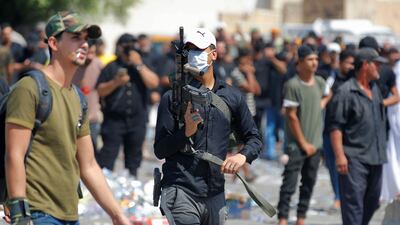
  • Armed members of Saraya Al Salam, the military wing affiliated with Shiite cleric Moqtada Al Sadr. AFP
    Armed members of Saraya Al Salam, the military wing affiliated with Shiite cleric Moqtada Al Sadr. AFP
  • An armed member of Saraya Al Salam. AFP
    An armed member of Saraya Al Salam. AFP
  • A member of Saraya Al Salam takes aim. AFP
    A member of Saraya Al Salam takes aim. AFP
  • Armed members of the Peace Brigades militia in Baghdad's Green Zone. AFP
    Armed members of the Peace Brigades militia in Baghdad's Green Zone. AFP
  • They are affiliated with Shiite cleric Moqtada Al Sadr. AFP
    They are affiliated with Shiite cleric Moqtada Al Sadr. AFP
  • Peace Brigades members clash with security forces in the Iraqi capital. AFP
    Peace Brigades members clash with security forces in the Iraqi capital. AFP
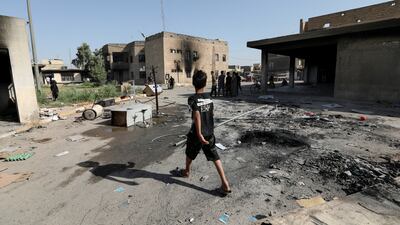
  • The office of rival Shiite party the Badr Organisation, which was burnt by Sadrists. Reuters
    The office of rival Shiite party the Badr Organisation, which was burnt by Sadrists. Reuters
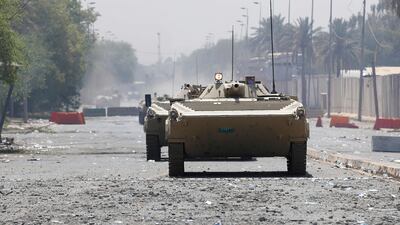
  • Iraqi security armoured vehicles during clashes with the Peace Brigades in the Green Zone. AFP
    Iraqi security armoured vehicles during clashes with the Peace Brigades in the Green Zone. AFP
  • Peace Brigades members carry weapons in the fortified zone. AFP
    Peace Brigades members carry weapons in the fortified zone. AFP
  • Smoke over Baghdad during an army-imposed curfew, a day after 23 Al Sadr supporters were shot dead. AFP
    Smoke over Baghdad during an army-imposed curfew, a day after 23 Al Sadr supporters were shot dead. AFP
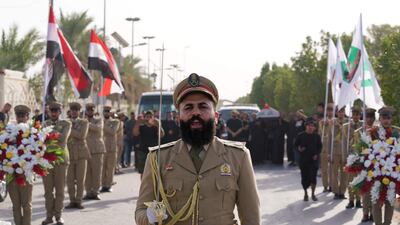
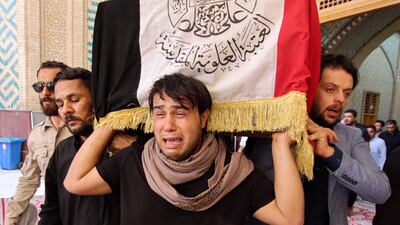
  • A Peace Brigades member leads a mass funeral in Najaf for Al Sadr supporters killed in the clashes in Baghdad's Green Zone. AFP
    A Peace Brigades member leads a mass funeral in Najaf for Al Sadr supporters killed in the clashes in Baghdad's Green Zone. AFP
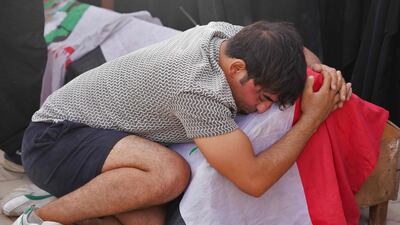
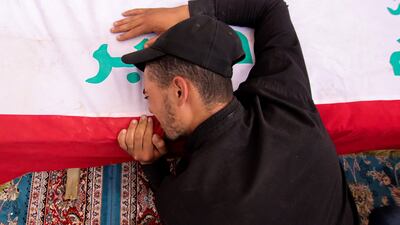
  • Tears during the mass funeral. AFP
    Tears during the mass funeral. AFP
  • Mourners pray in front of the coffins of Al Sadr supporters. Reuters
    Mourners pray in front of the coffins of Al Sadr supporters. Reuters
  • A coffin is carried at the funeral. AFP
    A coffin is carried at the funeral. AFP
  • The ceremony took place at a cemetery in Najaf, central Iraq. AFP
    The ceremony took place at a cemetery in Najaf, central Iraq. AFP
Indoor cricket in a nutshell

Indoor cricket in a nutshell
Indoor Cricket World Cup - Sept 16-20, Insportz, Dubai

16 Indoor cricket matches are 16 overs per side
8 There are eight players per team
9 There have been nine Indoor Cricket World Cups for men. Australia have won every one.
5 Five runs are deducted from the score when a wickets falls
4 Batsmen bat in pairs, facing four overs per partnership

Scoring In indoor cricket, runs are scored by way of both physical and bonus runs. Physical runs are scored by both batsmen completing a run from one crease to the other. Bonus runs are scored when the ball hits a net in different zones, but only when at least one physical run is score.

Zones

A Front net, behind the striker and wicketkeeper: 0 runs
B Side nets, between the striker and halfway down the pitch: 1 run
C Side nets between halfway and the bowlers end: 2 runs
D Back net: 4 runs on the bounce, 6 runs on the full

How Islam's view of posthumous transplant surgery changed

Transplants from the deceased have been carried out in hospitals across the globe for decades, but in some countries in the Middle East, including the UAE, the practise was banned until relatively recently.

Opinion has been divided as to whether organ donations from a deceased person is permissible in Islam.

The body is viewed as sacred, during and after death, thus prohibiting cremation and tattoos.

One school of thought viewed the removal of organs after death as equally impermissible.

That view has largely changed, and among scholars and indeed many in society, to be seen as permissible to save another life.

How does ToTok work?

The calling app is available to download on Google Play and Apple App Store

To successfully install ToTok, users are asked to enter their phone number and then create a nickname.

The app then gives users the option add their existing phone contacts, allowing them to immediately contact people also using the application by video or voice call or via message.

Users can also invite other contacts to download ToTok to allow them to make contact through the app.


World ranking (at month’s end)
Jan - 257
Feb - 198
Mar - 159
Apr - 161
May - 159
Jun – 162
Currently: 88

Year-end rank since turning pro
2016 - 279
2015 - 185
2014 - 143
2013 - 63
2012 - 384
2011 - 883

CHELSEA'S NEXT FIVE GAMES

Mar 10: Norwich(A)

Mar 13: Newcastle(H)

Mar 16: Lille(A)

Mar 19: Middlesbrough(A)

Apr 2: Brentford(H)

MATCH INFO

Rugby World Cup (all times UAE)

Final: England v South Africa, Saturday, 1pm

Quick facts on cancer
  • Cancer is the second-leading cause of death worldwide, after cardiovascular diseases 
  •  About one in five men and one in six women will develop cancer in their lifetime 
  • By 2040, global cancer cases are on track to reach 30 million 
  • 70 per cent of cancer deaths occur in low and middle-income countries 
  • This rate is expected to increase to 75 per cent by 2030 
  • At least one third of common cancers are preventable 
  • Genetic mutations play a role in 5 per cent to 10 per cent of cancers 
  • Up to 3.7 million lives could be saved annually by implementing the right health
    strategies 
  • The total annual economic cost of cancer is $1.16 trillion


UAE currency: the story behind the money in your pockets
Zakat definitions

Zakat: an Arabic word meaning ‘to cleanse’ or ‘purification’.

Nisab: the minimum amount that a Muslim must have before being obliged to pay zakat. Traditionally, the nisab threshold was 87.48 grams of gold, or 612.36 grams of silver. The monetary value of the nisab therefore varies by current prices and currencies.

Zakat Al Mal: the ‘cleansing’ of wealth, as one of the five pillars of Islam; a spiritual duty for all Muslims meeting the ‘nisab’ wealth criteria in a lunar year, to pay 2.5 per cent of their wealth in alms to the deserving and needy.

Zakat Al Fitr: a donation to charity given during Ramadan, before Eid Al Fitr, in the form of food. Every adult Muslim who possesses food in excess of the needs of themselves and their family must pay two qadahs (an old measure just over 2 kilograms) of flour, wheat, barley or rice from each person in a household, as a minimum.

Engine: 5.6-litre V8

Transmission: seven-speed automatic

Power: 400hp

Torque: 560Nm

Price: Dh234,000 - Dh329,000

On sale: now

Ain Dubai in numbers

126: The length in metres of the legs supporting the structure

1 football pitch: The length of each permanent spoke is longer than a professional soccer pitch

16 A380 Airbuses: The equivalent weight of the wheel rim.

9,000 tonnes: The amount of steel used to construct the project.

5 tonnes: The weight of each permanent spoke that is holding the wheel rim in place

192: The amount of cable wires used to create the wheel. They measure a distance of 2,4000km in total, the equivalent of the distance between Dubai and Cairo.

European arms

Known EU weapons transfers to Ukraine since the war began: Germany 1,000 anti-tank weapons and 500 Stinger surface-to-air missiles. Luxembourg 100 NLAW anti-tank weapons, jeeps and 15 military tents as well as air transport capacity. Belgium 2,000 machine guns, 3,800 tons of fuel. Netherlands 200 Stinger missiles. Poland 100 mortars, 8 drones, Javelin anti-tank weapons, Grot assault rifles, munitions. Slovakia 12,000 pieces of artillery ammunition, 10 million litres of fuel, 2.4 million litres of aviation fuel and 2 Bozena de-mining systems. Estonia Javelin anti-tank weapons.  Latvia Stinger surface to air missiles. Czech Republic machine guns, assault rifles, other light weapons and ammunition worth $8.57 million.

If you go

The flights
Emirates and Etihad fly direct to Nairobi, with fares starting from Dh1,695. The resort can be reached from Nairobi via a 35-minute flight from Wilson Airport or Jomo Kenyatta International Airport, or by road, which takes at least three hours.

The rooms
Rooms at Fairmont Mount Kenya range from Dh1,870 per night for a deluxe room to Dh11,000 per night for the William Holden Cottage.

New process leads to panic among jobseekers

As a UAE-based travel agent who processes tourist visas from the Philippines, Jennifer Pacia Gado is fielding a lot of calls from concerned travellers just now. And they are all asking the same question.  

“My clients are mostly Filipinos, and they [all want to know] about good conduct certificates,” says the 34-year-old Filipina, who has lived in the UAE for five years.

Ms Gado contacted the Philippines Embassy to get more information on the certificate so she can share it with her clients. She says many are worried about the process and associated costs – which could be as high as Dh500 to obtain and attest a good conduct certificate from the Philippines for jobseekers already living in the UAE. 

“They are worried about this because when they arrive here without the NBI [National Bureau of Investigation] clearance, it is a hassle because it takes time,” she says.

“They need to go first to the embassy to apply for the application of the NBI clearance. After that they have go to the police station [in the UAE] for the fingerprints. And then they will apply for the special power of attorney so that someone can finish the process in the Philippines. So it is a long process and more expensive if you are doing it from here.”

The five new places of worship

Church of South Indian Parish

St Andrew's Church Mussaffah branch

St Andrew's Church Al Ain branch

St John's Baptist Church, Ruwais

Church of the Virgin Mary and St Paul the Apostle, Ruwais


When Umm Kulthum performed in Abu Dhabi


Known as The Lady of Arabic Song, Umm Kulthum performed in Abu Dhabi on November 28, 1971, as part of celebrations for the fifth anniversary of the accession of Sheikh Zayed bin Sultan Al Nahyan as Ruler of Abu Dhabi. A concert hall was constructed for the event on land that is now Al Nahyan Stadium, behind Al Wahda Mall. The audience were treated to many of Kulthum's most well-known songs as part of the sold-out show, including Aghadan Alqak and Enta Omri.

 
Profile of Hala Insurance

Date Started: September 2018

Founders: Walid and Karim Dib

Based: Abu Dhabi

Employees: Nine

Amount raised: $1.2 million

Funders: Oman Technology Fund, AB Accelerator, 500 Startups, private backers


Infiniti QX80 specs

Engine: twin-turbocharged 3.5-liter V6

Power: 450hp

Torque: 700Nm

Price: From Dh450,000, Autograph model from Dh510,000

Available: Now

The specs

Engine: 4.0-litre V8 twin-turbocharged and three electric motors

Power: Combined output 920hp

Torque: 730Nm at 4,000-7,000rpm

Transmission: 8-speed dual-clutch automatic

Fuel consumption: 11.2L/100km

On sale: Now, deliveries expected later in 2025

Price: expected to start at Dh1,432,000

Mercer, the investment consulting arm of US services company Marsh & McLennan, expects its wealth division to at least double its assets under management (AUM) in the Middle East as wealth in the region continues to grow despite economic headwinds, a company official said.

Mercer Wealth, which globally has $160 billion in AUM, plans to boost its AUM in the region to $2-$3bn in the next 2-3 years from the present $1bn, said Yasir AbuShaban, a Dubai-based principal with Mercer Wealth.

Within the next two to three years, we are looking at reaching $2 to $3 billion as a conservative estimate and we do see an opportunity to do so,” said Mr AbuShaban.

Mercer does not directly make investments, but allocates clients’ money they have discretion to, to professional asset managers. They also provide advice to clients.

“We have buying power. We can negotiate on their (client’s) behalf with asset managers to provide them lower fees than they otherwise would have to get on their own,” he added.

Mercer Wealth’s clients include sovereign wealth funds, family offices, and insurance companies among others.

From its office in Dubai, Mercer also looks after Africa, India and Turkey, where they also see opportunity for growth.

Wealth creation in Middle East and Africa (MEA) grew 8.5 per cent to $8.1 trillion last year from $7.5tn in 2015, higher than last year’s global average of 6 per cent and the second-highest growth in a region after Asia-Pacific which grew 9.9 per cent, according to consultancy Boston Consulting Group (BCG). In the region, where wealth grew just 1.9 per cent in 2015 compared with 2014, a pickup in oil prices has helped in wealth generation.

BCG is forecasting MEA wealth will rise to $12tn by 2021, growing at an annual average of 8 per cent.

Drivers of wealth generation in the region will be split evenly between new wealth creation and growth of performance of existing assets, according to BCG.

Another general trend in the region is clients’ looking for a comprehensive approach to investing, according to Mr AbuShaban.

“Institutional investors or some of the families are seeing a slowdown in the available capital they have to invest and in that sense they are looking at optimizing the way they manage their portfolios and making sure they are not investing haphazardly and different parts of their investment are working together,” said Mr AbuShaban.

Some clients also have a higher appetite for risk, given the low interest-rate environment that does not provide enough yield for some institutional investors. These clients are keen to invest in illiquid assets, such as private equity and infrastructure.

“What we have seen is a desire for higher returns in what has been a low-return environment specifically in various fixed income or bonds,” he said.

“In this environment, we have seen a de facto increase in the risk that clients are taking in things like illiquid investments, private equity investments, infrastructure and private debt, those kind of investments were higher illiquidity results in incrementally higher returns.”

The Abu Dhabi Investment Authority, one of the largest sovereign wealth funds, said in its 2016 report that has gradually increased its exposure in direct private equity and private credit transactions, mainly in Asian markets and especially in China and India. The authority’s private equity department focused on structured equities owing to “their defensive characteristics.”

Company%20Profile
%3Cp%3E%3Cstrong%3ECompany%20name%3A%3C%2Fstrong%3E%20myZoi%3Cbr%3E%3Cstrong%3EStarted%3A%3C%2Fstrong%3E%202021%3Cbr%3E%3Cstrong%3EFounders%3A%3C%2Fstrong%3E%20Syed%20Ali%2C%20Christian%20Buchholz%2C%20Shanawaz%20Rouf%2C%20Arsalan%20Siddiqui%2C%20Nabid%20Hassan%3Cbr%3E%3Cstrong%3EBased%3A%3C%2Fstrong%3E%20UAE%3Cbr%3E%3Cstrong%3ENumber%20of%20staff%3A%3C%2Fstrong%3E%2037%3Cbr%3E%3Cstrong%3EInvestment%3A%3C%2Fstrong%3E%20Initial%20undisclosed%20funding%20from%20SC%20Ventures%3B%20second%20round%20of%20funding%20totalling%20%2414%20million%20from%20a%20consortium%20of%20SBI%2C%20a%20Japanese%20VC%20firm%2C%20and%20SC%20Venture%3C%2Fp%3E%0A
Updated: September 23, 2022, 4:52 AM