Iraqi schoolboys walk past damaged houses on their way to school in Mosul. AFP

Iraq faces vital services crisis without budget as political rivals bicker


  • English
  • Arabic

The Iraqi government's ability to manage urgent needs, including vital services such as electricity, water and school construction, will be paralysed by a Supreme Court ruling that prohibits the caretaker government from spending money, officials said on Monday.

The decision issued by the Federal Supreme Court on Sunday stated that Prime Minister Mustafa Al Kadhimi’s caretaker government has no authority to present bills to Parliament or sign any commercial agreements.

Iraqi Finance Minister Ali Allawi said he respects the decision, but warned of tough days ahead.

“It will have consequences on the work of the Finance Ministry,” Mr Allawi said, as it will “limit our abilities” to mitigate the impact of rising commodity prices, meet electricity sector needs before summer, cover oil production expenses and boost agriculture.

Critics of Mr Al Kadhimi say that is exactly the point and that, as a caretaker body, his government should have limited power.

With this year’s budget shelved amid political deadlock over forming a new government, monthly spending is limited to one twelfth of the 2021 budget.

Last year's budget was 130 trillion Iraqi dinars ($89.65 billion), with an estimated deficit of 28.7tn dinars.

To meet mounting needs, the government sent a draft to Parliament of the Emergency Law for Food Security and Development.

The latest version of the bill calls for 27tn Iraqi dinars (about $18.5bn), said Mustafa Sanad, who sits in Parliament’s Financial Committee.

The lion’s share, 8tn Iraqi dinars (about $5.5bn), has been allocated to the Ministry of Trade to buy wheat from local farmers and international suppliers and to keep the government-run food ration programme going, Mr Sanad said.

It also sets aside 10tn Iraqi dinars (about $6.85bn) for development projects across the country as well as 3tn dinars (about $2.05bn) for the Electricity Ministry to buy gas from Iran to keep power generation running, he added.

Electricity crisis looms

Iraq currently produces about 21 gigawatts of electricity, but summer demand spikes to at least 27 gigawatts — by some estimates even more.

At the same time, Iraq's electricity grid remains in a state of disrepair, meaning that generated power suffers high losses before reaching communities.

Iraq has planned to increase investment in upgrading the national grid and Mr Al Kadhimi's government has touted plans to increase solar power generation to 30 per cent of production by 2030.

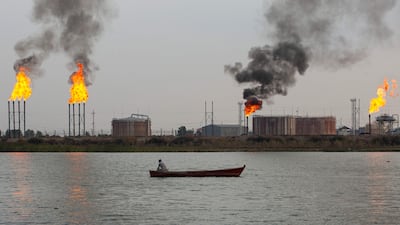
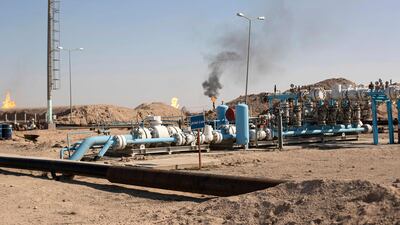
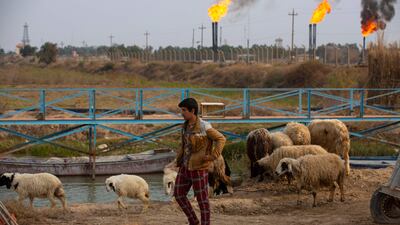
  • Flare stacks above Umm Qasr port near Iraq's southern city of Basra. In the oilfields of southern Iraq, billions of cubic feet of gas literally go up in smoke, burnt off on flare stacks for want of the infrastructure to capture and process it. All photos: AFP
    Flare stacks above Umm Qasr port near Iraq's southern city of Basra. In the oilfields of southern Iraq, billions of cubic feet of gas literally go up in smoke, burnt off on flare stacks for want of the infrastructure to capture and process it. All photos: AFP
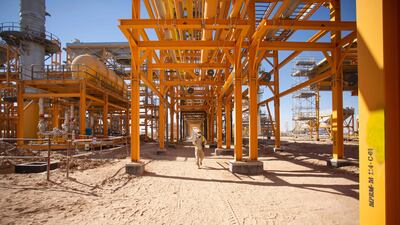
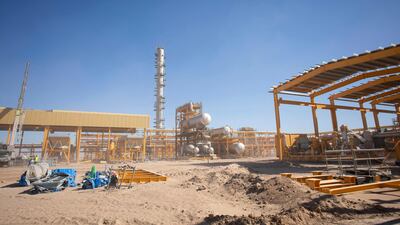
  • A gas separation plant under construction near Iraq's southern port city of Basra.
    A gas separation plant under construction near Iraq's southern port city of Basra.
  • The Nahr bin Omar oil field and facility near Basra. The flares produce vast amounts of carbon dioxide and other greenhouse gases, contributing to global warming without any economic or social benefit.
    The Nahr bin Omar oil field and facility near Basra. The flares produce vast amounts of carbon dioxide and other greenhouse gases, contributing to global warming without any economic or social benefit.
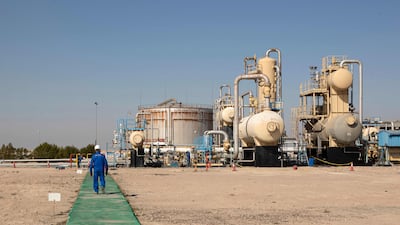
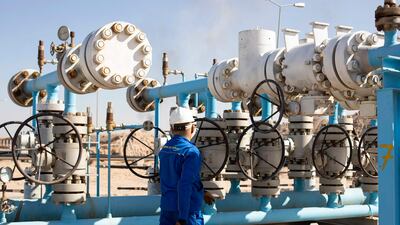
  • A processing facility in Artawi, near Basra.
    A processing facility in Artawi, near Basra.
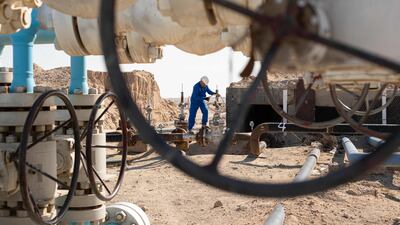
  • Part of the processing facility in Artawi.
    Part of the processing facility in Artawi.
  • Flare stacks burn off excess gas at the facility in Artawi.
    Flare stacks burn off excess gas at the facility in Artawi.
  • A gas separation plant under construction near Basra.
    A gas separation plant under construction near Basra.
  • Flare stacks at the Nahr bin Omar oil field near Basra.
    Flare stacks at the Nahr bin Omar oil field near Basra.
  • A technician at the processing facility in Artawi.
    A technician at the processing facility in Artawi.
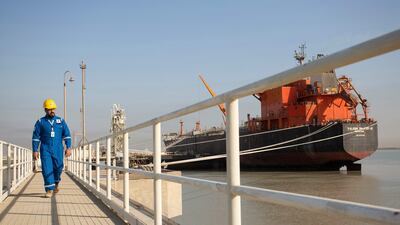
  • Umm Qasr port near Basra, in southern Iraq.
    Umm Qasr port near Basra, in southern Iraq.

Several high-profile deals have been signed with international electricity companies to construct solar parks but no work has yet begun.

Iraq also desperately needs new schools and in December, it reportedly signed an agreement with two Chinese companies to build 1,000 new education centres.

The Supreme Court's ruling puts a stop to any new plans of this scale, curbing Mr Al Kadhimi's attempt to continue governing.

“No budget means limited capital spending because they can't sign for loans, although the Cabinet continues to appropriate spending amounts for some projects, I presume as unfinished projects from last year,” said Kirk Sowell, principal at Utica Risk Services, an Iraq-focused consultancy firm.

“Arguably some of the Cabinet decisions are subject to challenge as well. But no one is challenging them, and if Al Kadhimi can point to some previous policy decision that they are simply completing, then perhaps some decisions can be defended as being valid caretaker powers,” he said.

Mr Sowell added that another long delay without a budget — as happened in 2014 — could have a serious impact on services down the line.

“Given how ineffective the government is even when money is approved on time, it will be more ineffective if a new government decides to try to spend it in large quantities after a long delay,” he said.

Moqtada Al Sadr digs in

In October, Iraq held early elections in response to one of the core demands of a nationwide, pro-reform protest movement that erupted in 2019.

But since then, political rivals have failed to reach an agreement on the formation of a new government.

The main rift is mainly among Shiite political adversaries.

Shiite cleric Moqtada Al Sadr, whose political group took 73 of the 329 seats in Parliament, wants to form a majority government only with the winners among Sunni and Kurdish political parties.

This has irritated his rivals from the Iran-backed Co-ordination Framework, who have been delayed forming the government to force Mr Al Sadr to give them a voice.

Shiite cleric Moqtada Al Sadr speaks during a news conference in 2021. Reuters

Sunday’s ruling came after some lawmakers aligned with the Co-ordination Framework requested an explanation from President Barham Salih on the caretaker government’s authority. He, in turn, sent the question to the court.

The ruling is “politically motivated as the bill has been supported by one side and rejected by another which wants to derail the process to exercise more pressure”, Hadi Jalo Marie, chairman of the Political Decision think tank in Baghdad, told The National.

“I don’t see the latest development pushing rivals to negotiating tables, but it will further deepen the rifts among them,” he added.

Shortly after Sunday’s ruling, Mr Al Sadr acknowledged that he had failed to form a new government, giving his partners and rivals 30 days to reach agreement.

“Because of the increased pressure made on me from inside and outside on the idea of forming a national majority government, I didn’t succeed at this endeavour,” Mr Al Sadr said in a statement.

He blamed independents who have resisted calls from both rival political blocs to take a side.

“We are left with one option that we should try, which is turning into a national opposition for at least 30 days,” Mr Al Sadr said.

If other parties fail to form the government, “we will have another decision that we will announce then”, he added.

On Monday, Mr Al Sadr reiterated his firm stance against forming a government with the Co-ordination Framework.

“Do you think that your acts will force us to ally with you?” Mr Al Sadr said in a pre-recorded televised speech. “No, and a thousand times no.”

He vowed “not take Iraq back to corruption, detestable consensus and Muhassasa”, referring to the quota-based system introduced after 2003 that aims to give equal representation to the country's different religious and ethnic communities.


If you go

The flights
Emirates flies from Dubai to Seattle from Dh5,555 return, including taxes.


The car
Hertz offers compact car rental from about $300 (Dh1,100) per week, including taxes. Emirates Skywards members can earn points on their car hire through Hertz.


The national park
Entry to Mount Rainier National Park costs $30 for one vehicle and passengers for up to seven days. Accommodation can be booked through mtrainierguestservices.com. Prices vary according to season. Rooms at the Holiday Inn Yakima cost from $125 per night, excluding breakfast.

The five new places of worship

Church of South Indian Parish

St Andrew's Church Mussaffah branch

St Andrew's Church Al Ain branch

St John's Baptist Church, Ruwais

Church of the Virgin Mary and St Paul the Apostle, Ruwais


Ipaf in numbers

Established: 2008

Prize money:  $50,000 (Dh183,650) for winners and $10,000 for those on the shortlist.

Winning novels: 13

Shortlisted novels: 66

Longlisted novels: 111

Total number of novels submitted: 1,780

Novels translated internationally: 66

Avatar%20(2009)
%3Cp%3E%3Cstrong%3EDirector%3A%20%3C%2Fstrong%3EJames%20Cameron%3C%2Fp%3E%0A%3Cp%3E%3Cstrong%3EStars%3A%20%3C%2Fstrong%3ESam%20Worthington%2C%20Zoe%20Saldana%2C%20Sigourney%20Weaver%3C%2Fp%3E%0A%3Cp%3E%3Cstrong%3ERating%3A%20%3C%2Fstrong%3E3%2F5%3C%2Fp%3E%0A
CHELSEA SQUAD

Arrizabalaga, Bettinelli, Rudiger, Christensen, Silva, Chalobah, Sarr, Azpilicueta, James, Kenedy, Alonso, Jorginho, Kante, Kovacic, Saul, Barkley, Ziyech, Pulisic, Mount, Hudson-Odoi, Werner, Havertz, Lukaku. 

UAE currency: the story behind the money in your pockets
Profile

Company name: Jaib

Started: January 2018

Co-founders: Fouad Jeryes and Sinan Taifour

Based: Jordan

Sector: FinTech

Total transactions: over $800,000 since January, 2018

Investors in Jaib's mother company Alpha Apps: Aramex and 500 Startups

Citadel: Honey Bunny first episode

Directors: Raj & DK

Stars: Varun Dhawan, Samantha Ruth Prabhu, Kashvi Majmundar, Kay Kay Menon

Rating: 4/5

Cultural fiesta

What: The Al Burda Festival
When: November 14 (from 10am)
Where: Warehouse421,  Abu Dhabi
The Al Burda Festival is a celebration of Islamic art and culture, featuring talks, performances and exhibitions. Organised by the Ministry of Culture and Knowledge Development, this one-day event opens with a session on the future of Islamic art. With this in mind, it is followed by a number of workshops and “masterclass” sessions in everything from calligraphy and typography to geometry and the origins of Islamic design. There will also be discussions on subjects including ‘Who is the Audience for Islamic Art?’ and ‘New Markets for Islamic Design.’ A live performance from Kuwaiti guitarist Yousif Yaseen should be one of the highlights of the day. 

Ten tax points to be aware of in 2026

1. Domestic VAT refund amendments: request your refund within five years

If a business does not apply for the refund on time, they lose their credit.

2. E-invoicing in the UAE

Businesses should continue preparing for the implementation of e-invoicing in the UAE, with 2026 a preparation and transition period ahead of phased mandatory adoption. 

3. More tax audits

Tax authorities are increasingly using data already available across multiple filings to identify audit risks. 

4. More beneficial VAT and excise tax penalty regime

Tax disputes are expected to become more frequent and more structured, with clearer administrative objection and appeal processes. The UAE has adopted a new penalty regime for VAT and excise disputes, which now mirrors the penalty regime for corporate tax.

5. Greater emphasis on statutory audit

There is a greater need for the accuracy of financial statements. The International Financial Reporting Standards standards need to be strictly adhered to and, as a result, the quality of the audits will need to increase.

6. Further transfer pricing enforcement

Transfer pricing enforcement, which refers to the practice of establishing prices for internal transactions between related entities, is expected to broaden in scope. The UAE will shortly open the possibility to negotiate advance pricing agreements, or essentially rulings for transfer pricing purposes. 

7. Limited time periods for audits

Recent amendments also introduce a default five-year limitation period for tax audits and assessments, subject to specific statutory exceptions. While the standard audit and assessment period is five years, this may be extended to up to 15 years in cases involving fraud or tax evasion. 

8. Pillar 2 implementation 

Many multinational groups will begin to feel the practical effect of the Domestic Minimum Top-Up Tax (DMTT), the UAE's implementation of the OECD’s global minimum tax under Pillar 2. While the rules apply for financial years starting on or after January 1, 2025, it is 2026 that marks the transition to an operational phase.

9. Reduced compliance obligations for imported goods and services

Businesses that apply the reverse-charge mechanism for VAT purposes in the UAE may benefit from reduced compliance obligations. 

10. Substance and CbC reporting focus

Tax authorities are expected to continue strengthening the enforcement of economic substance and Country-by-Country (CbC) reporting frameworks. In the UAE, these regimes are increasingly being used as risk-assessment tools, providing tax authorities with a comprehensive view of multinational groups’ global footprints and enabling them to assess whether profits are aligned with real economic activity. 

Contributed by Thomas Vanhee and Hend Rashwan, Aurifer

What drives subscription retailing?

Once the domain of newspaper home deliveries, subscription model retailing has combined with e-commerce to permeate myriad products and services.

The concept has grown tremendously around the world and is forecast to thrive further, according to UnivDatos Market Insights’ report on recent and predicted trends in the sector.

The global subscription e-commerce market was valued at $13.2 billion (Dh48.5bn) in 2018. It is forecast to touch $478.2bn in 2025, and include the entertainment, fitness, food, cosmetics, baby care and fashion sectors.

The report says subscription-based services currently constitute “a small trend within e-commerce”. The US hosts almost 70 per cent of recurring plan firms, including leaders Dollar Shave Club, Hello Fresh and Netflix. Walmart and Sephora are among longer established retailers entering the space.

UnivDatos cites younger and affluent urbanites as prime subscription targets, with women currently the largest share of end-users.

That’s expected to remain unchanged until 2025, when women will represent a $246.6bn market share, owing to increasing numbers of start-ups targeting women.

Personal care and beauty occupy the largest chunk of the worldwide subscription e-commerce market, with changing lifestyles, work schedules, customisation and convenience among the chief future drivers.

The specs

Engine: 1.5-litre 4-cylinder petrol

Power: 154bhp

Torque: 250Nm

Transmission: 7-speed automatic with 8-speed sports option 

Price: From Dh79,600

On sale: Now

Updated: May 16, 2022, 3:51 PM