

Iraq's leaders have criticised the country’s political stalemate and inability to form a new government six months after nationwide elections were held.
The country's post-election period often produces deadlock, with power-sharing discussions between political blocs typically lasting about five months or longer. However, this time round those crucial talks are not happening and sporadic meetings between parties have not come close to achieving compromise.
A dispute between the two largest political blocs has led to a boycott of parliament, meaning quorum cannot be reached and voting for a new president has repeatedly failed. Iraq's parliament needs to agree on a president, who then selects the largest bloc in parliament within 15 days, which in turn can form the government.
-
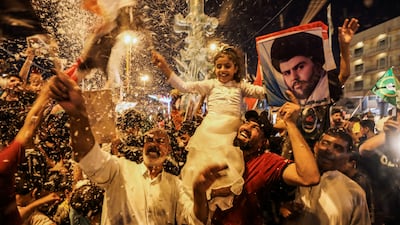
Supporters of the movement of Shiite cleric Moqtada Al Sadr celebrate in Najaf, Iraq, after preliminary results of the country’s parliamentary election were announced. Reuters -

Judge Jalil Adnan Khalaf (C), the chairman of Iraq’s Independent High Electoral Commission, speaks in the capital, Baghdad. AFP -

EU observers of the election hold a press conference in Baghdad. AP -
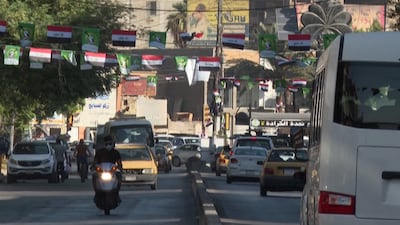
Iraqi flags are strung across a street. -
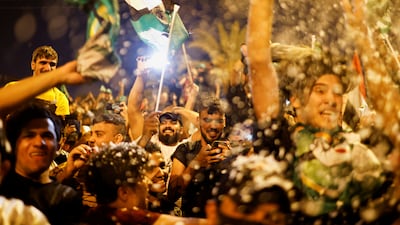
Sadrists celebrate after preliminary results of Iraq’s parliamentary election were announced in Baghdad on October 11. Reuters -
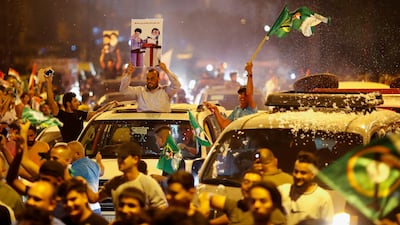
Supporters of Shiite cleric Moqtada Al Sadr celebrate after preliminary results were announced. Reuters -
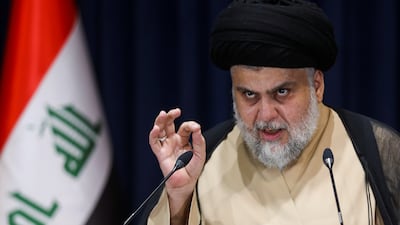
Shiite cleric Moqtada Al Sadr speaks after preliminary results of Iraq’s parliamentary election were announced in Najaf on October 11. Reuters


“The current political blockage in completing constitutional requirements and forming a new government has become a worrying and unacceptable matter, and if it continues, will lead the country into a dangerous maze,” outgoing Iraqi President Barham Salih, said late on Tuesday.
Mr Salih, among other politicians, spoke in Baghdad during a ceremony marking 41 years since the establishment of the Badr Organisation, a Shiite party that was formerly a militia organisation, set up by Iran's Islamic Revolutionary Guard Corps. The Badr Organisation remains linked to a number of militias within Iraq.
Early elections were held last October to meet the demands of anti-government protesters who staged months of mass demonstrations in 2019 and were killed in their hundreds, while thousands were injured.
They called for an overhaul of the political system and for an end to corruption and nepotism.
“The call for early elections was a solution to achieve political and social stability that ran into obstacles that should not be ignored,” Mr Salih said, adding that it was possible to overcome those issues with unity.
“Protecting the country requires a serious pause to address the mistakes that have accumulated due to the crumbling of the ruling system and to create reform,” he said.
For his part, Prime Minister Mustafa Al Kadhimi said Iraq’s political crisis is a result of the failure to form a new government.
“We strive to find solutions and citizens are worried about the future from the consequences of the political obstruction that hinders their daily life,” he said.
With no government, Iraq's parliament cannot pass a budget for the year. By law, this means that spending for vital investments such as electricity and water infrastructure is based on a fraction of the previous budget, which was based on much lower oil prices.
“We must admit that there are constitutional differences and inconsistencies in the administration of the state,” Mr Al Kadhimi said, adding that confidence must be restored to overcome the obstacles.
Populist cleric Moqtada Al Sadr was the biggest winner in the vote on October 10, with 73 seats in the 329-member parliament, but his Iran-backed rivals have frustrated his government formation efforts.
Mr Al Sadr joined forces with powerful parties including the Kurdistan Democratic Party (KDP) and the Sovereignty Coalition led by parliamentary Speaker Mohammed Al Halbousi.
For his part, Mr Al Halbousi said the new government will be formed soon.
“We must all strive, side by side, to work to strengthen state institutions, and to affirm our belief in it,” he said.
“We are going through challenges at the local, regional and international levels, and everyone knows the challenges of the international crisis that the world is witnessing and its impact on food security and the economy,” he said.
Iraq is ready to move forward and solve its problems, he said.

