

The Iraqi government's deadline for an investigation into the Ibn Al Khatib hospital fire, which killed 83 people, passed on April 30 without any official announcement.
The hospital was gutted by a ferocious inferno five days earlier, thought to have been caused by an exploding oxygen cylinder.
The disaster stunned a nation accustomed to tragedy – witnesses said many of the victims were burnt alive.
-
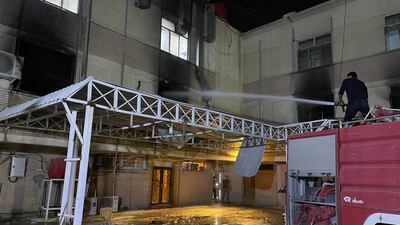
Firefighters extinguish a fire that broke out at Ibn Al Khateeb hospital, south of Baghdad, EPA -
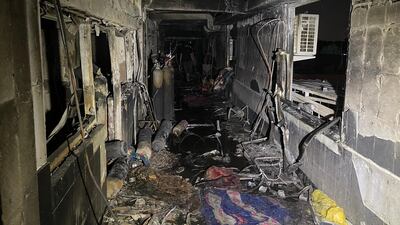
Aftermath of a fire that ripped through the intensive care unit of Ibn Al Khateeb hospital, south of Iraq's capital Baghdad. EPA -
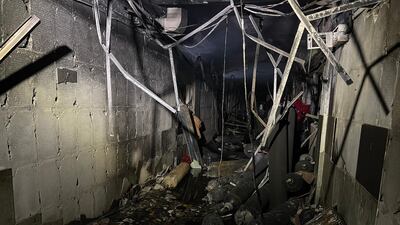
Parts of the walls and windows of the second floor of Ibn Al Khateeb hospital in Baghdad were blackened by soot from the fire. EPA -
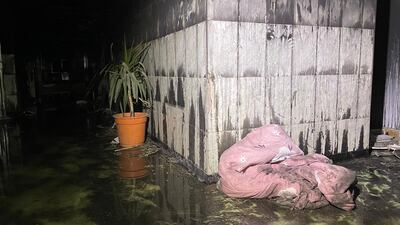
At least 82 people died and another 110 injured when a fire broke out following the explosion of an oxygen tank at Ibn Al Khateeb hospital in the Iraqi capital Baghdad. EPA -
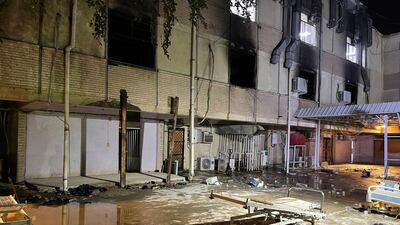
Investigative teams are looking for the cause of an oxygen tank explosion in an intensive care unit for coronavirus patients at Ibn Al Khateeb hospital, south of Baghdad. EPA -
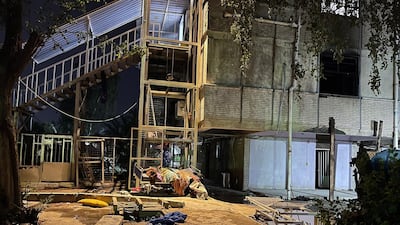
The Ibn Al Khateeb hospital in southern Baghdad where a fire broke out following the explosion of an oxygen tank on April 24, 2021. EPA -
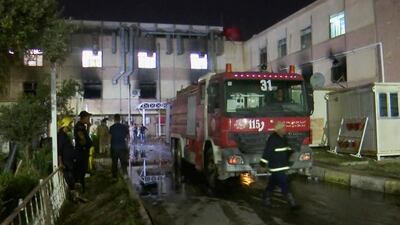
A firefighting vehicle arrives at the scene of a fire that erupted in a Baghdad hospital's intensive care unit for coronavirus patients. AP -
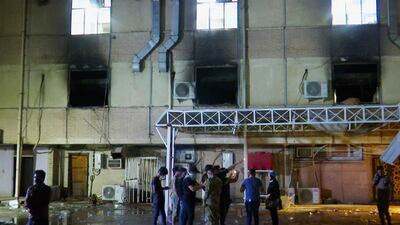
First responders work at the scene of a fire at Ibn Al Qateeb hospital, south of Baghdad. AP -
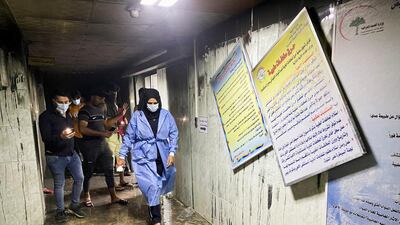
People and medical staff walk through the Ibn Al Khateeb hospital in Baghdad after a fire caused by an oxygen tank explosion. Reuters -
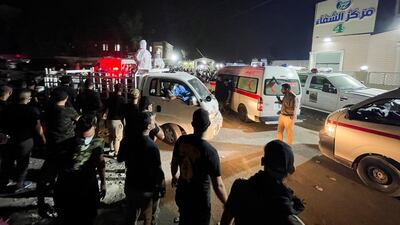
People gather outside the Ibn Al Khateeb hospital in Baghdad after a fire caused by an oxygen tank explosion. Reuters -
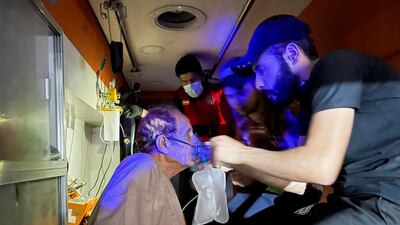
A Covid-19 patient is prepared for rescue in an ambulance outside Ibn Al Khateeb hospital in Baghdad. Reuters -
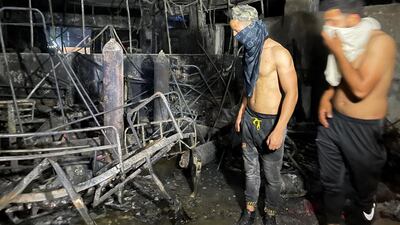
People look at dmage from an explosion and fire at Ibn Al Khateeb hospital in Baghdad. Reuters -
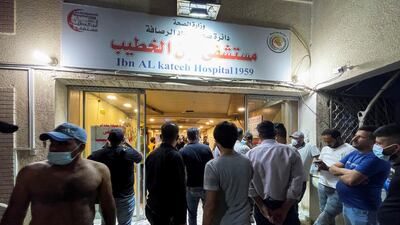
People gather at Ibn Al Khateeb hospital after a fire caused by an oxygen tank explosion. Reuters -
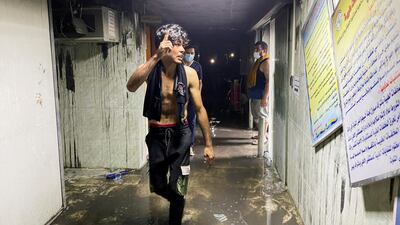
People walk through the Ibn Al Khateeb hospital after the oxygen tank explosion and fire. Reuters -

Medics attend to a Covid-19 patient in an ambulance outside Ibn Al Khateeb hospital, after a fire caused by an oxygen tank explosion. Reuters


A day after the fire, Prime Minister Mustafa Al Kadhimi suspended the health minister, Hassan Al Tamimi, a nominee of the powerful Sadrist movement led by radical cleric Moqtada Al Sadr. The director of Rusafa health directorate in Baghdad was also suspended.
But analysts and Iraqis with experience in the health sector say these moves may have little impact.
Lines of accountability in the health ministry are blurred because it is divided among a number of political groups that have been compared to “mafias”, with one of the most powerful being the Sadrist movement.
Indeed, the causes of the fire may have already been determined – Iraq’s Independent High Commission for Human Rights has already documented a litany of failures, including a lack of functioning smoke detectors and overcrowding.
But Iraqis cannot expect powerful political movements like the Sadrists to be held to account any time soon, even if some politicians are removed from office.
Without root and branch reform of a dysfunctional power-sharing system that dates back to 2003, these parties will cling on to power, analysts say.
The root of the problem
After the US-led invasion, rival Iraqi parties agreed on a sectarian, quota-based power-sharing arrangement, “muhasasa ta’ifia”, that allowed them to stuff the bureaucracy with unqualified party loyalists.
The Ministry of Health was soon taken over by the Sadrists, who won control of the ministry after the 2005 elections.
Before long, medicine was being overpurchased, with the excess resold on the black market; qualified staff were purged; and murder on hospital wards became one of the darkest features of Iraq's sectarian conflict.
“Back when I worked in the public health sector, the Sadrists used the health ministry to make money and carry out sectarian cleansing. And this is the real issue. You have government agencies that are supposed to provide services but the people in charge are not concerned with serving the public,” said Omar Al Nidawi, who worked as a dentist in the public sector in Baghdad and Basra through the 2003 invasion and subsequent civil war.
Mr Al Nidawi is currently a programme manager at Education for Peace in Iraq, an NGO.
Amid this chaos, there was a brief pushback against the Sadrists.
Sadrist deputy health minister Hakim Al Zamili was arrested by US and Iraqi forces in February 2007, accused of running sectarian death squads. Mr Al Sadr’s nominated health minister, Ali Al Shammari, also resigned from office.
Mr Al Zamili and his militiamen were bent on exacting revenge on loyalists of the former regime of Saddam Hussein. Thousands of innocent victims were caught in their campaign of terror.
After his arrest, it briefly looked as if Sadrist control of the ministry had ended.
But even after Mr Al Zamili and Mr Al Shammari were removed, a US military cable in the summer of 2007 warned that “the emplacement of a weak minister will allow behind the scenes control of the ministry by Sadr loyalists”.
Fourteen years later, whole departments of the ministry remain under the control of either Sadrists or loyalists of former premier Nouri Al Maliki. Mr Al Zamili stayed in government, albeit as an MP.
Mr Al Maliki, a long-time rival of Mr Al Sadr who led the Dawa party, has now aligned himself with Iran-backed parties.
“The fire incident has Sadrist incompetence and corruption written all over it,” said a health ministry administrative employee who asked for her real name to be withheld.
“The hospital is within the jurisdiction of Al Rusafa Health Department and that department is heavily infested with Sadrists," she said.
Corruption is still endemic.
“Iraq has a sizeable but pretty much unregulated network of medical device suppliers, health insurance companies, and private clinics. Contracts between these companies and the MOH have been a chronic source of corruption allegations,” said David Benes, a freelance investment analyst.
Even ministers respected as “independent” struggle to push back.
In 2019, former health minister Ala Al Alwan told the New York Times that there had been attempts to purchase medicine at vastly inflated prices.
He faced resistance from powerful forces within the ministry when trying to stop fraudulent procurement.
Foreign aid
The problems at Ibn Al Khatib hospital underline how difficult it is for international organisations to assist Iraq.
While the Biden administration offered Iraq assistance after the fire, the hospital had been receiving help from Medecins Sans Frontieres as recently as last year, albeit not in health and safety, but care of Covid-19 patients.
A 1999 UN report on the hospital shows how little progress Iraq has made implementing modern health and safety measures after 22 years of sanctions, war and corruption.
“On the roof, old air compressors lie rusty and broken. Where their pipes and wires penetrate the roof, deep-running cracks have formed in the cement blocks, and water has dripped through the holes,” the report said.
Ali Al Mawlawi, a senior analyst with Inside Iraqi Politics, believes Iraq faces deeper problems than politicisation of ministries, such as fake qualifications.
“The whole debate over muhasasa can be a bit of a red herring. I'm not really convinced that people occupying positions that didn't come through muhasasa are any less incompetent or corrupt," he said.
"These institutions need a root-and-branch clear-out."
With so many problems, some are hoping that policy-focused parties could emerge in forthcoming elections and root out corruption.
They could be disappointed, says Joel Wing, a California based analyst who authors the Musings on Iraq blog on Iraq’s political economy.
“Sadr still has a popular base. More importantly, he knows how to turn it on come election day,” he says.
“The new voting law that breaks up Iraq into 83 districts plus a likely low turnout means people like Sadr who can bring people to the polls could gain more seats”, he adds.
Iraq is next scheduled to have an election in October.

