Iraqi security forces clashed with protesters in Baghdad's heavily fortified Green Zone. AP

More than 100 injured as police clash with pro-Iran groups in Baghdad


  • English
  • Arabic

Hundreds of supporters of pro-Iran groups clashed with security forces in Baghdad on Friday, leaving more than 100 people injured as they vented their fury over last month's Iraq election result, medical and security sources said.

“There were 125 people injured, 27 of them civilians and the rest from the security forces,” Iraq's health ministry said.

The political arm of the pro-Iran Hashed Al Shaabi paramilitary network saw its share of parliamentary seats decline substantially in the election, which the group's supporters have denounced as “fraud".

Demonstrators from groups loyal to Hashed Al Shaabi threw projectiles and “blocked … access to the Green Zone” on three sides before they were pushed back by police, who fired weapons in the air, a security source said, requesting anonymity.

The health ministry said nobody was killed in the clashes but some pro-Iran channels on messaging app Telegram claimed police fired live rounds at protesters.

“Two demonstrators were killed,” a leader of the Hezbollah Brigades, one of Hashed Al Shaabi's most powerful factions, told AFP, requesting anonymity.

Prime Minister Mustafa Al Kadhimi “ordered a full inquiry into Friday's events”, his office said, while President Barham Salih called for restraint.

After a brief lull, clashes resumed in the evening near the Green Zone, a source from the Hezbollah Brigades said.

The source also accused security forces of torching protest tents pitched by Hashed Al Shaabi supporters in the area.

Discontent over elections festers

Iraq's final election results have yet to be confirmed, almost four weeks since the October 10 ballot.

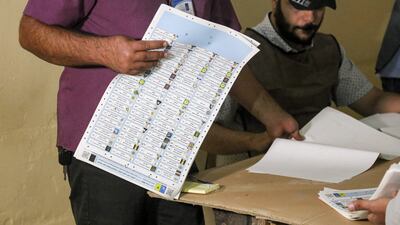
  • Iraqi election officials conduct a manual count of votes from a ballot box picked at random as part of the verification process for the electronic count, at a polling station in the central city of Karbala. AFP
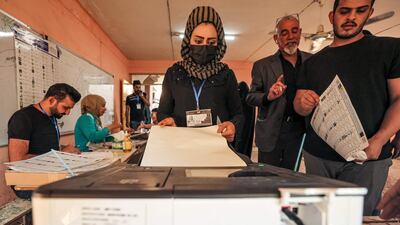
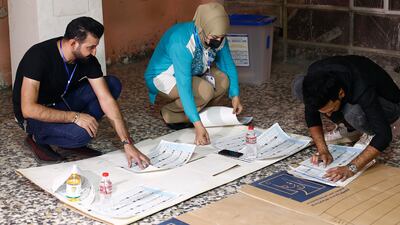
    Iraqi election officials conduct a manual count of votes from a ballot box picked at random as part of the verification process for the electronic count, at a polling station in the central city of Karbala. AFP
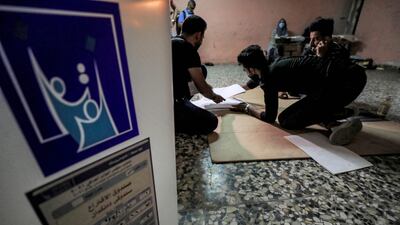
  • Iraqi election officials in Karbala. AFP
    Iraqi election officials in Karbala. AFP
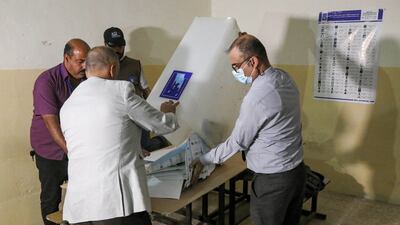
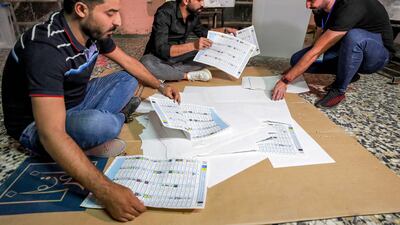
  • Iraqi election officials conduct a manual count of votes at a polling station in the capital Baghdad. AFP
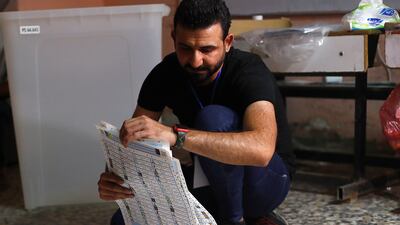
    Iraqi election officials conduct a manual count of votes at a polling station in the capital Baghdad. AFP
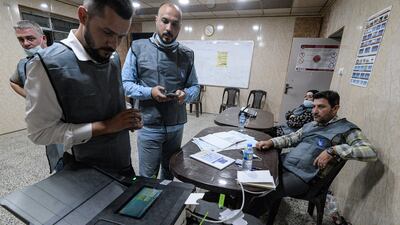
  • Iraqi election officials check data at a polling station in Baghdad. AFP
    Iraqi election officials check data at a polling station in Baghdad. AFP
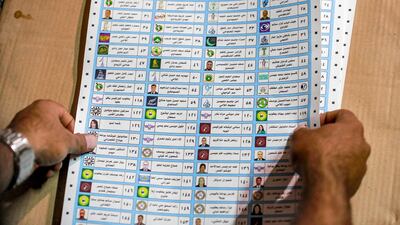
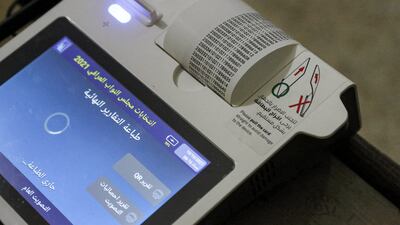
  • Iraqi officials print out the electronic count of votes at a polling station in Karbala. AFP
    Iraqi officials print out the electronic count of votes at a polling station in Karbala. AFP
  • Iraqi election officials conduct the electronic count of votes at a polling station in the northern city of Mosul. AFP
    Iraqi election officials conduct the electronic count of votes at a polling station in the northern city of Mosul. AFP
  • Iraqi election officials count votes at a polling station in Baghdad. AFP
    Iraqi election officials count votes at a polling station in Baghdad. AFP
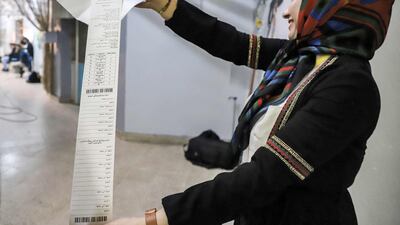
  • An Iraqi election official holds a printout of the electronic count of votes at a polling station in the north-eastern city of Sulaymaniyah in Iraq's autonomous Kurdistan region. AFP
    An Iraqi election official holds a printout of the electronic count of votes at a polling station in the north-eastern city of Sulaymaniyah in Iraq's autonomous Kurdistan region. AFP
  • Iraqi officials print out the electronic count of votes at a polling station in the north-eastern city of Sulaymaniyah. AFP
    Iraqi officials print out the electronic count of votes at a polling station in the north-eastern city of Sulaymaniyah. AFP
  • Iraqi election committee staff members count votes at the end of the parliamentary election day at a polling station in Baghdad's Karada district. EPA
    Iraqi election committee staff members count votes at the end of the parliamentary election day at a polling station in Baghdad's Karada district. EPA
  • Iraqi election committee staff members count votes to elect 329 new members of the Council of Representatives. EPA
    Iraqi election committee staff members count votes to elect 329 new members of the Council of Representatives. EPA
  • Iraq's Independent High Electoral Commission is expected to announce the results of Sunday's election within two days. EPA
    Iraq's Independent High Electoral Commission is expected to announce the results of Sunday's election within two days. EPA
  • Iraqi election committee staff members count votes at the end of Sunday's parliamentary election day at a polling station in Baghdad's Karada district. EPA
    Iraqi election committee staff members count votes at the end of Sunday's parliamentary election day at a polling station in Baghdad's Karada district. EPA
  • A woman voter casts her vote at a polling station in Baghdad. AFP
    A woman voter casts her vote at a polling station in Baghdad. AFP
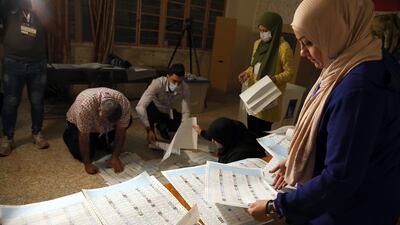
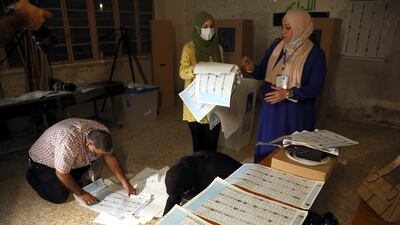
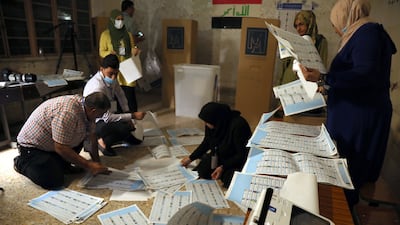
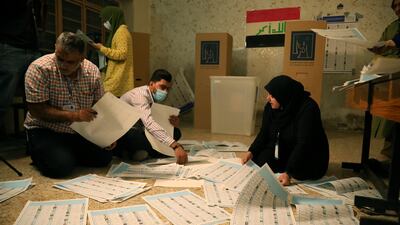
  • Election workers count ballots at a polling station in Baghdad at the end of voting in parliamentary elections. AP
    Election workers count ballots at a polling station in Baghdad at the end of voting in parliamentary elections. AP
  • An election worker counts ballots after polls close. Parliamentary elections were held months ahead of schedule in response to a popular uprising against corruption and mismanagement. AP
    An election worker counts ballots after polls close. Parliamentary elections were held months ahead of schedule in response to a popular uprising against corruption and mismanagement. AP

Early indications showed populist cleric Moqtada Al Sadr's bloc was likely to win 73 seats in the 329-member house. Mr Al Sadr has criticised foreign intervention in Iraq, including that of Iran.

The Conquest (Fatah) Alliance, the political arm of the multiparty Hashed Al Shaabi, won about 15, preliminary results showed.

In the last Parliament, it held 48 seats, making it the second-largest bloc.

The Taqadum party, led by Parliamentary Speaker Mohammed Al Halbousi, took 37 seats, while former prime minister Nouri Al Maliki’s State of Law bloc won 35 seats.

As final results draw nearer, wrangling over government formation appears to have already begun. Mr Al Sadr was in Baghdad this week, holding meetings with Mr Al Halbousi, former prime minister Haider Al Abadi and cleric Ammar Al Hakim.

Mr Al Maliki said on Twitter that protesters, who were “claiming their legitimate rights”, should not escalate the violence and avoid provoking security forces.

“We strongly condemn the assault and the use of violence and excessive force by any party and we warn against the interference of malicious hands and suspicious parties in order to ignite sedition,” he said.

So far, unsubstantiated claims of voter fraud are casting a shadow over an election that was praised by the US, the UN Security Council and others for being the smoothest in years and without major technical glitches.

Last week, manual recounting was called at more than 2,000 polling stations after appeals over the results poured in.

Once the appeals are dealt with by the Judicial Commission, the results will be sent to the High Federal Court for ratification, and then Mr Salih will have 15 days to call for the new Parliament to convene.

It remains unclear when the final election results will be announced.

This week, the same area of Baghdad was hit by three rockets, which struck an area near a Red Crescent hospital, a bank and the district's water management department. No casualties were reported.

The so far unclaimed attack was the first to hit the Green Zone since two rockets were fired into the area on July 29.


THE%20SPECS
%3Cp%3EBattery%3A%2060kW%20lithium-ion%20phosphate%3Cbr%3EPower%3A%20Up%20to%20201bhp%3Cbr%3E0%20to%20100kph%3A%207.3%20seconds%3Cbr%3ERange%3A%20418km%3Cbr%3EPrice%3A%20From%20Dh149%2C900%3Cbr%3EAvailable%3A%20Now%3C%2Fp%3E%0A
Ten tax points to be aware of in 2026

1. Domestic VAT refund amendments: request your refund within five years

If a business does not apply for the refund on time, they lose their credit.

2. E-invoicing in the UAE

Businesses should continue preparing for the implementation of e-invoicing in the UAE, with 2026 a preparation and transition period ahead of phased mandatory adoption. 

3. More tax audits

Tax authorities are increasingly using data already available across multiple filings to identify audit risks. 

4. More beneficial VAT and excise tax penalty regime

Tax disputes are expected to become more frequent and more structured, with clearer administrative objection and appeal processes. The UAE has adopted a new penalty regime for VAT and excise disputes, which now mirrors the penalty regime for corporate tax.

5. Greater emphasis on statutory audit

There is a greater need for the accuracy of financial statements. The International Financial Reporting Standards standards need to be strictly adhered to and, as a result, the quality of the audits will need to increase.

6. Further transfer pricing enforcement

Transfer pricing enforcement, which refers to the practice of establishing prices for internal transactions between related entities, is expected to broaden in scope. The UAE will shortly open the possibility to negotiate advance pricing agreements, or essentially rulings for transfer pricing purposes. 

7. Limited time periods for audits

Recent amendments also introduce a default five-year limitation period for tax audits and assessments, subject to specific statutory exceptions. While the standard audit and assessment period is five years, this may be extended to up to 15 years in cases involving fraud or tax evasion. 

8. Pillar 2 implementation 

Many multinational groups will begin to feel the practical effect of the Domestic Minimum Top-Up Tax (DMTT), the UAE's implementation of the OECD’s global minimum tax under Pillar 2. While the rules apply for financial years starting on or after January 1, 2025, it is 2026 that marks the transition to an operational phase.

9. Reduced compliance obligations for imported goods and services

Businesses that apply the reverse-charge mechanism for VAT purposes in the UAE may benefit from reduced compliance obligations. 

10. Substance and CbC reporting focus

Tax authorities are expected to continue strengthening the enforcement of economic substance and Country-by-Country (CbC) reporting frameworks. In the UAE, these regimes are increasingly being used as risk-assessment tools, providing tax authorities with a comprehensive view of multinational groups’ global footprints and enabling them to assess whether profits are aligned with real economic activity. 

Contributed by Thomas Vanhee and Hend Rashwan, Aurifer

COMPANY%20PROFILE
%3Cp%3E%3Cstrong%3ECompany%20name%3A%3C%2Fstrong%3E%203S%20Money%3Cbr%3E%3Cstrong%3EStarted%3A%3C%2Fstrong%3E%202018%3Cbr%3E%3Cstrong%3EBased%3A%3C%2Fstrong%3E%20London%3Cbr%3E%3Cstrong%3EFounders%3A%3C%2Fstrong%3E%20Ivan%20Zhiznevsky%2C%20Eugene%20Dugaev%20and%20Andrei%20Dikouchine%3Cbr%3E%3Cstrong%3ESector%3A%3C%2Fstrong%3E%20FinTech%3Cbr%3E%3Cstrong%3EInvestment%20stage%3A%3C%2Fstrong%3E%20%245.6%20million%20raised%20in%20total%3C%2Fp%3E%0A

FA Cup semi-finals

Saturday: Manchester United v Tottenham Hotspur, 8.15pm (UAE)
Sunday: Chelsea v Southampton, 6pm (UAE)

Matches on Bein Sports

Company%20Profile
%3Cp%3E%3Cstrong%3ECompany%3A%3C%2Fstrong%3E%20Astra%20Tech%3Cbr%3E%3Cstrong%3EStarted%3A%20%3C%2Fstrong%3EMarch%202022%3Cbr%3E%3Cstrong%3EBased%3A%20%3C%2Fstrong%3EDubai%3Cbr%3E%3Cstrong%3EFounder%3A%20%3C%2Fstrong%3EAbdallah%20Abu%20Sheikh%3Cbr%3E%3Cstrong%3EIndustry%3A%3C%2Fstrong%3E%20technology%20investment%20and%20development%3Cbr%3E%3Cstrong%3EFunding%20size%3A%3C%2Fstrong%3E%20%24500m%3C%2Fp%3E%0A
The specs: 2018 Opel Mokka X

Price, as tested: Dh84,000

Engine: 1.4L, four-cylinder turbo

Transmission: Six-speed auto

Power: 142hp at 4,900rpm

Torque: 200Nm at 1,850rpm

Fuel economy, combined: 6.5L / 100km

Updated: November 05, 2021, 10:09 PM