Iraq elections: Iran-linked parties reject results after major setback


Robert Tollast
  • English
  • Arabic

The political landscape in Iraq was set to shift dramatically on Monday evening with the vast majority of votes counted in more than 95 per cent of voting districts, giving a bloc led by Shiite cleric Moqtada Al Sadr a clear lead in the national poll.

But the result was challenged on Tuesday by Hadi Al Amiri, head of the now defeated Fatah Alliance, which by one count secured just 14 seats in the 329-member assembly, a huge drop from its 2018 performance, when it secured 48 seats.

The protest movement has yet to find a way to engage with the political system in a manner that could effect change
Nicholas Krohley,
risk analyst

Fatah's poor performance is being seen as a resounding rejection of overbearing Iranian influence in Iraqi affairs. Several small parties are likely to join the Fatah bloc, which could slightly raise their seat count, but not significantly.

Around 26 seats were still up for the taking by Tuesday afternoon, according to a count by Iraq analyst Sajad Jiyad. But these will likely be spread among a large number of parties.

“We will not accept these fabricated results, whatever the cost,” said Mr Al Amiri, speaking to the pro-Iranian Al Aahd TV channel.

By the highest count, the Sadrist bloc was leading with 73 seats in the 329-member assembly, putting it in pole position to nominate the prime minister and take the lion's share of cabinet positions.

Two other parties also rejected the results, including the party of former Prime Minister Haider Al Abadi, the National State Forces, who also co-signed a letter rejecting the vote as fraudulent.

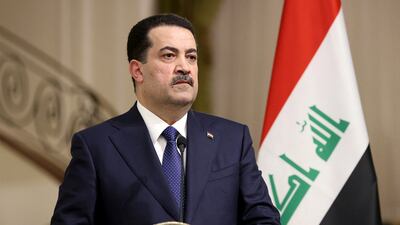
  • Iraq's Prime Minister Mohamed Shia al-Sudani. AFP
    Iraq's Prime Minister Mohamed Shia al-Sudani. AFP
  • Hadi al-Amiri leader of the Badr Organisation attends an election rally, along with his Fatih bloc supporters, ahead of the parliamentary election in Baghdad, Iraq October 5, 2021. REUTERS/Ahmed Saad
    Hadi al-Amiri leader of the Badr Organisation attends an election rally, along with his Fatih bloc supporters, ahead of the parliamentary election in Baghdad, Iraq October 5, 2021. REUTERS/Ahmed Saad
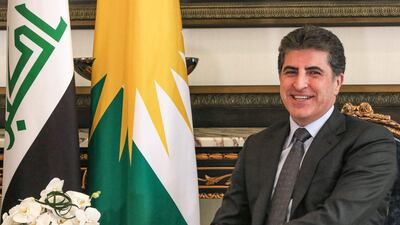
  • Nechirvan Barzani, President of Iraq's autonomous Kurdistan Region, meets with the Iraqi prime minister in Erbil, the capital of the northern Iraqi Kurdish autonomous region, on March 14, 2022. AFP
    Nechirvan Barzani, President of Iraq's autonomous Kurdistan Region, meets with the Iraqi prime minister in Erbil, the capital of the northern Iraqi Kurdish autonomous region, on March 14, 2022. AFP
  • Shiite Muslim cleric Moqtada Sadr gives a speech in Iraq's central holy shrine city of Najaf. AFP
    Shiite Muslim cleric Moqtada Sadr gives a speech in Iraq's central holy shrine city of Najaf. AFP
  • A member of the Iraqi Sadrist bloc (of Shiite leader Moqtada Sadr) announces the party's electoral programme for the upcoming elections, in the central city of Najaf, on September 30, 2021. - Iraq will hold parliamentary elections on October 10, a year early to appease an anti-government protest movement, at a time of simmering anger over graft and economic crisis. (Photo by Ali NAJAFI / AFP)
    A member of the Iraqi Sadrist bloc (of Shiite leader Moqtada Sadr) announces the party's electoral programme for the upcoming elections, in the central city of Najaf, on September 30, 2021. - Iraq will hold parliamentary elections on October 10, a year early to appease an anti-government protest movement, at a time of simmering anger over graft and economic crisis. (Photo by Ali NAJAFI / AFP)
  • Ammar al-Hakim, Leader of the Hikma movement and accompanied by his children, shows his inked finger at a polling station in Baghdad, as Iraqis go to the polls to vote in the parliamentary election, in Iraq, October 10, 2021. REUTERS/Thaier al-Sudani
    Ammar al-Hakim, Leader of the Hikma movement and accompanied by his children, shows his inked finger at a polling station in Baghdad, as Iraqis go to the polls to vote in the parliamentary election, in Iraq, October 10, 2021. REUTERS/Thaier al-Sudani
  • Former Iraqi Prime Minister Nouri al-Maliki shows his inked finger at a polling station in Baghdad, as Iraqis go to the poll to vote in the parliamentary election, in Iraq, October 10, 2021. REUTERS/Thaier al-Sudani
    Former Iraqi Prime Minister Nouri al-Maliki shows his inked finger at a polling station in Baghdad, as Iraqis go to the poll to vote in the parliamentary election, in Iraq, October 10, 2021. REUTERS/Thaier al-Sudani

Harakat Huqooq, the newly formed political party of Iran-backed militia Kataib Hezbollah, which stands accused of conducting numerous attacks on Coalition forces and Iraqi protesters, also rejected the results as a "scam."

In addition to his role at the head of Fatah, Mr Al Amiri heads the Badr Organisation — a paramilitary group turned political party formed in Iran during the Iran-Iraq war. The Islamist group has long been one of the foremost power brokers in post-2003 Iraq, rising to prominence in the aftermath of the US-led invasion.

With backing from Iran, it secured its position in the political scene by refraining from openly attacking US forces, despite keeping some ties to insurgent groups and filling the ranks of the police with loyalists, who have been accused of numerous human rights abuses.

But the fortunes of the Fatah Alliance have sunk dramatically following a national protest movement against corruption and poor public services, which began in October 2019.

Political factions in the Fatah Alliance linked to militias, including Qais Al Khazali's Asaib Ahl Al Haq, were accused of killing about 600 protesters.

This led to growing public outrage across Iraq, overshadowing a claim by Popular Mobilisation Forces (PMF) within Fatah to have saved the country from ISIS. The PMF is a collection of mainly Iran-backed, Shiite militias formed in 2014 to fight ISIS.

Most of the parties in the Fatah Alliance are long-term rivals of Mr Al Sadr, the hardline nationalist cleric who has promised to keep Iraq free from foreign influence. Gunmen from both sides fought bloody street battles in the holy city of Karbala in 2007. Fifty died before calm was restored.

Mr Al Sadr rejects the Iranian system of government espoused by Fatah loyalists. Both Fatah and the Sadrists frequently accuse each other's political leaders of corruption.

Mr Al Amiri's remarks could set the stage for intra-Shiite Islamist tensions in the weeks to come as government formation begins.

Competing for ministries

But there have been several other surprise developments that complicate the picture, notably the return of former prime minister Nouri Al Maliki, whose State of Law Coalition secured at least 37 seats, 12 more than in 2018.

While this allocation is not game changing for the former PM, it could complicate alliance building to form the largest bloc, which will have the biggest say in government formation.

Sunni parliament speaker Mohammed Al Halbousi's Taqaddum coalition won at least 38 seats, Iraq's state news agency reported, making it the second largest in parliament.

Kurdish parties won 61 seats, the results showed, including 32 for the Kurdistan Democratic Party which dominates the government of the autonomous Kurdish region of Iraq, and 15 for its rival the Patriotic Union of Kurdistan party, which has historically had good relations with Iran-linked parties.

Reformers face uphill struggle

A number of outlying parties, including the Kurdish New Generation Party, the reformist Imtidad Movement and a host of independent candidates — just some of the 3,249 candidates competing for parliament — will further complicate government formation as new blocs emerge to challenge the Sadrist bloc.

Notably, a number of candidates inspired by the October 2019 protests picked up seats, including Alaa Al Rikabi, who founded Imtidad in January 2020, despite an attempt on his life by Iran-linked paramilitaries. Imtidad secured at least 10 seats, with other independents securing 30.

Any influence they have is likely dependent upon working with established parties.

"The protest movement has yet to find a way to engage with the political system in a manner that could effect change, cautions Nicholas Krohley, author of The Death of the Mehdi Army, which charts the history of Mr Al Sadr's movement.

"As things stand, 'the system' seems poised to survive, with a shuffling of chairs in parliament."

Joel Wing, a California-based analyst and author of the Musings on Iraq website warns that the largest parties will bargain with each other over government positions, to the exclusion of reformists.

"All the major parties know politics is about gaining access to the state to exploit it," he says.

"None want to start the precedent of excluding another because that opens the door to them being shut out in the future."


What can you do?

Document everything immediately; including dates, times, locations and witnesses

Seek professional advice from a legal expert

You can report an incident to HR or an immediate supervisor

You can use the Ministry of Human Resources and Emiratisation’s dedicated hotline

In criminal cases, you can contact the police for additional support

PROFILE OF HALAN

Started: November 2017

Founders: Mounir Nakhla, Ahmed Mohsen and Mohamed Aboulnaga

Based: Cairo, Egypt

Sector: transport and logistics

Size: 150 employees

Investment: approximately $8 million

Investors include: Singapore’s Battery Road Digital Holdings, Egypt’s Algebra Ventures, Uber co-founder and former CTO Oscar Salazar

Dust and sand storms compared

Sand storm

  • Particle size: Larger, heavier sand grains
  • Visibility: Often dramatic with thick "walls" of sand
  • Duration: Short-lived, typically localised
  • Travel distance: Limited 
  • Source: Open desert areas with strong winds

Dust storm

  • Particle size: Much finer, lightweight particles
  • Visibility: Hazy skies but less intense
  • Duration: Can linger for days
  • Travel distance: Long-range, up to thousands of kilometres
  • Source: Can be carried from distant regions
Everton%20Fixtures
%3Cp%3EApril%2015%20-%20Chelsea%20(A)%3Cbr%3EApril%2021%20-%20N.%20Forest%20(H)%3Cbr%3EApril%2024%20-%20Liverpool%20(H)%3Cbr%3EApril%2027%20-%20Brentford%20(H)%3Cbr%3EMay%203%20-%20Luton%20Town%20(A)%3Cbr%3EMay%2011%20-%20Sheff%20Utd%20(H)%3Cbr%3EMay%2019%20-%20Arsenal%20(A)%3C%2Fp%3E%0A
UAE currency: the story behind the money in your pockets
US tops drug cost charts

The study of 13 essential drugs showed costs in the United States were about 300 per cent higher than the global average, followed by Germany at 126 per cent and 122 per cent in the UAE.

Thailand, Kenya and Malaysia were rated as nations with the lowest costs, about 90 per cent cheaper.

In the case of insulin, diabetic patients in the US paid five and a half times the global average, while in the UAE the costs are about 50 per cent higher than the median price of branded and generic drugs.

Some of the costliest drugs worldwide include Lipitor for high cholesterol. 

The study’s price index placed the US at an exorbitant 2,170 per cent higher for Lipitor than the average global price and the UAE at the eighth spot globally with costs 252 per cent higher.

High blood pressure medication Zestril was also more than 2,680 per cent higher in the US and the UAE price was 187 per cent higher than the global price.

COMPANY%20PROFILE
%3Cp%3E%3Cstrong%3EName%3A%20%3C%2Fstrong%3EKinetic%207%3Cbr%3E%3Cstrong%3EStarted%3A%3C%2Fstrong%3E%202018%3Cbr%3E%3Cstrong%3EFounder%3A%3C%2Fstrong%3E%20Rick%20Parish%3Cbr%3E%3Cstrong%3EBased%3A%3C%2Fstrong%3E%20Abu%20Dhabi%2C%20UAE%3Cbr%3E%3Cstrong%3EIndustry%3A%3C%2Fstrong%3E%20Clean%20cooking%3Cbr%3E%3Cstrong%3EFunding%3A%3C%2Fstrong%3E%20%2410%20million%3Cbr%3E%3Cstrong%3EInvestors%3A%3C%2Fstrong%3E%20Self-funded%3C%2Fp%3E%0A
While you're here
The five pillars of Islam

1. Fasting

2. Prayer

3. Hajj

4. Shahada

5. Zakat 

UAE squad

Men's draw: Victor Scvortov and Khalifa Al Hosani, (both 73 kilograms), Sergiu Toma and Mihail Marchitan (90kg), Ivan Remarenco (100kg), Ahmed Al Naqbi (60kg), Musabah Al Shamsi and Ahmed Al Hosani (66kg)

Women’s draw: Maitha Al Neyadi (57kg)

FIXTURES (all times UAE)

Sunday
Brescia v Lazio (3.30pm)
SPAL v Verona (6pm)
Genoa v Sassuolo (9pm)
AS Roma v Torino (11.45pm)

Monday
Bologna v Fiorentina (3.30pm)
AC Milan v Sampdoria (6pm)
Juventus v Cagliari (6pm)
Atalanta v Parma (6pm)
Lecce v Udinese (9pm)
Napoli v Inter Milan (11.45pm)

The specs

  Engine: 2-litre or 3-litre 4Motion all-wheel-drive Power: 250Nm (2-litre); 340 (3-litre) Torque: 450Nm Transmission: 8-speed automatic Starting price: From Dh212,000 On sale: Now

Company Profile

Name: Thndr
Started: 2019
Co-founders: Ahmad Hammouda and Seif Amr
Sector: FinTech
Headquarters: Egypt
UAE base: Hub71, Abu Dhabi
Current number of staff: More than 150
Funds raised: $22 million

Mercer, the investment consulting arm of US services company Marsh & McLennan, expects its wealth division to at least double its assets under management (AUM) in the Middle East as wealth in the region continues to grow despite economic headwinds, a company official said.

Mercer Wealth, which globally has $160 billion in AUM, plans to boost its AUM in the region to $2-$3bn in the next 2-3 years from the present $1bn, said Yasir AbuShaban, a Dubai-based principal with Mercer Wealth.

Within the next two to three years, we are looking at reaching $2 to $3 billion as a conservative estimate and we do see an opportunity to do so,” said Mr AbuShaban.

Mercer does not directly make investments, but allocates clients’ money they have discretion to, to professional asset managers. They also provide advice to clients.

“We have buying power. We can negotiate on their (client’s) behalf with asset managers to provide them lower fees than they otherwise would have to get on their own,” he added.

Mercer Wealth’s clients include sovereign wealth funds, family offices, and insurance companies among others.

From its office in Dubai, Mercer also looks after Africa, India and Turkey, where they also see opportunity for growth.

Wealth creation in Middle East and Africa (MEA) grew 8.5 per cent to $8.1 trillion last year from $7.5tn in 2015, higher than last year’s global average of 6 per cent and the second-highest growth in a region after Asia-Pacific which grew 9.9 per cent, according to consultancy Boston Consulting Group (BCG). In the region, where wealth grew just 1.9 per cent in 2015 compared with 2014, a pickup in oil prices has helped in wealth generation.

BCG is forecasting MEA wealth will rise to $12tn by 2021, growing at an annual average of 8 per cent.

Drivers of wealth generation in the region will be split evenly between new wealth creation and growth of performance of existing assets, according to BCG.

Another general trend in the region is clients’ looking for a comprehensive approach to investing, according to Mr AbuShaban.

“Institutional investors or some of the families are seeing a slowdown in the available capital they have to invest and in that sense they are looking at optimizing the way they manage their portfolios and making sure they are not investing haphazardly and different parts of their investment are working together,” said Mr AbuShaban.

Some clients also have a higher appetite for risk, given the low interest-rate environment that does not provide enough yield for some institutional investors. These clients are keen to invest in illiquid assets, such as private equity and infrastructure.

“What we have seen is a desire for higher returns in what has been a low-return environment specifically in various fixed income or bonds,” he said.

“In this environment, we have seen a de facto increase in the risk that clients are taking in things like illiquid investments, private equity investments, infrastructure and private debt, those kind of investments were higher illiquidity results in incrementally higher returns.”

The Abu Dhabi Investment Authority, one of the largest sovereign wealth funds, said in its 2016 report that has gradually increased its exposure in direct private equity and private credit transactions, mainly in Asian markets and especially in China and India. The authority’s private equity department focused on structured equities owing to “their defensive characteristics.”

The President's Cake

Director: Hasan Hadi

Starring: Baneen Ahmad Nayyef, Waheed Thabet Khreibat, Sajad Mohamad Qasem 

Rating: 4/5

COMPANY PROFILE
Name: Kumulus Water
 
Started: 2021
 
Founders: Iheb Triki and Mohamed Ali Abid
 
Based: Tunisia 
 
Sector: Water technology 
 
Number of staff: 22 
 
Investment raised: $4 million 
HIV on the rise in the region

A 2019 United Nations special analysis on Aids reveals 37 per cent of new HIV infections in the Mena region are from people injecting drugs.

New HIV infections have also risen by 29 per cent in western Europe and Asia, and by 7 per cent in Latin America, but declined elsewhere.

Egypt has shown the highest increase in recorded cases of HIV since 2010, up by 196 per cent.

Access to HIV testing, treatment and care in the region is well below the global average.  

Few statistics have been published on the number of cases in the UAE, although a UNAIDS report said 1.5 per cent of the prison population has the virus.

Updated: October 12, 2021, 2:22 PM