



Powerful cleric Moqtada Al Sadr's parliamentary bloc looked set to make large gains in Iraq's elections on Monday as final votes were being counted, the country's electoral body announced.
Head of Iraq's Independent High Electoral Commission, Jalil Adnan, said results were in for 94 per cent of polling stations at a press conference on Monday evening.
Results from the remaining 6 per cent and the complaints process could still change the results, Mr Adnan said.
Journalists were told to visit the Independent High Electoral Commission's website, which promptly crashed, for results. But by 6pm local time voter tallies were coming through, district by district.
The Sadrist Bloc led by radical cleric Moqtada Al Sadr was leading, having picked up the majority of seats in the southern Shiite-dominated provinces.
As in the last national elections in 2018, Mr Al Sadr appears to have benefited from a very low turnout, the commission said.
Millions of voters, particularly young Iraqis, are disillusioned with the political class and widespread corruption in government, and chose to boycott the vote. But Sadr's base has a reputation for organisation and it appears he has rallied supporters in force.
The Iran-backed Fatah bloc led by paramilitary leader Hadi Al Amiri — comprising an array of politicians and militia commanders linked to Iran — looked likely to suffer significant losses.
But results are subject to change as more votes are tallied, and legal challenges are possible in some governorates.
In a surprise turn, former prime minister Nouri Al Maliki’s State of Law coalition managed to make a strong comeback. Parliament Speaker Mohammed Al Halbousi's Taqadum party also made significant headway, especially in the western province of Anbar
Intimad, a party linked to the anti-government protest movement, has won so far 10 seats, its co-founder Alaa Al Rikabi told The National.
“Thank God, this is a victory for our country and its people,” Mr Al Rikabi said. “God willing it will be a step in the right direction to change the situation,” he added. The party based its campaign on being an opposition inside parliament and to refuse any government posts, a strategy welcomed by its supporters.
Ballots still being counted in Iraq's 18 governorates and political negotiations could quickly influence the final result. The largest political bloc, likely that of Mr Al Sadr, will be declared by the president, who will then nominate a prime minister.
The country's electoral commission chairman said late on Monday that over 22 million of Iraq's 26 million eligible voters were registered to vote," Mr Adnan said during a press conference.
“More than nine million Iraqis have cast their votes and we’ve only received 25 complaints,” he said.
Starting from Tuesday the commission will receive appeals, Mr Adnan said.
Low turnout mars vote
The estimated turnout of 41 per cent is down from 44.5 per cent recorded at the 2018 election, and is on track to be the lowest turnout in any Iraqi election since 2005.
Sunday's vote, held months before schedule to meet the demands of a mass protest movement calling for sweeping political reform, passed off largely without incident. But there were widespread reports of people being unable to cast ballots because of problems with the new biometric voter ID cards issued by the electoral commission.
The highest turnout was registered in Dohuk province, in the semi-autonomous northern Kurdish region, at 54 per cent. It was followed by Salahuddin province in central Iraq, with 48 per cent turnout.
The provinces of Babil, Diyala and Erbil each registered turnout of 46 per cent.
The lowest turnout was in Baghdad, with 31 per cent in the eastern side of the city and 34 per cent in the west.
Within an hour, results began to filter in from several major provinces outside Baghdad, district by district, including Erbil, Dohuk and Kirkuk and Najaf in southern Iraq.
Once the votes are in, they are tallied electronically and manually. Full results were not expected until later in the week, but analysts told The National that political negotiations to form coalitions were already under way.
Iraqi populist cleric Mr Al Sadr, who commands millions of followers, said on Monday that his movement would accept the announced results. In 2018, a recount was ordered amid allegations of fraud, which turned out to be unfounded, and the final tally did not change significantly.
Mr Al Sadr called on the electoral commission to “accelerate its efforts in announcing the results and to ensure that all obstacles and attempts to falsify or disrupt the process will be removed".
“We will accept the results with open arms and we will not resort to anything that is not in accordance with Sharia,” he said on Twitter.
A total of 3,249 candidates were vying for 329 seats in Parliament. Among them were 951 women, who are guaranteed 25 per cent of seats — 83 MP positions under the new law.
“The commission encourages and supports voting but there has been a slight shortage [in the turnout of voters]," Iraqi political analyst Bassam Al Qazwini said, on state-owned Al Ikhbariya television.
“The citizens are being stubborn and determining the current situation using the past.”
Out of about 25 million registered voters, more than 23 million updated their information to be eligible to take part.
The general election was Iraq's fifth since Saddam Hussein's dictatorship was toppled by a US-led invasion in 2003 and the first to be held under a new electoral law allowing independent candidates to contest for the first time.
Female candidates in Iraq elections — in pictures
-
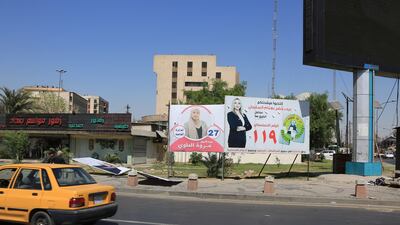
Election posters for Iraqi candidates in Baghdad. EPA -
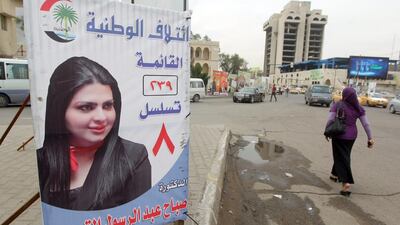
A banner shows the parliamentary candidate Sabah abed Al Rasul Al Tamimi. AFP -
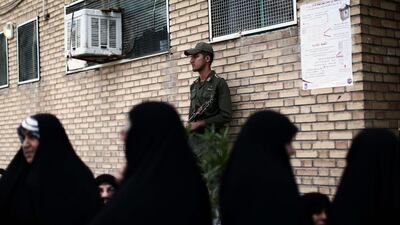
Iraqi women living in Iran line up to vote in Iraq’s parliamentary elections. AFP Photo -

A poster for Dr Dinia Al Naemi, who has given up her job in London to stand for election in her native Mosul. Photo: Mahmoud Ridha -

Life goes on - including for fruit sellers - in the run-up to parliamentary elections in Baghdad. AP Photo



