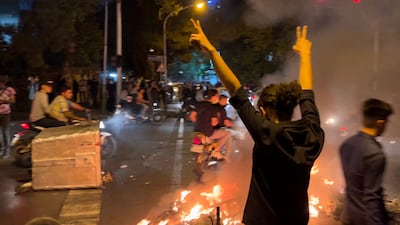
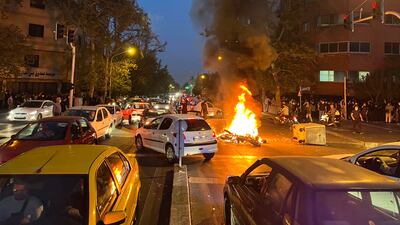
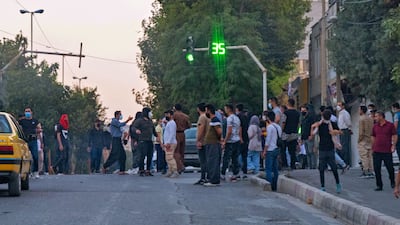
People clash with police during a protest following the death of Mahsa Amini in Tehran, Iran. EPA

US sanctions Iranian morality police and blames them for Mahsa Amini death


Kyle Fitzgerald
  • English
  • Arabic

The US on Thursday sanctioned Iran's morality police and blamed the notorious force for the death of 22-year-old Mahsa Amini, who died after being detained for allegedly not wearing her hijab properly.

“Today, the US Department of the Treasury’s Office of Foreign Assets Control is designating Iran’s morality police for abuse and violence against Iranian women and the violation of the rights of peaceful Iranian protesters,” the Treasury said.

Amini, who was from Iran's western Kurdistan province, fell into a coma after being arrested by morality police in Tehran last week. Her death has prompted days of deadly protests, with at least 31 people now thought to have been killed in authorities' response to the demonstrations.

The woman's father claimed that Iranian authorities covered bruises on Amini's body and refused to allow her family to see them.

“Mahsa Amini was a courageous woman whose death in morality police custody was yet another act of brutality by the Iranian regime’s security forces against its own people,” Treasury Secretary Janet Yellen said.

“We condemn this unconscionable act in the strongest terms and call on the Iranian government to end its violence against women and its ongoing violent crackdown on free expression and assembly.”

US Secretary of State Antony Blinken added: “We mourn with her loved ones and with the Iranian people.”

Sanctions were placed on Mohammad Rostami Cheshmeh Gachi, head of the Iranian morality police; Haj Ahmad Mirzaei, who heads the morality police's division in Tehran; and five other security officials involved in repressing protesters.

Iran protests — in pictures

  • A protest for Mahsa Amini, a woman who died after being arrested by the Islamic republic's 'morality police', in Tehran. AFP
    A protest for Mahsa Amini, a woman who died after being arrested by the Islamic republic's 'morality police', in Tehran. AFP
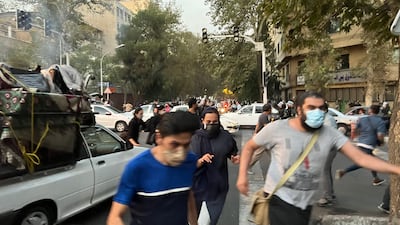
  • Demonstrators disperse during the protest for Amini, who died in a hospital in the capital Tehran on Friday. AFP
    Demonstrators disperse during the protest for Amini, who died in a hospital in the capital Tehran on Friday. AFP
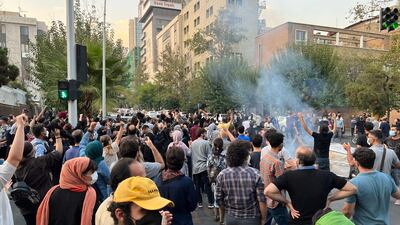
  • The crowd chanted 'Death to the dictator', meaning Supreme Leader Ayatollah Ali Khamenei, while some women took off their headscarves. AFP
    The crowd chanted 'Death to the dictator', meaning Supreme Leader Ayatollah Ali Khamenei, while some women took off their headscarves. AFP
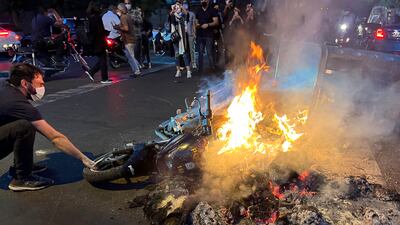
  • A man pulls out a police motorcycle set on fire during the protest. Amini had been detained for violating the country's conservative dress code. AP
    A man pulls out a police motorcycle set on fire during the protest. Amini had been detained for violating the country's conservative dress code. AP
  • In recent months, rights activists have urged women to remove their veils in public, a gesture that would risk their arrest for defying a dress code as the country's rulers crack down on 'immoral behaviour'. AP
    In recent months, rights activists have urged women to remove their veils in public, a gesture that would risk their arrest for defying a dress code as the country's rulers crack down on 'immoral behaviour'. AP
  • Iranians protest in Sanandaj, the capital of Iran's Kurdistan province, following the Amini's death while in custody. AFP
    Iranians protest in Sanandaj, the capital of Iran's Kurdistan province, following the Amini's death while in custody. AFP
  • Iranian police officers clash with demonstrators in Tehran. Police said Amini fell into a coma as she waited with other detained women at a morality police station, rejecting allegations that she was probably beaten. AFP
    Iranian police officers clash with demonstrators in Tehran. Police said Amini fell into a coma as she waited with other detained women at a morality police station, rejecting allegations that she was probably beaten. AFP

The department said Mr Rostami declared earlier this year that the morality police would punish Iranian women who refuse to wear the hijab.

The Treasury accused the sanctioned officials of routinely using violence to “suppress peaceful protesters”, as well as members of Iranian civil society, political dissidents, advocates for women's rights and those belonging to the Baha’i community

“The Iranian government needs to end its systemic persecution of women and allow peaceful protest. The United States will continue to voice our support for human rights in Iran and hold those who violate them to account,” Mr Blinken said.

US President Joe Biden on Wednesday declared his support for protesters during a speech at the UN and his administration has been quicker to condemn the growing protest movement than Barack Obama did with Iran's Green Movement in 2009.

Iranian President Ebrahim Raisi, also in attendance at the UN General Assembly this week, reportedly backed out of an interview in New York because the television interviewer refused to wear a headscarf.

An aide of Mr Raisi told CNN's Christiane Amanpour the Iranian president would only participate if she wore a headscarf, referring to “the situation in Iran”.

“I politely declined. We are in New York, where there is no law or tradition regarding headscarves,” Ms Amanpour wrote on Instagram, next to a picture of her facing an empty chair. “As protests continue in Iran and people are being killed, it would have been an important moment to speak with President Raisi.”

Sanctions from the Treasury Department aim to freeze any assets designated people might have in the US and also forbid them from conducting business dealings with Americans and US companies in an attempt to place limits on their financial networks.


Switching%20sides
%3Cp%3EMahika%20Gaur%20is%20the%20latest%20Dubai-raised%20athlete%20to%20attain%20top%20honours%20with%20another%20country.%0D%3C%2Fp%3E%0A%3Cp%3E%3Cstrong%3EVelimir%20Stjepanovic%20(Serbia%2C%20swimming)%20%3C%2Fstrong%3E%0D%3Cbr%3EBorn%20in%20Abu%20Dhabi%20and%20raised%20in%20Dubai%2C%20he%20finished%20sixth%20in%20the%20final%20of%20the%202012%20Olympic%20Games%20in%20London%20in%20the%20200m%20butterfly%20final.%20%0D%3C%2Fp%3E%0A%3Cp%3E%3Cstrong%3EJonny%20Macdonald%20(Scotland%2C%20rugby%20union)%20%3C%2Fstrong%3E%0D%3Cbr%3EBrought%20up%20in%20Abu%20Dhabi%20and%20represented%20the%20region%20in%20international%20rugby.%20When%20the%20Arabian%20Gulf%20team%20was%20broken%20up%20into%20its%20constituent%20nations%2C%20he%20opted%20to%20play%20for%20Scotland%20instead%2C%20and%20went%20to%20the%20Hong%20Kong%20Sevens.%20%0D%3C%2Fp%3E%0A%3Cp%3E%3Cstrong%3ESophie%20Shams%20(England%2C%20rugby%20union)%20%3C%2Fstrong%3E%0D%3Cbr%3EThe%20daughter%20of%20an%20English%20mother%20and%20Emirati%20father%2C%20Shams%20excelled%20at%20rugby%20in%20Dubai%2C%20then%20after%20attending%20university%20in%20the%20UK%20played%20for%20England%20at%20sevens.%20%0D%3C%2Fp%3E%0A

Mercer, the investment consulting arm of US services company Marsh & McLennan, expects its wealth division to at least double its assets under management (AUM) in the Middle East as wealth in the region continues to grow despite economic headwinds, a company official said.

Mercer Wealth, which globally has $160 billion in AUM, plans to boost its AUM in the region to $2-$3bn in the next 2-3 years from the present $1bn, said Yasir AbuShaban, a Dubai-based principal with Mercer Wealth.

Within the next two to three years, we are looking at reaching $2 to $3 billion as a conservative estimate and we do see an opportunity to do so,” said Mr AbuShaban.

Mercer does not directly make investments, but allocates clients’ money they have discretion to, to professional asset managers. They also provide advice to clients.

“We have buying power. We can negotiate on their (client’s) behalf with asset managers to provide them lower fees than they otherwise would have to get on their own,” he added.

Mercer Wealth’s clients include sovereign wealth funds, family offices, and insurance companies among others.

From its office in Dubai, Mercer also looks after Africa, India and Turkey, where they also see opportunity for growth.

Wealth creation in Middle East and Africa (MEA) grew 8.5 per cent to $8.1 trillion last year from $7.5tn in 2015, higher than last year’s global average of 6 per cent and the second-highest growth in a region after Asia-Pacific which grew 9.9 per cent, according to consultancy Boston Consulting Group (BCG). In the region, where wealth grew just 1.9 per cent in 2015 compared with 2014, a pickup in oil prices has helped in wealth generation.

BCG is forecasting MEA wealth will rise to $12tn by 2021, growing at an annual average of 8 per cent.

Drivers of wealth generation in the region will be split evenly between new wealth creation and growth of performance of existing assets, according to BCG.

Another general trend in the region is clients’ looking for a comprehensive approach to investing, according to Mr AbuShaban.

“Institutional investors or some of the families are seeing a slowdown in the available capital they have to invest and in that sense they are looking at optimizing the way they manage their portfolios and making sure they are not investing haphazardly and different parts of their investment are working together,” said Mr AbuShaban.

Some clients also have a higher appetite for risk, given the low interest-rate environment that does not provide enough yield for some institutional investors. These clients are keen to invest in illiquid assets, such as private equity and infrastructure.

“What we have seen is a desire for higher returns in what has been a low-return environment specifically in various fixed income or bonds,” he said.

“In this environment, we have seen a de facto increase in the risk that clients are taking in things like illiquid investments, private equity investments, infrastructure and private debt, those kind of investments were higher illiquidity results in incrementally higher returns.”

The Abu Dhabi Investment Authority, one of the largest sovereign wealth funds, said in its 2016 report that has gradually increased its exposure in direct private equity and private credit transactions, mainly in Asian markets and especially in China and India. The authority’s private equity department focused on structured equities owing to “their defensive characteristics.”

Updated: June 13, 2023, 12:17 PM