Iranian supreme leader Ayatollah Ali Khamenei marked the 33rd anniversary of revolutionary leader Ruhollah Khomeini's death with criticism of what he called Iran's enemies. EPA

Iranian supreme leader says Tehran took oil from Greek tankers


Amr Mostafa
  • English
  • Arabic

Supreme leader Ayatollah Ali Khamenei said on Saturday that Iran took oil from two Greek tankers last month in the Arabian Gulf.

Helicopter raids were launched in retaliation for Greece’s part in the US taking crude from an Iranian-flagged tanker in the Mediterranean Sea because of sanctions on the Islamic Republic.

“They steal Iranian oil off the Greek coast, then our brave men who don’t fear death respond and seized the enemy’s oil tanker,” Mr Khamenei said in a speech marking the 33rd anniversary of the death of the leader of Iran's 1979 Islamic revolution, Ruhollah Khomeini.

“Who is the pirate? You stole our oil, we took it back from you.”

Iran’s confiscation of the tankers was the latest in a string of hijackings and explosions in the region that includes the Strait of Hormuz, the narrow mouth of the Arabian Gulf through which a fifth of all traded oil passes.

A file photo of Iranian Revolutionary Guards, which seized two Greek oil tankers in the Gulf on May 27. AFP

The incidents began in 2018, after US president Donald Trump abandoned the 2015 nuclear deal between Iran and six world powers. Under that, Tehran had limited its enrichment of uranium in exchange for the lifting of economic sanctions.

In his speech, Mr Khamenei accused the US of supporting recent protests in Iran sparked by price increases and the slashing of subsidies by the government, saying enemies were fuelling unrest in attempts to overthrow the government.

“The enemies have counted on public protests to put people against the Islamic Republic,” Mr Khamenei said. “Surely the enemy’s forecast is wrong, like many of its others.”

Street protests across several provinces in Iran have simmered in recent weeks following the latest cut in state food subsidies nearly a year after President Ebrahim Raisi took office.

The latest protests underscore an economic crisis and stalled negotiations with major powers over the country’s nuclear enrichment plans

“They think they can cause confrontation between people and the Islamic Republic, which is wrong because the Islamic Republic attaches great importance to people,” IRNA news agency quoted Mr Khamenei as saying, referring to enemies.

“The nature of the Islamic Republic is against oppression.”

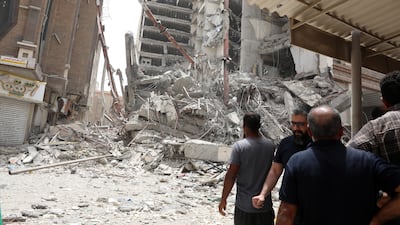
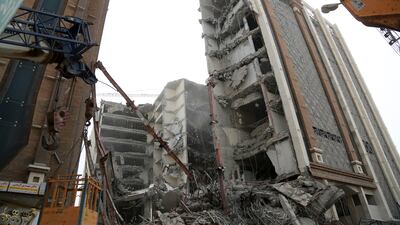
  • People stand at the site where a 10-storey building collapsed in the city of Abadan, Iran. EPA
    People stand at the site where a 10-storey building collapsed in the city of Abadan, Iran. EPA
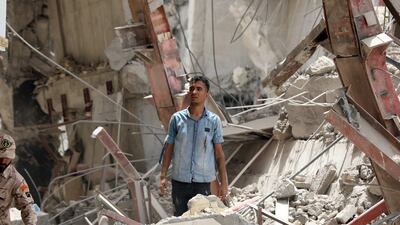
  • There are fears the death toll could rise as dozens of people are still believed to be trapped under the rubble. EPA
    There are fears the death toll could rise as dozens of people are still believed to be trapped under the rubble. EPA
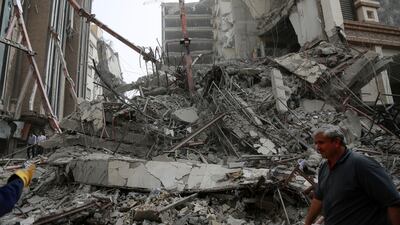
  • Building collapses are not uncommon in Iran. Fars News Agency / AP
    Building collapses are not uncommon in Iran. Fars News Agency / AP
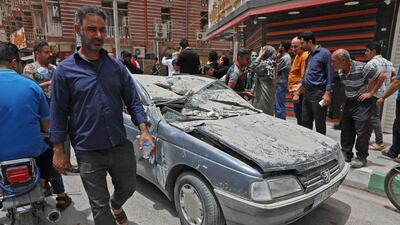
  • People gather at the site where the 10-storey building collapsed. Tasnim News / AFP
    People gather at the site where the 10-storey building collapsed. Tasnim News / AFP
  • The cause of the collapse, which occurred during a sandstorm, is still unclear. Tasnim News / AFP
    The cause of the collapse, which occurred during a sandstorm, is still unclear. Tasnim News / AFP
  • The owner of the building and the project manager of the construction company that built it were arrested. Fars News Agency / AP
    The owner of the building and the project manager of the construction company that built it were arrested. Fars News Agency / AP
  • People gather at the site of the building collapse. Tasnim News / AFP
    People gather at the site of the building collapse. Tasnim News / AFP

The government has sharply raised the price of some basic goods, such as cooking oil and flour-based staples.

People snatched loaves of bread from shop shelves before the prices increased.

For months, teachers have protested, demanding better pay, working conditions, and education reforms.


Mercer, the investment consulting arm of US services company Marsh & McLennan, expects its wealth division to at least double its assets under management (AUM) in the Middle East as wealth in the region continues to grow despite economic headwinds, a company official said.

Mercer Wealth, which globally has $160 billion in AUM, plans to boost its AUM in the region to $2-$3bn in the next 2-3 years from the present $1bn, said Yasir AbuShaban, a Dubai-based principal with Mercer Wealth.

Within the next two to three years, we are looking at reaching $2 to $3 billion as a conservative estimate and we do see an opportunity to do so,” said Mr AbuShaban.

Mercer does not directly make investments, but allocates clients’ money they have discretion to, to professional asset managers. They also provide advice to clients.

“We have buying power. We can negotiate on their (client’s) behalf with asset managers to provide them lower fees than they otherwise would have to get on their own,” he added.

Mercer Wealth’s clients include sovereign wealth funds, family offices, and insurance companies among others.

From its office in Dubai, Mercer also looks after Africa, India and Turkey, where they also see opportunity for growth.

Wealth creation in Middle East and Africa (MEA) grew 8.5 per cent to $8.1 trillion last year from $7.5tn in 2015, higher than last year’s global average of 6 per cent and the second-highest growth in a region after Asia-Pacific which grew 9.9 per cent, according to consultancy Boston Consulting Group (BCG). In the region, where wealth grew just 1.9 per cent in 2015 compared with 2014, a pickup in oil prices has helped in wealth generation.

BCG is forecasting MEA wealth will rise to $12tn by 2021, growing at an annual average of 8 per cent.

Drivers of wealth generation in the region will be split evenly between new wealth creation and growth of performance of existing assets, according to BCG.

Another general trend in the region is clients’ looking for a comprehensive approach to investing, according to Mr AbuShaban.

“Institutional investors or some of the families are seeing a slowdown in the available capital they have to invest and in that sense they are looking at optimizing the way they manage their portfolios and making sure they are not investing haphazardly and different parts of their investment are working together,” said Mr AbuShaban.

Some clients also have a higher appetite for risk, given the low interest-rate environment that does not provide enough yield for some institutional investors. These clients are keen to invest in illiquid assets, such as private equity and infrastructure.

“What we have seen is a desire for higher returns in what has been a low-return environment specifically in various fixed income or bonds,” he said.

“In this environment, we have seen a de facto increase in the risk that clients are taking in things like illiquid investments, private equity investments, infrastructure and private debt, those kind of investments were higher illiquidity results in incrementally higher returns.”

The Abu Dhabi Investment Authority, one of the largest sovereign wealth funds, said in its 2016 report that has gradually increased its exposure in direct private equity and private credit transactions, mainly in Asian markets and especially in China and India. The authority’s private equity department focused on structured equities owing to “their defensive characteristics.”

ETFs explained

Exhchange traded funds are bought and sold like shares, but operate as index-tracking funds, passively following their chosen indices, such as the S&P 500, FTSE 100 and the FTSE All World, plus a vast range of smaller exchanges and commodities, such as gold, silver, copper sugar, coffee and oil.

ETFs have zero upfront fees and annual charges as low as 0.07 per cent a year, which means you get to keep more of your returns, as actively managed funds can charge as much as 1.5 per cent a year.

There are thousands to choose from, with the five biggest providers BlackRock’s iShares range, Vanguard, State Street Global Advisors SPDR ETFs, Deutsche Bank AWM X-trackers and Invesco PowerShares.

Ten tax points to be aware of in 2026

1. Domestic VAT refund amendments: request your refund within five years

If a business does not apply for the refund on time, they lose their credit.

2. E-invoicing in the UAE

Businesses should continue preparing for the implementation of e-invoicing in the UAE, with 2026 a preparation and transition period ahead of phased mandatory adoption. 

3. More tax audits

Tax authorities are increasingly using data already available across multiple filings to identify audit risks. 

4. More beneficial VAT and excise tax penalty regime

Tax disputes are expected to become more frequent and more structured, with clearer administrative objection and appeal processes. The UAE has adopted a new penalty regime for VAT and excise disputes, which now mirrors the penalty regime for corporate tax.

5. Greater emphasis on statutory audit

There is a greater need for the accuracy of financial statements. The International Financial Reporting Standards standards need to be strictly adhered to and, as a result, the quality of the audits will need to increase.

6. Further transfer pricing enforcement

Transfer pricing enforcement, which refers to the practice of establishing prices for internal transactions between related entities, is expected to broaden in scope. The UAE will shortly open the possibility to negotiate advance pricing agreements, or essentially rulings for transfer pricing purposes. 

7. Limited time periods for audits

Recent amendments also introduce a default five-year limitation period for tax audits and assessments, subject to specific statutory exceptions. While the standard audit and assessment period is five years, this may be extended to up to 15 years in cases involving fraud or tax evasion. 

8. Pillar 2 implementation 

Many multinational groups will begin to feel the practical effect of the Domestic Minimum Top-Up Tax (DMTT), the UAE's implementation of the OECD’s global minimum tax under Pillar 2. While the rules apply for financial years starting on or after January 1, 2025, it is 2026 that marks the transition to an operational phase.

9. Reduced compliance obligations for imported goods and services

Businesses that apply the reverse-charge mechanism for VAT purposes in the UAE may benefit from reduced compliance obligations. 

10. Substance and CbC reporting focus

Tax authorities are expected to continue strengthening the enforcement of economic substance and Country-by-Country (CbC) reporting frameworks. In the UAE, these regimes are increasingly being used as risk-assessment tools, providing tax authorities with a comprehensive view of multinational groups’ global footprints and enabling them to assess whether profits are aligned with real economic activity. 

Contributed by Thomas Vanhee and Hend Rashwan, Aurifer

The Settlers

Director: Louis Theroux

Starring: Daniella Weiss, Ari Abramowitz

Rating: 5/5

Bundesliga fixtures

Saturday, May 16 (kick-offs UAE time)

Borussia Dortmund v Schalke (4.30pm) 

RB Leipzig v Freiburg (4.30pm) 

Hoffenheim v Hertha Berlin (4.30pm) 

Fortuna Dusseldorf v Paderborn  (4.30pm) 

Augsburg v Wolfsburg (4.30pm) 

Eintracht Frankfurt v Borussia Monchengladbach (7.30pm)

Sunday, May 17

Cologne v Mainz (4.30pm),

Union Berlin v Bayern Munich (7pm)

Monday, May 18

Werder Bremen v Bayer Leverkusen (9.30pm)

Arabian Gulf Cup FINAL

Al Nasr 2

(Negredo 1, Tozo 50)

Shabab Al Ahli 1

(Jaber 13)

Updated: June 04, 2022, 11:23 AM