• A satellite image of the Grand Ethiopian Renaissance Dam on the Blue Nile river in the Benishangul-Gumuz region of Ethiopia. Maxar Technologies via AP
    A satellite image of the Grand Ethiopian Renaissance Dam on the Blue Nile river in the Benishangul-Gumuz region of Ethiopia. Maxar Technologies via AP
  • A satellite image of the Grand Ethiopian Renaissance Dam on the Blue Nile river in the Benishangul-Gumuz region of Ethiopia. Maxar Technologies via AP
    A satellite image of the Grand Ethiopian Renaissance Dam on the Blue Nile river in the Benishangul-Gumuz region of Ethiopia. Maxar Technologies via AP
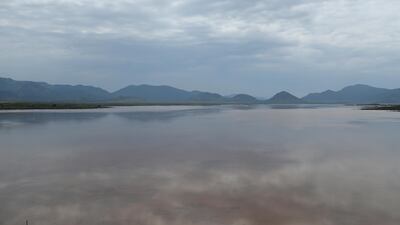
  • A 2013 photo showing the Blue Nile river flowing near the site of the Grand Ethiopian Renaissance Dam near Assosa in the Benishangul-Gumuz region of Ethiopia. AP, File
    A 2013 photo showing the Blue Nile river flowing near the site of the Grand Ethiopian Renaissance Dam near Assosa in the Benishangul-Gumuz region of Ethiopia. AP, File
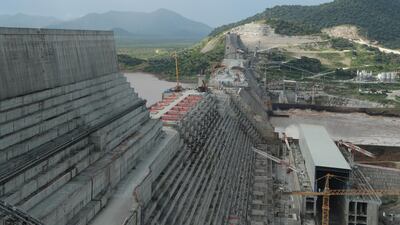
  • A general view of construction work at the site of the Grand Ethiopian Renaissance Dam near Assosa, Ethiopia. AP, File
    A general view of construction work at the site of the Grand Ethiopian Renaissance Dam near Assosa, Ethiopia. AP, File
  • A general view of construction work at the site of the Grand Ethiopian Renaissance Dam near Assosa, Ethiopia. AFP, File
    A general view of construction work at the site of the Grand Ethiopian Renaissance Dam near Assosa, Ethiopia. AFP, File
  • A general view of construction work at the site of the Grand Ethiopian Renaissance Dam near Assosa, Ethiopia. AFP, File
    A general view of construction work at the site of the Grand Ethiopian Renaissance Dam near Assosa, Ethiopia. AFP, File
  • Construction workers are seen at the site of the Grand Ethiopian Renaissance Dam near Assosa, Ethiopia. AFP, File
    Construction workers are seen at the site of the Grand Ethiopian Renaissance Dam near Assosa, Ethiopia. AFP, File
  • A general view of construction work at the site of the Grand Ethiopian Renaissance Dam near Assosa, Ethiopia. AFP, File
    A general view of construction work at the site of the Grand Ethiopian Renaissance Dam near Assosa, Ethiopia. AFP, File
  • A general view of construction work at the site of the Grand Ethiopian Renaissance Dam near Assosa, Ethiopia. AFP, File
    A general view of construction work at the site of the Grand Ethiopian Renaissance Dam near Assosa, Ethiopia. AFP, File
  • A view of construction work at the site of the Grand Ethiopian Renaissance Dam near Assosa, Ethiopia. AFP, File
    A view of construction work at the site of the Grand Ethiopian Renaissance Dam near Assosa, Ethiopia. AFP, File
  • A general view of construction work at the site of the Grand Ethiopian Renaissance Dam near Assosa, Ethiopia. AFP, File
    A general view of construction work at the site of the Grand Ethiopian Renaissance Dam near Assosa, Ethiopia. AFP, File
  • A general view of construction work at the site of the Grand Ethiopian Renaissance Dam near Assosa, Ethiopia. AFP, File
    A general view of construction work at the site of the Grand Ethiopian Renaissance Dam near Assosa, Ethiopia. AFP, File
  • Sudan's Minister of Irrigation and Water Resources Yasir Mohamed (C) takes part in a video meeting over the Grand Ethiopian Renaissance Dam on June 9, 2020. AFP
    Sudan's Minister of Irrigation and Water Resources Yasir Mohamed (C) takes part in a video meeting over the Grand Ethiopian Renaissance Dam on June 9, 2020. AFP
  • Egyptian Foreign Minister Sameh Shukry. AP
    Egyptian Foreign Minister Sameh Shukry. AP
  • The Nile in the Sudanese capital, Khartoum. AFP
    The Nile in the Sudanese capital, Khartoum. AFP
  • The Nile in the Sudanese capital, Khartoum. AFP
    The Nile in the Sudanese capital, Khartoum. AFP
  • The Nile in the Sudanese capital, Khartoum. AFP
    The Nile in the Sudanese capital, Khartoum. AFP
  • A pleasure boat carrying tourists and locals sails on the Nile at sunset in Aswan, Egypt. AP, file
    A pleasure boat carrying tourists and locals sails on the Nile at sunset in Aswan, Egypt. AP, file
  • Sayed Ahmed Abdoh poles his boat to check fish traps in the Nile, near Abu Al Nasr village, about 770 kilometres south of Cairo, in Egypt. AP, file
    Sayed Ahmed Abdoh poles his boat to check fish traps in the Nile, near Abu Al Nasr village, about 770 kilometres south of Cairo, in Egypt. AP, file
  • An aerial view shows the Nile before sunset in the Egyptian capital, Cairo. AFP
    An aerial view shows the Nile before sunset in the Egyptian capital, Cairo. AFP
  • An aerial view shows the Nile before sunset in the Egyptian capital, Cairo on June 20, 2020. AFP
    An aerial view shows the Nile before sunset in the Egyptian capital, Cairo on June 20, 2020. AFP

Nile crisis: Egypt says millions will 'suffer' if Ethiopia continues filling dam


Hamza Hendawi
  • English
  • Arabic

Egypt and Sudan will be left to “suffer” from reduced and erratic water supplies if a second filling of a Nile Dam being built in Ethiopia goes ahead this summer, the Egyptian Ministry of Irrigation said on Monday.

Ethiopia's assertion that the dam complies with international standards is a false claim

The two nations would be affected if the river's flood this year proves to be average or low, the ministry said, highlighting what it alleged was a serious design flaw in the dam.

An escalating row over the dam's construction has led to international fears that a military stand-off could occur.

In a letter to the UN Security Council last week, Egyptian Foreign Minister Sameh Shukry said the second filling would cause "great if not disastrous harm" to Egypt and Sudan and warned that failure to reach an agreement with Ethiopia would raise regional tensions and pose a threat to international peace and security.

  • Ethiopia's Grand Renaissance Dam under construction on September 26, 2019. Reuters
    Ethiopia's Grand Renaissance Dam under construction on September 26, 2019. Reuters
  • Ethiopia's Grand Renaissance Dam under construction on September 26, 2019. Reuters
    Ethiopia's Grand Renaissance Dam under construction on September 26, 2019. Reuters
  • A water basin near Ethiopia's Grand Renaissance Dam. Reuters
    A water basin near Ethiopia's Grand Renaissance Dam. Reuters
  • Turbine housings at Ethiopia's Grand Renaissance Dam powerhouse. Reuters
    Turbine housings at Ethiopia's Grand Renaissance Dam powerhouse. Reuters

Egypt's irrigation ministry said on Monday that last year's first filling was designed for "media and political purposes" rather than technical requirements.

This was because last year, the hydroelectric dam was not ready to generate electricity, a situation which would not change when the next filling is due, it said.

Talks on water sharing stumble 

Talks between Egypt, Sudan and Ethiopia on the dam have been deadlocked for a decade, with the two nations unable to persuade Addis Ababa to enter a legally binding deal on the filling and the operation of the dam.

Cairo and Khartoum have also failed to persuade Ethiopia to allow a quartet of the UN the US, European Union and African Union to mediate in the dispute.

There has been no progress in the latest negotiations since the AU began sponsoring them nearly a year ago, but Addis Ababa wants the AU to remain as the sole party with a say in the process, beside the three nations.

“Regrettably, the process led by the African Union has thus far proved ineffective,” Mr Shukry told the UN Security Council last week.

Ethiopia meanwhile insists the second filling of the Grand Ethiopian Renaissance Dam, or GERD, will go ahead regardless of whether a deal is reached.

"The two downstream nations will suffer in the case of an average flood. Conditions will be worse in the case of a low flood," said the Egyptian ministry.

The next filling is expected to total 13.5 billion cubic metres, nearly three times the size of last year's.

The earlier filling disrupted work at Sudan’s water treatment plants, leaving thousands of homes without running water for days. Sudan says this year’s filling could put the lives of 20 million of its people at risk.

A view of Egyptian sailboats (feluccas) anchored on the River Nile in Luxor, Egypt, 10 April 2021. EPA

Egypt, which depends on the Nile for more than 90 per cent of its fresh water needs, was not affected by last year’s filling, thanks to a bumper flood that filled its large Aswan Dam reservoir to near capacity.

"Why a second filling when the dam is not ready to generate electricity?" said the irrigation ministry.

“It is a continuation of a policy that aims to impose a fait accompli through unilateral actions that harm the two downstream nations because of the absence of a clear co-ordination mechanism framed through a legally binding and fair agreement.”

The ministry went on to question the safety of the GERD, citing what it said were a series of changes that suggested a level of shoddiness in construction. These include the reduction of the number of power turbines originally planned from 16 to 13 and adjusting the level of the dam's gates.

“Ethiopia’s assertion that the dam complies with international standards is a false claim,” it said.

Egypt, the most populous Arab nation with more than 100 million people, is deeply concerned that a significant cut in its share of the Nile water would wipe out hundreds of thousands of jobs and disrupt its delicate food balance.

Egyptian President Abdel Fattah El Sisi has repeatedly stated his preference for a negotiated resolution of the GERD dispute but also warned Egypt would not stand by idly if denied a “single drop” of water and that no one should be in doubt about the far reach of its “capabilities,” a thinly-veiled reference to its military.

Egypt and Sudan have also forged close military ties in recent months, conducting joint air and land war games and signing a military co-operation agreement.


Hunger and Fury: The Crisis of Democracy in the Balkans
Jasmin Mujanović, Hurst Publishers

'The worst thing you can eat'

Trans fat is typically found in fried and baked goods, but you may be consuming more than you think.

Powdered coffee creamer, microwave popcorn and virtually anything processed with a crust is likely to contain it, as this guide from Mayo Clinic outlines: 

Baked goods - Most cakes, cookies, pie crusts and crackers contain shortening, which is usually made from partially hydrogenated vegetable oil. Ready-made frosting is another source of trans fat.

Snacks - Potato, corn and tortilla chips often contain trans fat. And while popcorn can be a healthy snack, many types of packaged or microwave popcorn use trans fat to help cook or flavour the popcorn.

Fried food - Foods that require deep frying — french fries, doughnuts and fried chicken — can contain trans fat from the oil used in the cooking process.

Refrigerator dough - Products such as canned biscuits and cinnamon rolls often contain trans fat, as do frozen pizza crusts.

Creamer and margarine - Nondairy coffee creamer and stick margarines also may contain partially hydrogenated vegetable oils.

What is cyberbullying?

Cyberbullying or online bullying could take many forms such as sending unkind or rude messages to someone, socially isolating people from groups, sharing embarrassing pictures of them, or spreading rumors about them.

Cyberbullying can take place on various platforms such as messages, on social media, on group chats, or games.

Parents should watch out for behavioural changes in their children.

When children are being bullied they they may be feel embarrassed and isolated, so parents should watch out for signs of signs of depression and anxiety