


With Ramadan festivities in full swing, many Egyptians seem unperturbed by the deadly virus quietly stalking Egypt, killing hundreds every week.
In 2020, the holy month fell at a time when the country of 100 million people was firmly locked down to contain the spread of the coronavirus.
Then, the foreboding feeling of a mysterious but deadly disease stalking the country seemed to hang over everyone’s head.
But the tone is different this year. Despite the threat remaining high, Egyptians are taking risks with Covid-19 on an unprecedented scale.
With only a handful of restrictions in place, millions are savouring the return of the month’s traditions; from packed restaurants and cafes to large family gatherings and live music shows held in special tents. But for some, the holy month will change forever, as tragedy strikes.
Families destroyed
Hassan had a sinking feeling that his Covid-19-infected father was soon to depart this world.
The father, 62, passed away this month, leaving behind a wife, two daughters and Hassan, 33.
“For the final two weeks of his life, I felt that I was ready for his death. His death was frequently on my mind and I could even see it sometimes in visions,” said Hassan, who only wanted to be identified by his first name to protect his privacy.
“For those two weeks I was unconsciously repeating to myself a prayer that speaks of the resignation to God’s plans: ‘What God wills will be, and what He doesn’t, will not’.”
Hassan’s pain is more acute now that Ramadan has arrived.
During the holy month of fasting, praying and family gatherings, Muslims feel the loss of loved ones more deeply, and more painfully than at any other time of the year.
Hassan’s family are among many who must live through the special month with all its cherished rituals and beloved customs without a parent.
With the festivities in full swing, many, if not most, seem oblivious to a “third wave” of the pandemic that’s silently taking hundreds of lives and infecting thousands every week.
“People, the coronavirus is on the rise … I beg you, take care of yourselves and your children,” popular TV show host Amr Adeeb screamed in despair on the Saturday night edition of his programme “Al Hekayah,” or “The Story,” aired on the Saudi-owned MBC network.
He also complained about the return of packed, all-night Ramadan celebrations in tents where food and beverages are served while live music played. “How come they are allowed to make a comeback?” he lamented.
Economic priorities
The government has decided not to order a lockdown like it did last year, when the economy was battered despite a generous economic stimulus package.
Those measures led to a quick return to business as usual, albeit with a sharp rise in prices.
A second lockdown could have caused an economic meltdown, wiping out the hard won gains the economy made after ambitious reforms.
-

Egyptian policeman Mohamed Nasser, wearing a face mask, fires a Ramadan cannon, a traditional cannon that was used in the earlier days to announce breaking fast time, in Cairo, Egypt. EPA -

Children are seen as Hajja Dalal, a 46-year-old Mesaharati, beats a drum to wake up Muslims to have the predawn meal. Reuters -

An Egyptian craftsman makes traditional Ramadan lanterns, called Fanous, at a workshop in Cairo, Egypt. EPA -

Ramadan is the ninth month in the Islamic calendar and it is believed that the revelation of the Koran's first verses occurred during its last 10 nights. EPA -

Egyptian muslims perform tarawih prayers during the holy fasting month of Ramadan inside the Al Azhar Mosque in Cairo. EPA -

Egyptian muslims perform tarawih prayers during the holy fasting month of Ramadan inside the Al Azhar Mosque in Cairo. EPA -

A worker wearing a protective suit poses for a photograph as he prepares to spray disinfectant in Al Fateh mosque in Cairo. EPA -
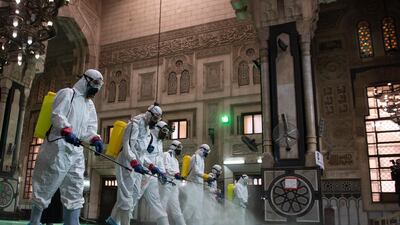
Workers wearing protective suits spray disinfectant in Cairo's Al Fateh mosque. EPA -

A worker sprays disinfectant on the gates of Al Hussein mosque in Cairo, Egypt, in preparation for prayers during Ramadan. Reuters -

Al Hussein mosque was closed last year because of failures to adhere to preventive measures against the coronavirus. Reuters -

Al Hussein mosque was built in 1154, and was reconstructed in 1874. Reuters -

Ramadan will begin next week. Reuters -

Disinfecting is a vital part of preparing Al Hussein mosque to receive worshippers during the holy month. Reuters -

Prayers continued at Al Hussein mosque this week while it was being prepared for Ramadan. Reuters


Authorities subsequently opted for minimal restrictions while emphasising the need to maintain preventive measures such as social distancing and wearing face masks.
The decision has kept the economy humming and protected the livelihoods of millions depending on a daily wage.
“The atmosphere is quiet this Ramadan with none of the panic that was widespread last year because of the pandemic. That’s a good thing,” said Gihad Auda, a political science professor at Cairo’s Helwan University.
But he complained that authorities appear unable to bring down the number of infections. Counselling Egyptians to observe preventive measures was no longer enough, he said.
“We need to ‘restructure’ public space like we did last year when authorities physically prevented people from going to crowded markets. That helped reduce the rate of infections,” he said.
The relative leniency of this year’s anti-coronavirus measures has meanwhile helped create a false sense of immunity that has in turn encouraged large gatherings of people.
Making matters worse, the vaccination roll-out has gone off to a very slow start, with less than one per cent of the population vaccinated four months after the programme began.
The government’s handling of the pandemic has invited some criticism amid repeated pledges by the Health Ministry that millions of vaccine doses will soon be available and that it would soon be locally manufactured, satisfying domestic demand and exporting the surplus.
But until then, the elderly and those suffering from chronic diseases are falling prey to the virus. On Tuesday Egypt reported 855 new cases of Covid-19 and 42 deaths, bringing the death toll to over 250 in seven days and over 12,000 since the pandemic began.
The figures provided by the Health Ministry, are thought by experts to reflect the curve of the pandemic but not the actual rate of infections and fatalities, which could be as much as ten fold more.
Grief at Ramadan
Salma, her sister and parents contracted Covid-19 in early February and were fortunate enough to recover a couple of weeks later.
But her father, in his 60s and with a heart condition, suddenly fell ill later in the month and died barely two hours after he arrived at hospital.
Salma, who is in her 30s and wanted only to be identified by her first name, suspects that her father died of Covid-19 complications, but isn’t sure.
She was reluctant to talk about how the family is coping with their first Ramadan without their father, but her social media posts spoke clearly of the depth of her grief and how much she was missing him.
“God, on this first day of Ramadan, grant mercy to the pure souls that once waited for and found joy in Ramadan with us but lie today in their graves,” were Salma’s heart-rending words in one Facebook post last week. “God, on this first day of Ramadan, grant mercy to he who is not fasting with us this year and make his Ramadan better in heaven.”
In an unusually critical article in Cairo's daily El Masry El Youm, former deputy prime minister and economist Ziad Bahaa El Deen acknowledged that the government had limited resources with which to fight the pandemic, but that it needed to ensure that the vaccination roll-out is credible, fair and transparent to win the trust of Egyptians.
“It’s also the right of the people to expect two things: transparency and credibility in making available information pertaining to the pandemic, plans to fight it and to commit to a national policy respected by everyone,” he wrote in the daily’s April 15 edition.
But until the most vulnerable are vaccinated and infections are brought under control, the misery and grief brought about by the virus cannot be ignored.
“Every time I sign in on Facebook I read about someone I know or someone known to a relative or a friend who died of the Coronavirus,” said a 23-year-old university graduate, who also wanted to be identified only by her first name, Farida.
“It’s so sad.”

