
Protesters in Israel blocked major roads on Tuesday in Tel Aviv, Haifa and Jerusalem a day after parliament gave preliminary approval to a judicial overhaul bill that limits the Supreme Court's power.
Crowds waved Israeli flags during the morning rush hour, closing off roads and intersections in central Israel, Tel Aviv and near the entrance to Jerusalem, while some threw flares.
Police say they used water cannons to disperse demonstrators and arrested at least 73 people.
About 15,000 protesters were gathered at Ben Gurion International Airport and crowds were attempting to remove barricades, which led to clashes, police said.
-

Mass protests continue across Israel against the government's justice system reform plan. EPA -

Anti-government protesters march towards the Israeli Knesset in Jerusalem. EPA -

Protesters blocked roads across Israel, hours after parliament adopted a key clause of the government's judicial overhaul package, which opponents say threatens democracy. AFP -

A demonstrator in a dinosaur suit marches at Ben Gurion Airport near Lod. AFP -
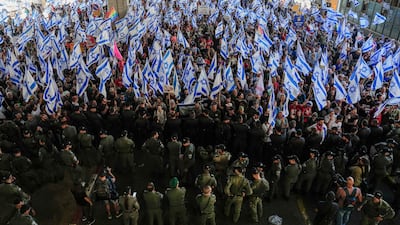
Israelis wave flags during a protest against plans by Prime Minister Benjamin Netanyahu's government to overhaul the judicial system. AP -

Israelis have taken to the streets en masse to protest against the government’s plans to weaken the power of judges. Bloomberg -

Mass protests continue across the country against the government's justice system reform plan. EPA -
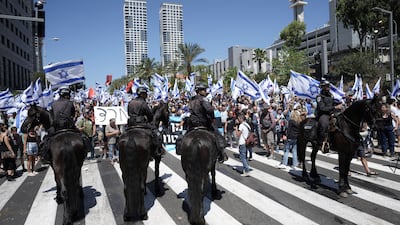
Mounted police in Tel Aviv, Israel, control protesters demonstrating against plans to overhaul the judicial system. AP -

Police and protesters clash on the 'Day of Disruption' opposing the judicial overhaul, in Tel Aviv. Reuters -

Israeli demonstrators wave flags as they block Highway 443 between Jerusalem and Tel Aviv, near Modiin. AFP -
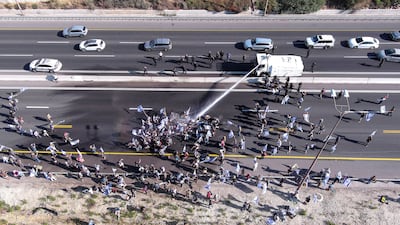
Israeli police use a water cannon against demonstrators at the Ein Hemed junction towards Jerusalem. Reuters -

Protesters set off a flare near Jerusalem as they oppose a bill to curb the Israeli Supreme Court's power to void government decisions. Reuters -

A confrontation in Tel Aviv, Israel, during protests against the move by Prime Minister Benjamin Netanyahu's coalition. Reuters -

Members of the Israeli security forces remove demonstrators blocking a highway to Jerusalem. Reuters -
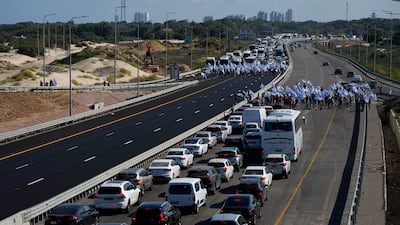
Israeli protesters block the Tel Aviv to Haifa highway near Beit Yanai, Israel. AP -
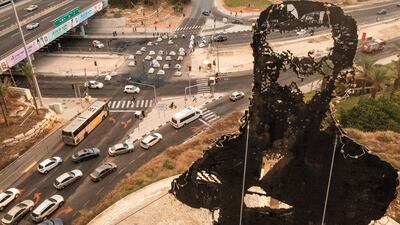
Demonstrators block a road with tents at the entrance to Herzliya, north of Tel Aviv, Israel. Reuters -

Israeli anti-government protesters block the entrance to Jerusalem, where some demonstrators entered the Knesset building. EPA


Hundreds of protesters also gathered outside the US consulate in Tel Aviv on Tuesday evening, calling for Washington to intervene in the judicial crisis.
Previous moves by Prime Minister Benjamin Netanyahu's coalition of nationalist and religious parties to change the justice system have been met with unprecedented demonstrations from the public.
Late on Monday, the coalition, which commands 64 of the Knesset's 120 seats, won the first of three required rounds of voting for the new bill to become law.
The new bill seeks to curb the Supreme Court's power to void decisions made by the government, ministers and elected officials. It now returns to the committee for debate and could be altered before going to a vote.
The bill must still pass through two more rounds of voting before it can be written into law. But the initial approval is a boost for Mr Netanyahu’s far-right government.
Ahead of the debate, some protesters entered the Knesset building in Jerusalem and had to be dragged out as hundreds demonstrated outside.
On Sunday, Mr Netanyahu signalled impatience with the rallies across the country, while protesters promised nationwide disruption on Tuesday.
Critics argue the new legislation will lead to corruption and abuse of power. Supporters say the change will aid effective government by curbing court intervention.
“It is not the end of democracy, it strengthens democracy,” Mr Netanyahu said in a video released as the Knesset debated the bill.
“Even after the amendment, court independence and civil rights in Israel will not be harmed in any way. The court will continue to oversee the legality of government action and appointments.”
His statement did little to calm opponents of the bill.
Protesters rallied outside the Supreme Court before marching to parliament and the nearby Bank of Israel after the bank’s governor Amir Yaron urged the government to seek agreement and safeguard institutional independence.
“Continued uncertainty is liable to have notable economic costs,” Mr Yaron told reporters, citing an excess depreciation of the shekel and underperformance of Israel's stock market.
In January, Mr Netanyahu was forced to dismiss cabinet member Aryeh Deri, of the ultra-Orthodox Jewish party Shas, after intervention by the Supreme Court, on the grounds of “reasonableness”, over a previous tax evasion conviction.

