

In front of a now destroyed 150-year-old church in the southern Turkish city of Samandag, Father Trifon Yumurta supervises the distribution of 2,500 meals a day cooked by volunteers.
The 54-year-old hopes that shared food and a sense of community will encourage locals to remain in the devastated region, located close to the epicentre of the February 6 earthquake that killed over 50,000 people in Turkey and Syria.
But most people have fled for safer cities. Much to the despair of Father Trifon, it is unclear if they will ever return.
If they do not return to Samandag, it could further diminish once thriving religious minority communities who lived in the Ottoman Empire and who the government of President Recep Tayyip Erdogan has said it wants to be revived in modern Turkey.
“We want people to stay here,” Father Trifon told The National.
“We don’t want them to go to another country or another city and leave their culture behind.”
The earthquake is a double blow to the country’s tiny Greek-Orthodox community, which had kept a presence in Hatay, in most part due to the province's distinct integration process into the modern state.
Many say that the community is now scattered and are fearful for its future.
Overall, experts believe that the Christian population living in Anatolia has shrunk from over a million in the 19th century under the Ottoman empire to roughly 100,000 today in modern Turkey.
Hatay is famous for housing a number of religious minorities, including Alawites, Assyrians, Jews and Armenians, though numbers dwindled throughout the past century.
Recently, public authorities have boosted this multi-religious aspect, and its name sometimes appeared spelt with a Jewish star of David in lieu of an 'A', a Christian cross in lieu of a 'T' and a Muslim half-crescent moon in lieu of a 'Y'.
Its capital Antakya was once one of early Christianity's most important cities alongside Rome and Jerusalem.
“Alawite Muslims, Greek-Orthodox Orthodox and Armenians live here,” said Father Trifon, one of two priests in Samandag, which has four churches in total and 400 Greek Orthodox families, according to him.
“We go to their funerals, they come to our ceremonies. We live peacefully. We don’t want to break this mosaic.”
In the hills above the city of roughly 200,000, a cave church founded by Saint Peter is said to be the first church in the world where Christians celebrated mass separately from Jews. It attracts pilgrims from around the world.
But the February 6 earthquake and its aftershocks have transformed the once proud Mediterranean city, which built its wealth in part thanks to its strategic geographical location on an ancient trade route, into a ghost town.
All day, cranes continue digging through the rubble of collapsed buildings to help rescue teams search for bodies which will be buried in mass graves in the suburbs.
In the old city, former neighbours hug each other in tears as they search for their belongings in the ruins.
Antakya, one of Turkey’s last symbols of tolerance and diversity, is no more.
Century-old mosques and churches have been reduced to piles of stone, and the local synagogue stands empty, its doors locked.
The handful of elderly Jews that lived in the city before the earthquake is reportedly gone or dead. No one thinks they will come back.
-
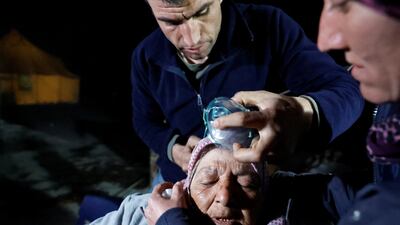
A woman is assisted after another earthquake in Antakya in Hatay province, Turkey. All photos by Reuters -
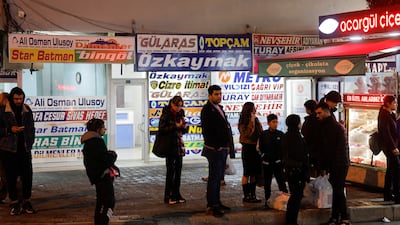
People gather on a street after an earthquake in Adana, Turkey. -
A resident checks his smartphone after an earthquake in Antakya in Hatay province, Turkey. -
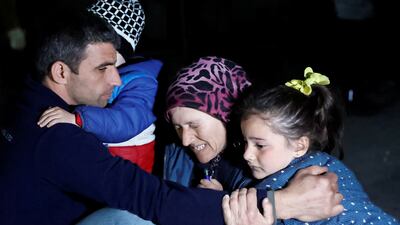
People react after an earthquake in Antakya in Hatay province, Turkey. -
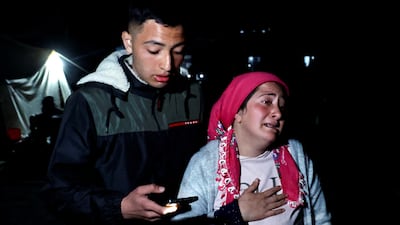
People react after an earthquake in Antakya in Hatay province, Turkey. -

People react after an earthquake in Antakya in Hatay province, Turkey. -
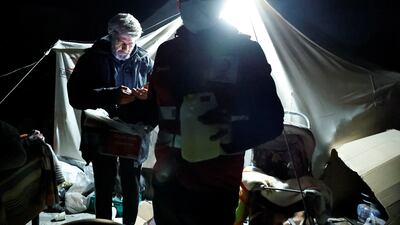
Residents walk outside after an earthquake in Antakya in Hatay province, Turkey. -
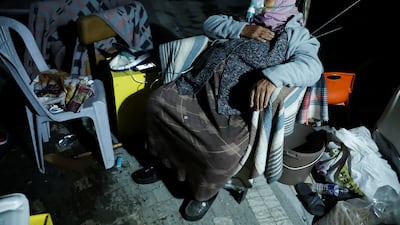
A woman rests after an earthquake in Antakya in Hatay province, Turkey. -
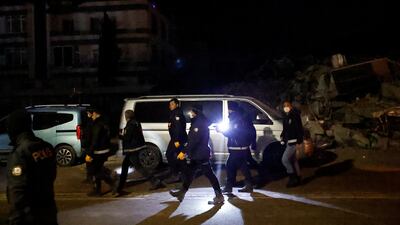
People walk outside after an earthquake in Antakya in Hatay province, Turkey. -
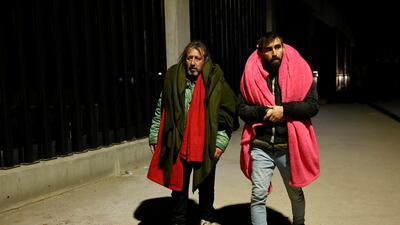
People walk outside after an earthquake in Antakya in Hatay province, Turkey. -
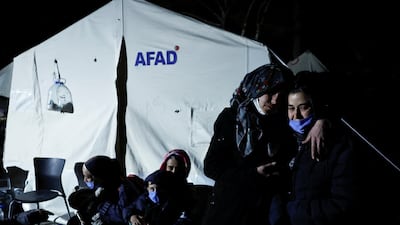
People react after an earthquake in Antakya in Hatay province, Turkey. -
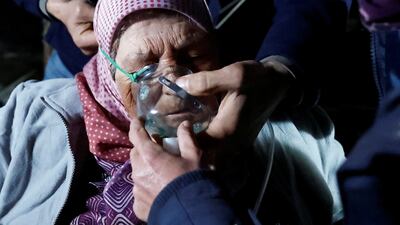
A woman is assisted after an earthquake in Antakya in Hatay province, Turkey.


Christians worry that they will suffer the same fate.
“There’s no life anymore,” said Father Ignatius Yapitzioglou, a Greek Orthodox priest from Antakya.
“Our biggest fear is that the young will leave and never return, and that’s a very difficult thought. It’s a very sad time.”
“There are no hospitals, no schools. For young families with small children, it's very difficult to return once they've built their lives elsewhere,” said Father Ignatius.
A special place
Hatay has a distinct history which enabled it to preserve its multi-religious identity.
“The balance of communities in Hatay is an amazing microcosm of what the Ottoman Empire once was,” said Hugh Pope, former director of communications at the International Crisis Group and author of a book on Turkey’s history.
After the fall of the Ottoman Empire in 1922, the region, at the time called Alexandretta, was put under a special administration within the French mandate of Syria, falling outside the borders of the new republic of Turkey in 1923.
In 1939, it joined Turkey in a controversial referendum and was dubbed Hatay by the country's founding father Mustafa Kemal Ataturk. The choice of name was a reference to the ancient Hittite people who lived in Anatolia more than 1,000 years before Christ.
It was also a way of laying claim to the land by indicating that modern-day Turks had direct links to the Hittites and lived there before any other ethno-religious group, said Christine Philliou, professor at the department of history at the University of California, Berkeley.
Hatay's late integration into the Turkish state meant its Greek Orthodox community did not undergo a compulsory population exchange with Greece’s Muslim population in 1923.
“This is the reason why there is still a sizeable population of Greek Orthodox in Hatay today,” said Ms Philliou, who has written several books on the Ottoman Empire.
The history of the province explains the diversity that was evident there when the earthquake struck.
Hatay province has a population of about 1.6 million, of whom 10,000 are Greek Orthodox, said Fr Ignatius’s brother, Ioannis, who is a priest and holds a doctorate in Ottoman and Byzantine history.
The Greek Orthodox population of Istanbul is even smaller, at about 2,000, Father Ioannis said.

Over the past century, Turkey’s Greek Orthodox community left in large numbers for countries like Greece, Germany or the US.
Their departure followed events including exclusionary legislation enforced by the Turkish republic and expulsion from Istanbul in 1964.
“These events are seared in our minds,” said Father Ioannis.
The largest departure was from Anatolia, but many members of the Greek Orthodox community in southern Turkey also left.
Many departed after anti-Greek sentiment increased following Turkey’s 1974 invasion of Cyprus, said Resat Kasaba, professor of international studies at the University of Washington.
“I remember as a small child, my parents had Greek-Orthodox friends who pretty much vanished overnight,” said Prof Kasaba, an Antakya native.
“The community felt increasingly unsafe, which is why younger people especially ended up leaving.”
Most of them went to Syria and Lebanon because they had ethnic, family and historical ties with those countries, Prof Kasaba said.
"Because Hatay remained under the French mandate, they were torn between Syrian Arab, Turkish, and Greek nationalisms," he said.
Despite dwindling numbers, the presence of such minorities in the region of Antakya is still felt in people’s social interactions, reputed to be open-minded and tolerant.
Turkey’s first Christian mayor was elected in 2004 in the town of Arsuz, around 80km from Antakya, Prof Kasaba said.
“Even if numbers are much smaller now, this long history of the presence of all these communities explains how people relate to each other even in other areas,” he said.
In other regions, it’s common for Christians to be asked where they come from despite their community having lived in what is today modern Turkey for thousands of years.
“We are such a small number that it’s normal that some people do not realise that there are non-Muslims in their country,” said Anna Maria Beylunioglu, one of the founders of an online platform called Nehna, which is dedicated to Antakya’s Greek Orthodox community.
“Personally, I built my culture and identity on being Antiochian,” she said.
“If we don’t have Antioch any more, we’ll forever be a diaspora.”

