

The Israeli army isn’t sufficiently prepared to continue a long-term military operation in the West Bank due to concerning shortages in logistics, Israel’s state auditor Matanyahu Englman has found.
Mr Englman conducted a surprise visit to two military training bases in the occupied territory, finding hundreds of reserve troops need improved living conditions, food and medical aid.
“It is not possible to accept a reality where in a heat of over 40 degrees [centigrade] in the Jordan Valley, troops will not have basic drinking water that is not boiling, and will have to make do with ineffective air conditioners, some of which are not repaired due to a lack of budget,” he said in a report, a copy of which was obtained by The Jerusalem Post.
Commanders, as well as troops and reservists, have shared their concerns regarding the infrastructure at the bases, such as a lack of shaded areas and malfunctioning air conditioning units.
Mr Englman also found that troops get a ration of one meat portion per day, an “insufficient quantity”. “As a result, they do not receive the amount of food needed in order to be in shape and face the physical challenges of their training,” he said.
At one of the bases, Mr Engleman found there were no facilities for cold drinking water. Troops had to buy cold drinks from vending machines, deal with drinking hot water from the taps, or carry a cooler with ice from the kitchen to training areas.
Mr Engleman also found troops lack equipment, including combat means, and there is a “significant” lack of vehicles, as many don’t work.
The Israeli army launched the military operation – codenamed Operation Break the Wave – in April, in response to a spate of terrorist attacks that killed 19 people.
Israel has carried out nightly arrest raids in the West Bank since.
Israel says its operations are aimed at dismantling militant infrastructure and preventing future attacks, and that it has been forced to act due to what it calls the ineffectiveness of Palestinian security forces.
The Palestinians see the nightly incursions into their cities, villages and towns as Israel’s way of deepening its occupation of lands they want for their hoped-for state and undermining the security forces.
The Israeli raids have killed some 100 Palestinians, making this year the deadliest since 2015, according to a tally by the Associated Press and the BBC.
Most of those killed are said by Israel to have been militants, but local youths protesting the incursions, as well as some civilians, have also been killed.
Hundreds have been rounded up, with many placed in so-called administrative detention, which allows Israel to hold them without trial or charge.
-

Palestinians search a house to retrieve the bodies of three Palestinians killed by Israeli troops during a raid in the West Bank city of Nablus. EPA -
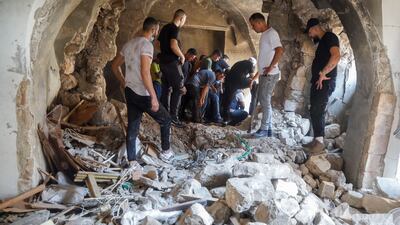
Palestinians inspect a building damaged during clashes with Israeli forces in Nablus. Reuters -
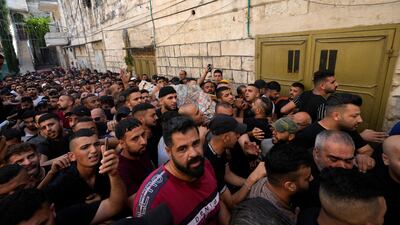
Palestinians carry the body of Islam Sabouh. Israeli police said forces encircled the home of Ibrahim Al Nabulsi, who they say was wanted for a string of shootings in the West Bank earlier this year, and that Al Nabulsi and Sabouh were killed in a shootout. AP Photo -
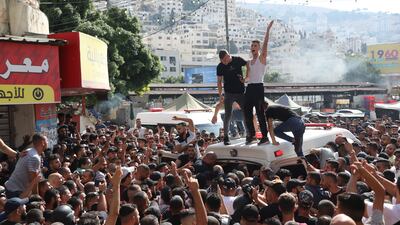
Palestinians evacuate the bodies of three Palestinians killed by Israeli troops. EPA -
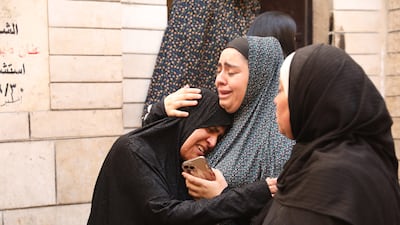
Palestinians grieve for those killed during the raid. EPA -
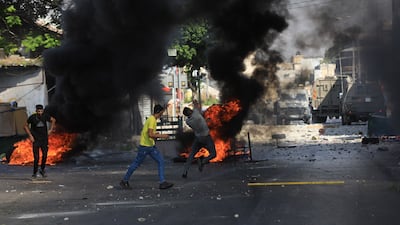
Palestinians clash with Israeli troops. EPA -
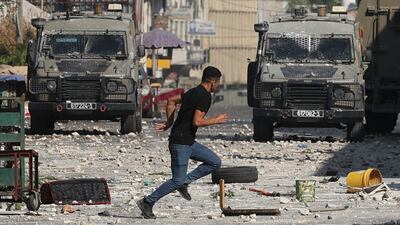
A Palestinian protester runs during clashes with Israeli security forces' vehicles. AFP -
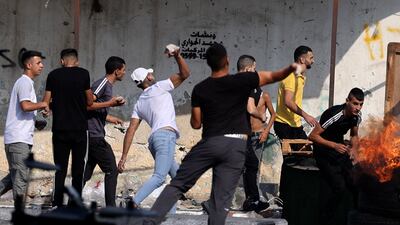
Protesters hurl rocks at Israeli security forces' vehicles. AFP -
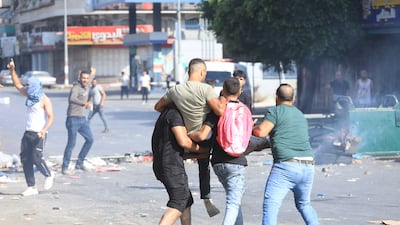
A wounded man is carried during the clashes with Israeli troops. EPA -
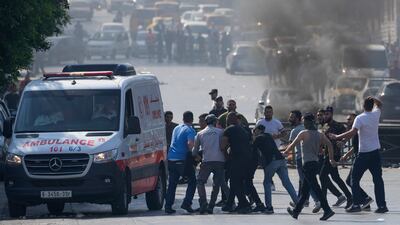
Palestinian health officials said three people were killed and at least 40 people wounded in the gun battle. AP Photo -
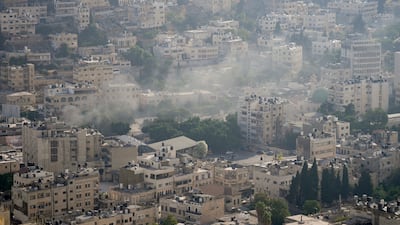
Smoke rises above buildings during the Israeli army operation in Nablus. AP Photo


'Many months' to see a doctor
In terms of medical care, troops can sometimes wait weeks before they see a doctor or a dentist and sometimes “many months” before seeing a specialist after receiving a referral from their primary physician.
“The reality of combat troops not seeing a doctor for months is unacceptable,” Mr Englman wrote, stressing that “those enlisting in combat units should know that the State of Israel stands behind them”.
The auditor also found that many of the small arms malfunction and the armoury needs to be improved, especially the management of its records.
Speaking with the battalion commander, he learned that the battalion is intended to operate in the northern part of the country, while they are training in a completely different area.
According to the report, the battalion commander “is afraid that the training of the battalion will not be sufficient for a future war in the North”.
The reservists also raised the concern that although most of them served in the Golani reconnaissance unit, whose training is aimed for the north, they are operating in the West Bank and are afraid that they will not be fit for war against Hezbollah.
According to them, they do not undergo training suitable for emergency operations, and “therefore fear that in the moment of truth they will not be prepared”.
"The IDF and the Defence Ministry must deal with this critical issue in order to support the reservists and maintain their motivation,” Mr Englman wrote. “They protect us — it is our duty to protect them."
In response to the report, the Israeli army noted that the competence and readiness level of troops for combat in all sectors “is high” and that at the two bases the auditor visited “the deficiencies that were found do not harm the operational readiness of the combat troops”.
According to the military, “some of the report's findings were dealt with immediately after the visit, and the rest are being dealt with”.

