

Negotiators have started a new round of Iran nuclear talks in Vienna as world powers seek to revive the 2015 agreement.
The EU official leading the negotiations, Enrique Mora, has said talks will focus on the most recent draft to restore the deal agreed to between Tehran and world powers.
Mr Mora will mediate between Iranian and US officials, who will not be involved in face-to-face talks.
But Iranian officials have stated publicly in recent months that the US must make the first move and lift trade sanctions before an agreement on Tehran's nuclear activities can be reached.
Signalling there was little flexibility from Iran on resolving the remaining thorny issues, Ali Bagheri Kani, its chief negotiator, put the onus on the White House to compromise. He said in a tweet that the US should "show maturity and act responsibly".
-
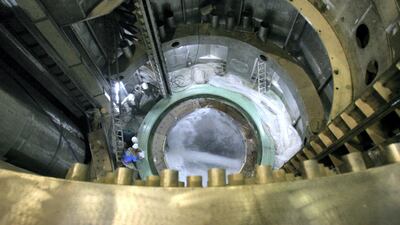
Russian contractors work at the Bushehr nuclear reactor site in 2007. The plant opened four years later. Bloomberg -
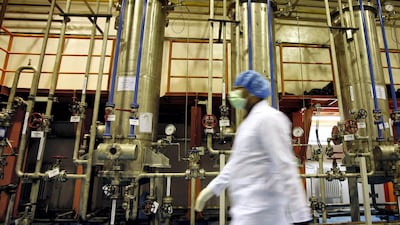
An Iranian technician at the International Atomic Energy Agency inspects the country's Isfahan plant in 2007. Tehran is no longer co-operating with the agency at nuclear sites across the country. EPA -

Workers wait to begin constructing a second reactor at the Bushehr nuclear power plant in 2019. AFP -
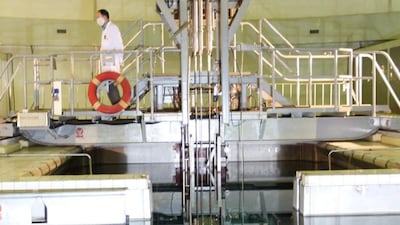
A metal-encased rod with 20 per cent enriched nuclear fuel is inserted into a reactor in Tehran in 2012. AFP -
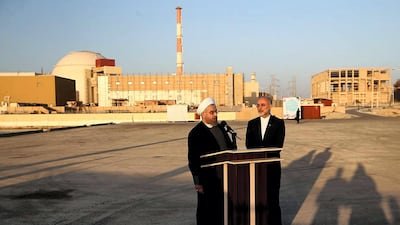
Fomer Iranian President Hassan Rouhani and the country's Atomic Energy Organisation chief Ali Akbar Salehi speak at the Bushehr nuclear site in 2015. AFP -
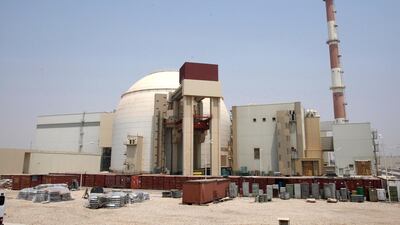
Iran's Bushehr nuclear plant has been restarted. EPA -
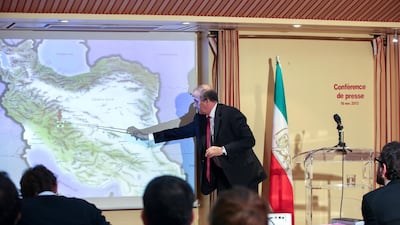
Mehdi Abrichamtchi, chairman of the Peace and Security Committee at the National Council of Resistance of Iran, shows journalists the location of a secret nuclear site in Iran in 2013. AFP -
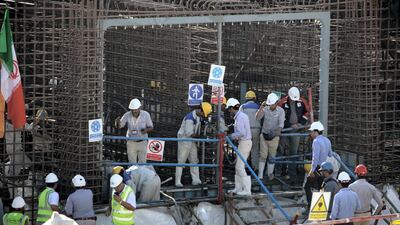
Workers prepare to begin the construction of a second reactor at the Bushehr site. AFP


Iran wants the US to remove its terrorist designation from the Islamic Revolutionary Guard Corps, the state-run Irna news agency reported.
US President Joe Biden has said delisting the IRGC – which is involved in a network of state-linked companies – cannot be part of a nuclear deal.
Western diplomats and the UN’s nuclear watchdog, the International Atomic Energy Agency, have said that time is running out to revive the agreement, known officially as the Joint Comprehensive Plan of Action.
The deal imposed curbs on Iran's nuclear programme in exchange for an easing of sanctions.
The Biden administration has relaxed some trade restrictions as a show of good faith – a move that is in stark contrast to the sanctions put in place after former president Donald Trump withdrew from the pact in 2018.
Previous round of talks to revive the deal, which Iran agreed to with the US, UK, France, Germany, Russia and China, stalled.
The IAEA has said that Iran is increasing its uranium enrichment projects.
The agency said in May that Tehran had produced enough highly enriched uranium to build a bomb.
Iranian officials have since made bold claims about the country's ambitions.
“Iran has the technical means to produce a nuclear bomb, but there has been no decision by Iran to build one,” Kamal Kharazi, an adviser to supreme leader Ayatollah Ali Khamenei, told Iranian media last month.
On Thursday, an Iranian official affirmed that the country would not switch on cameras at nuclear sites to the IAEA to monitor activities there, Irna reported.
Under the 2015 deal, Iran allowed the agency to use the cameras to monitor nuclear sites.
Iranian officials have accused the IAEA of being involved in an effort to sabotage the devices during a series of attacks on nuclear sites.
An official told Irna that cameras would only be reactivated if the IAEA halted an investigation into traces of enriched uranium found at a site Tehran had not disclosed as being used for nuclear research.
Iran has a stockpile of at least 3,800 kilograms of enriched uranium, the IAEA has said.
The country now enriches uranium up to 60 per cent purity – a short, technical step away from enriching uranium to weapons-grade levels of 90 per cent.
Experts have said that Iran has enough uranium of 60 per cent purity that it can reprocess it to create at least one nuclear bomb.
However, the country still would need to design a bomb and a delivery system, which could take months.
Iran maintains its programme is for peaceful purposes.

