


Nations must challenge the politics of the status quo to address the Middle East's biggest issues, the foreign ministers of Jordan and Saudi Arabia said on Tuesday.
Point-scoring on issues such as the Israeli occupation of Palestinian territories, the civil war in Syria and the refugee crisis were holding back progress, the leading politicians told a World Economic Forum panel discussion in Davos, Switzerland.
Jordan’s Foreign Minister Ayman Al Safadi said: “We can no longer double down on approaches that aren’t working. There must be an end to the politics of the status quo. It isn’t good for the status quo to continue.
"But before we look at a new security structure, we should look at the sources of threat in the region and the continuation of crises, beginning with the Palestinian issue.”
To address the Palestinian-Israeli conflict, Mr Al Safadi said, the “one-state reality” was not the answer as it consolidates the status quo and ultimately results in “apartheid”.
“There’s no political horizon for resolving the Palestinian-Israeli conflict," the Jordanian minister said. "There’s consolidation of occupation by building settlements, confiscation of land and eviction of people from their homes.
"I represent a country that signed a peace treaty with Israel 27 years ago, so when we speak, we speak with credibility as a peacemaker and we tell the Israelis that frankly and openly.
“That’s killing hope and leading to the entrenchment of despair and empowering radicalism on all sides.
"The whole world should act with consistency with all issues: what applies to Ukraine should apply to Palestine, to Africa and to Europe and everywhere. International order should be applied equally.”
-

Soldiers erect fences before the annual World Economic Forum meeting in Davos, Switzerland. All photos: EPA -

Army personnel transport fences to be used at the congress centre. -
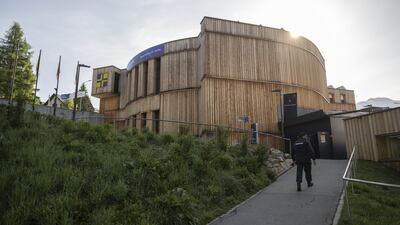
The centre can host up to 5,000 delegates. -
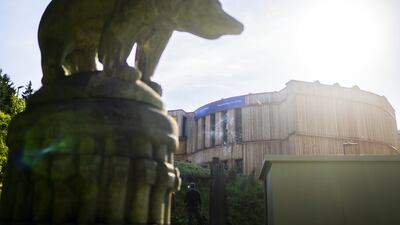
It covers 12,000 square metres and has three meeting areas, a plenary hall for 1,800 delegates and 34 rooms. -

Flags fly outside the congress centre. -
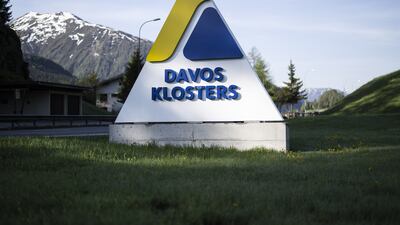
Davos Klosters is a popular ski resort, as well as a meeting place for the World Economic Forum. -
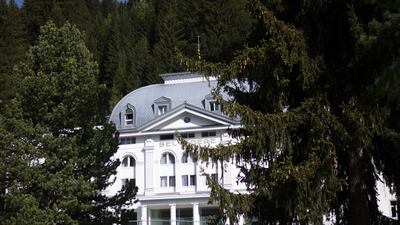
Hotels in Davos include the Steigenberger Belvedere. -
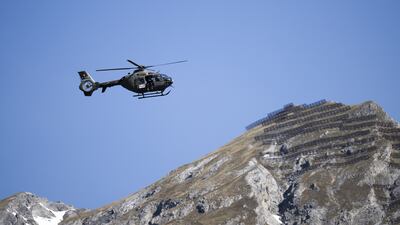
A police helicopter patrols the venue. -
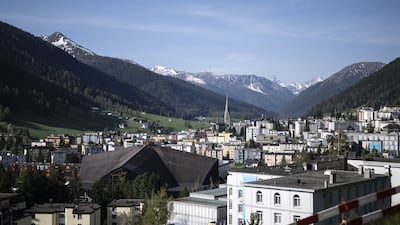
Davos will welcome nearly 2,500 leaders from politics, business, civil society and the media.


Saudi Arabia's Foreign Minister Prince Faisal bin Farhan said the kingdom had taken the initiative to end the conflict in 2002 when it championed an Arab peace plan with Israel to put an end to the Palestinian-Israeli conflict.
On Tuesday, he said normalisation of ties with Israel hinged on a solution to the conflict.
“Normalisation between us, the region and Israel will bring in benefits to the region, but we won’t be able to reap those benefits unless we are able to address the issue of Palestine," Prince Faisal said. "Not resolving this issue brings in significant instability to the region. If we don’t address this issue, we will continue to empower the most extreme voices in our region. The priority now is how to push the Palestinian-Israeli peace process forward."
He said the killing of Palestinian-American journalist Shireen Abu Akleh this month during an Israeli military operation in the occupied West Bank was only one incident that attests to the volatile and incendiary nature of a conflict that has remained unresolved for many decades.
-

Palestinian President Mahmoud Abbas pays his respects to Al Jazeera journalist Shireen Abu Akleh in Ramallah, the Israeli-occupied West Bank. Reuters -
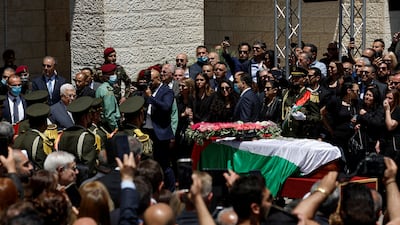
Shireen Abu Akleh was killed during an Israeli raid. Reuters -

Palestinians bid farewell to the Al Jazeera journalist. Reuters -
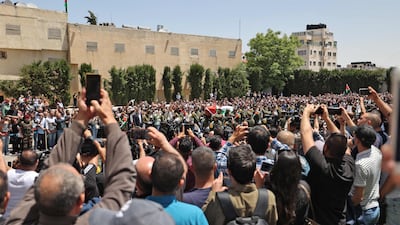
In the hours after her death, young Palestinians described Abu Akleh, 51, as an inspiration. AFP -

Shireen Abu Akleh was among Arab media’s most prominent figures and widely hailed for her bravery and professionalism. AFP -
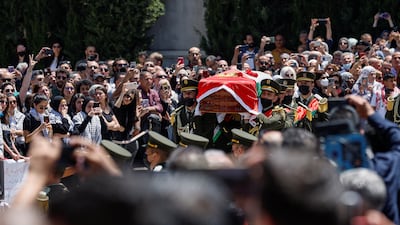
Young female reporters said they were motivated to pursue journalism because of her. Reuters -
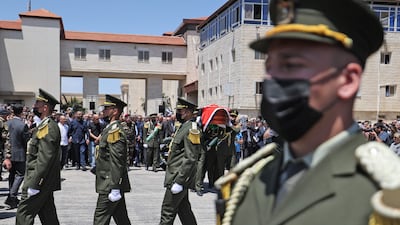
Palestinian honour guards carry the veteran journalist’s coffin. AFP -
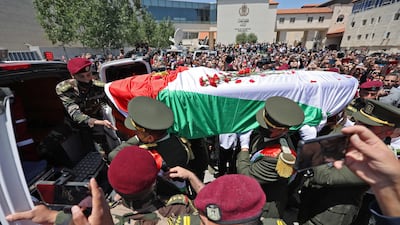
Her body was carried in a hearse accompanied by vehicles containing armed police as thousands of Palestinians lined the streets to pay their respects. AFP


Under the Saudi Arabian peace plan, presented at the Arab summit in Beirut in 2002, Israel would have withdrawn to the lines of June 1967, with a Palestinian state set up in the West Bank and Gaza. In return, Arab countries would recognise Israel. The plan was re-endorsed by another Arab summit in Riyadh in 2007.
Asked about relations with Tehran, Prince Faisal said the kingdom sought sound relations with all its neighbours, including Iran.
“Our 2030 vision is a vision of hope, prosperity and co-operation,” he said, referring to a master plan crafted and unveiled by Crown Prince Mohammad Bin Salman in 2016 to redevelop the kingdom and diversify its oil-based economy.
He said a new era of co-operation with Tehran would help to push the Middle East towards prosperity “but it needs a decision in Iran”.
“We have a dialogue with Iran,” he said. "It has made some progress but this is not enough."
Saudi Arabia and Iran have reportedly held a series of talks since last year aimed at easing the tension.
The world's top oil exporter has faced frequent missile and drone assaults on its oil installations by the Iran-aligned Houthi militia in Yemen, which has been battling a coalition led by Riyadh for seven years. Iran denies this.
On the Arab normalisation of ties with the Syrian regime of Bashar Al Assad, Mr Al Safadi said strengthening ties with Syria once more and ending its previous isolation in the region was part and parcel of shattering the politics of status quo.
“We firmly believe in the interconnectedness of the region," he said. "We should encourage political solution in Syria.
"Let’s engage and stop the suffering and create better conditions for everyone. It’s high time we addressed the Syrian crisis collectively as Arab neighbours and work as a team. Let’s bring in the focus to Syria and its people, rather than focusing on the battlefield and a global agenda."
Saudi Arabia's foreign minister agreed.
“I agree that the status quo isn’t viable and we need to look for a way forward and push forward the stalled political process," Prince Faisal said. "Pretending that the problem isn’t there and that the current way might work isn’t an answer.”
In recent years, relations between Syria and a number of Arab countries have gradually improved with efforts made to bring Damascus back into the Arab fold despite US opposition.
Mr Assad visited the United Arab Emirates in March, his first trip to an Arab country since the outbreak of the Syrian civil war in 2011.

