


Amnesty International on Tuesday accused Israel of a crime against humanity in its treatment of Palestinians, while criticising other countries for emboldening a regime committing apartheid.
In a report compiled over more than four years, the global rights organisation analysed decades of legislation and policy which it said proved Palestinians were treated as an inferior racial group.
“Israel has established and maintained an institutionalised regime of oppression and domination of the Palestinian population for the benefit of Jewish Israelis — a system of apartheid — wherever it has exercised control over Palestinians’ lives since 1948,” Amnesty said.
Israel’s Ministry of Foreign Affairs dismissed the findings as “false, biased and anti-Semitic”, while the US called it "absurd".
Agnes Callamard, Amnesty’s secretary general, said research had shown an “extremely worrisome” and worsening situation for Palestinians.
“I’m not sure that people outside [of] here understand what apartheid looks like here,” she told The National in Jerusalem.
“The reality of it is extremely disturbing.”
-
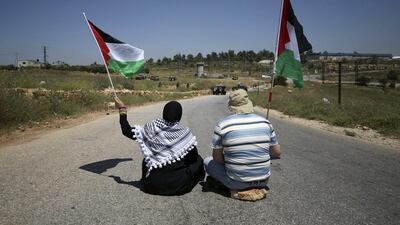
Palestinian protesters wave flags as Israeli troops take position during a protest against Jewish settlements in the West Bank village of Nabi Saleh, near Ramallah. Reuters -
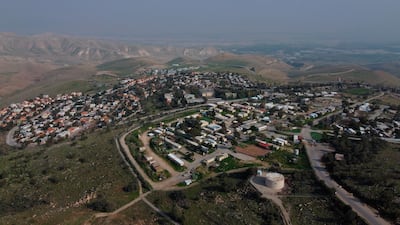
Now that Prime Minister Benjamin Netanyahu has secured a new term in office, there’s little to prevent him from annexing large parts of the West Bank as early as this summer. AP -
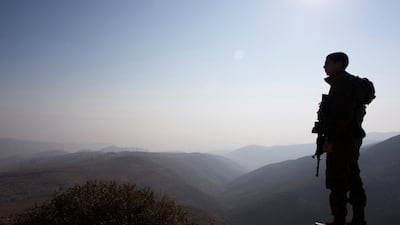
An Israeli soldier stands guard during a tour made by Israeli parliament members in the Jordan Valley near the Jewish settlement of Maale Efrayim. Reuters -
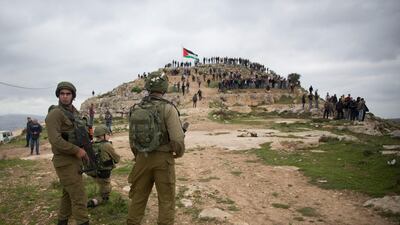
Israeli soldiers take position as Palestinian demonstrators gather during a protest against expansion of Israeli settlements in the West Bank. AP -
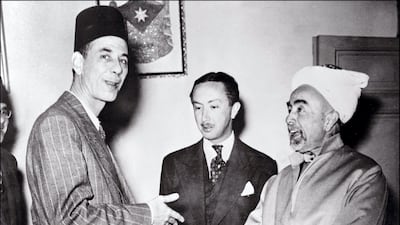
King Abdullah (r) of Transjordan on May 13, 1948 in Amman with Abed Al Rahman Azzam, the secretary general of the Arab League and Abd Al Elah Ibn Ali, the Prince Regent of Iraq, the day before the beginning of the first Arab-Israeli War. AFP -
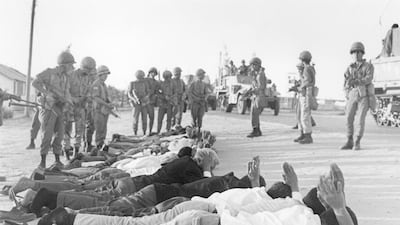
Palestinians surrender to Israeli soldiers in June 1967 in the occupied territory of the West Bank after Israel launched a pre-emptive attack on Egypt and Syria and seized the Gaza Strip, Sinai Peninsula and the Golan Heights in Syria as well as the West Bank and Arab East Jerusalem. AFP -
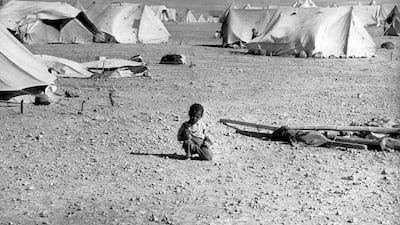
A Palestinian child plays in a refugee camp in Jordan on June 23, 1967. AFP -
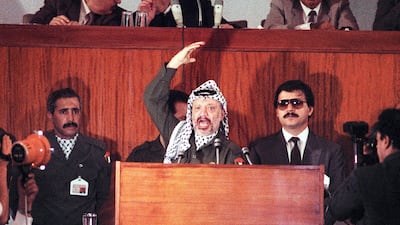
PLO chairman Yasser Arafat delivers a speech to the Palestine National Council meeting to make the historic proclamation of a Palestinian state in the Israeli-occupied territories and to recognize Israel in the Palace of Nations conference hall on November 12, 1988, in Algiers. AFP -

US President Bill Clinton stands between PLO leader Yasser Arafat and Israeli Prime Minister Yitzahk Rabin as they shake hands for the first time on September 13, 1993 at the White House. AFP -
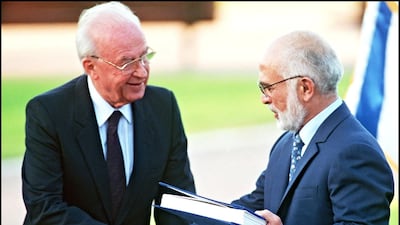
Hussein Ibn Talal, King of Jordan and Israeli Premier Yitzhak Rabin shake hands after they exchanged the documents of the Peace Treaty at Beit Gabriel conference centre on November 10, 1994 on the southern shore of the Sea of Galilee. AFP -
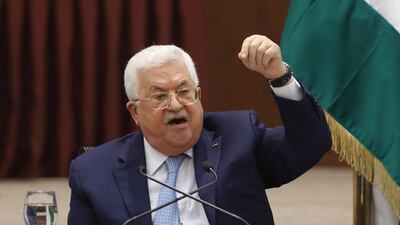
Palestinian President Mahmoud Abbas speaks during the Palestinian leadership meeting and threatened to end security coordination with Israel and the United States, saying Israeli annexation would ruin chances for peace. AFP -
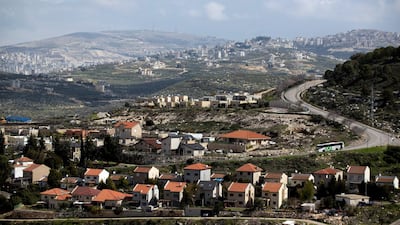
Houses in the Israeli settlement of settlement of Kedumim are seen in the foreground as part of the Palestinian city of Nablus is seen in the background (far left) in the Israeli-occupied West Bank. Reuters -
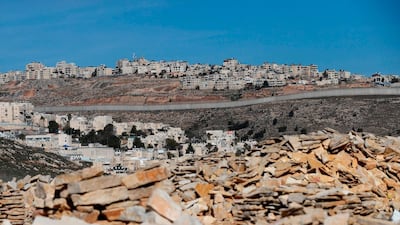
Israel's controversial concrete barrier (C) separating the Jewish settlement of Neve Yaakov (foreground) in the northern part of east Jerusalem and the Palestinian area of al-Ram (background) in the occupied West Bank. AFP -

An Israeli activist holds a banner during a protest against the US peace plan for the Middle East, in front of the US ambassador's residence in Jerusalem, on May 15, 2020, as Palestinians commemorate the 72nd anniversary of the 1948 Nakba or "catastrophe". AFP -

A Palestinian shepherd tends to his camels on arid land considered to be in "Area C" (under Israeli security and administrative control), southeast of Yatta town in the southern West Bank district of Hebron. AFP -
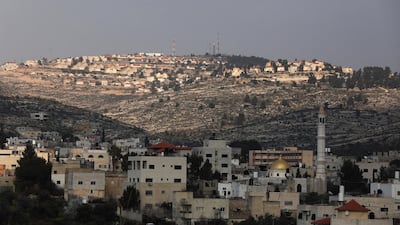
A general view of the Israeli settlement of Elon Moreh, as seen from the Palestinian village of Azmout near the West Bank City of Nablus. EPA -
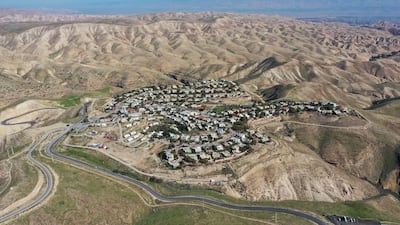
The West Bank Jewish settlement of Maale Michmash. AP


The report comes more than a year after Israeli rights group B'Tselem accused Israel of apartheid, followed by Human Rights Watch in April.
Through more than 200 pages, Amnesty detailed a system that reportedly discriminates against Palestinians in everything from family life to a shoot-to-kill policy.
The report quotes various Israeli political leaders whose statements demonstrate their explicit “intention to maintain this system” of apartheid, Amnesty said.
The organisation strongly criticised other countries for issuing “formulaic condemnations” following reported crimes committed by Israel.
“The international community has stood by as Israel has been given free rein to dispossess, segregate, control, oppress and dominate Palestinians,” the report said.

Amnesty named the EU, UK and US as having particularly close ties to Israel and called on them to “not support the system of apartheid”.
It pressed the UN Security Council to impose sanctions on Israeli officials “most implicated in the crime of apartheid” and an arms embargo on Israel.
US Ambassador Tom Nides said Amnesty's conclusion that Israel is committing apartheid is "absurd".
"That is not language that we have used and will not use," he wrote on Twitter.
The UK said it engaged in “encouraging the government of Israel to abide by its obligations under international law".
Many of the issues raised have attracted international attention in recent months.
They include demonstrations in occupied East Jerusalem, particularly in the Sheikh Jarrah neighbourhood and Al Aqsa Mosque compound, which Amnesty said were met with “brutal repression”.
Protests mounted last year over Palestinians being threatened with eviction under a law that allows deed holders to reclaim land that was owned by Jews in East Jerusalem before the establishment of Israel in 1948.
Separate legislation bans those residents and all other Palestinians from making equal claims to land or property they owned in what became Israel.
The EU on Tuesday said any state-sanctioned seizure of Palestinian property in occupied territory "risks entrenching a one-state reality of unequal rights, perpetual occupation and conflict".
Amnesty's findings were being given "due attention" by Brussels, which said it would "continue to closely monitor the developments on the ground".
The report also highlights separate legal systems employed in the occupied West Bank, where Israelis are subject to civilian courts, while Palestinians face military law.
The conviction rate of military courts in the West Bank is 99.74 per cent, the report said.

Amnesty also addressed a “planned and persistent policy of shooting to kill or maim Palestinians” by Israeli forces.
UN data show that 5,917 Palestinians have been killed by Israelis since 2008. Over the same period, 261 Israelis were killed by Palestinians.
Other matters detailed in the report include the 15-year Israeli blockade of Gaza, described as “collective punishment” of the enclave’s two million residents.
In rejecting the findings, Israel’s Ministry of Foreign Affairs said the report uses “extremist language” and distorts historical context “to demonise Israel and pour fuel on to the fire of anti-Semitism".
Foreign Minister Yair Lapid described Amnesty as “another radical organisation that echoes propaganda with no serious examination".
Aida Touma-Suleiman, a legislator with the opposition Joint List, said Parliament “is still in its majority living in total denial of the situation".
“What is established is an apartheid regime evolving in front of the world, and the world has to interfere in order to stop this,” she told The National.
Amnesty said it reached out to Israel’s foreign ministry in October regarding the report, but received no response. Its recommendations for the Israeli government include a review of all laws and policies that it identified as discriminatory.
“We recognise the state of Israel. We oppose, denounce anti-Semitism and anti-Semitic acts the world over,” Ms Callamard said on Tuesday.
“But we defend our right and the right of anyone else to critique, impartially and against international human rights law, Israel's treatment of the Palestinians,” she added.

