


Populist Shiite cleric Moqtada Al Sadr met his Sunni and Kurdish allies on Monday in a last-gasp attempt to end the political deadlock over forming a new government in Iraq.
Nearly four months after Iraq held national elections to satisfy the demands of a growing protest movement, political rivals remain at loggerheads over how to divide and allocate government posts.
Mr Al Sadr, whose Sadrist Bloc emerged as the clear winner in October elections with 73 seats, has blocked some of his Iran-backed Shiite rivals from being part of the new government.
-
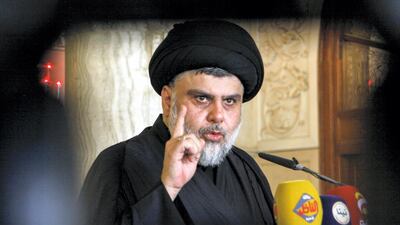
Iraqi Shiite cleric Moqtada Al Sadr delivering a speech to his supporters following Friday prayers, in September 2018. AFP -
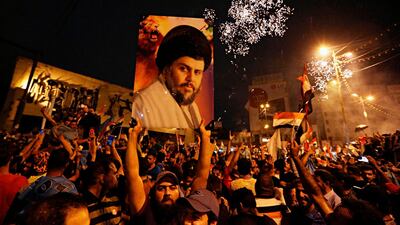
Supporters of Mr Al Sadr, who has gained popularity as a nationalist voice, campaigning against corruption. AP -
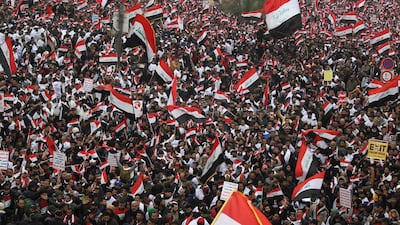
Thousands of Iraqis gathered in Baghdad on January 24, 2020, for a march called by the Shiite cleric Moqtada Al Sadr to demand that US troops leave Iraq. AFP -
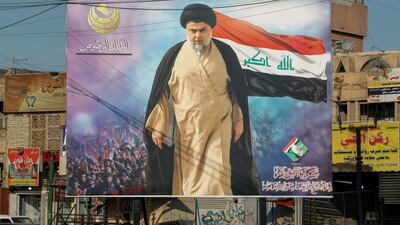
A poster of Mr Al Sadr in the Sadr City district of Baghdad. Reuters -
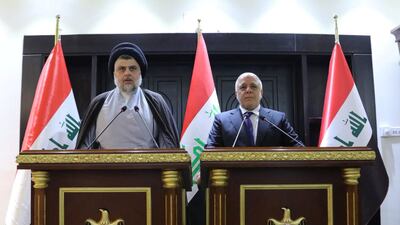
Mr Al Sadr, left, speaking at a news conference with Iraqi Prime Minister Haider Al Abadi, in Baghdad. Reuters -
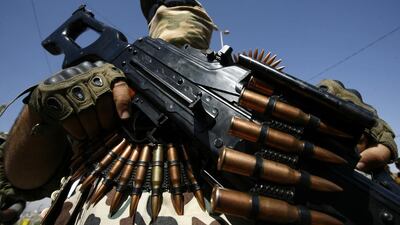
An Iraqi fighter from the Saraya AL Salam (Peace Brigades), a group formed by Mr Al Sadr, takes part in a parade in the central city of Kufa. AFP -
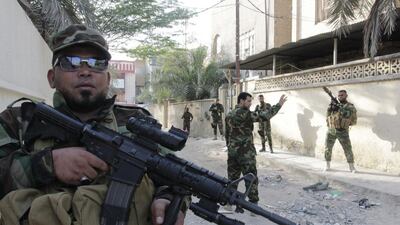
Mehdi Army fighters loyal to Shiite cleric Moqtada Al Sadr training in Basra in 2014, as Iraqi forces were massing north of Baghdad to strike back at Sunni Islamists. Reuters


At his home in the southern city of Najaf, Mr Al Sadr hosted the president of the semi-autonomous Kurdistan Region Nechirvan Barzani, Sunni Parliament Speaker Mohammed Al Halbousi and tycoon Khamis Al Khanjar.
They discussed a plan by Masoud Barzani, the leader of the Kurdistan Democratic Party, to break the deadlock.
Mr Barzani said his aim was “solving the problems and creating a suitable and good environment for the political process in Iraq.”
A Kurdish official told The National that a day earlier, the commander of Iran’s Islamic Revolutionary Guard Corps' Quds Force, Brig Gen Esmail Qaani had met officials in Erbil.
For weeks, Iran has orchestrated diplomatic efforts in Baghdad, Najaf and Erbil to bring Shiites together and secure Tehran’s allies a seat in the government.
In reference to Iran's efforts, Mr Al Halbousi tweeted before the meeting in Najaf: “That time of foreign intervention in forming Iraqi government is gone.”
Despite being a clear winner, Mr Al Sadr fell short of gaining the majority — 165 seats in the 329-seat parliament — needed to form a government and will have to create a bigger coalition with other players.
Former Shiite prime minister Nouri Al Maliki, who heads the State of Law bloc, won 33 seats, while the Iran-backed Fatah Alliance won 17.
Discussions with the Iran-allied Co-ordination Framework — which is formed from the State of Law, Fatah and other Shiite groups — have not lead to a deal.
Mr Al Maliki is one of the main obstacles to any deal, as Mr Al Sadr wishes to exclude him. The pair's enmity dates back to 2008, when Mr Al Maliki launched a military operation against the Mahdi Army.
The Co-ordination Framework has so far resisted Mr Al Sadr’s attempts to convince some its members to defect, threatening instead to disrupt government formation as an opposition bloc or boycott the political process.
After Monday's meeting, Mr Al Sadr tweeted that “we are still with forming a majority government and we welcome the dialogue with the national opposition”.
The rifts between Shiite rivals deepened during the first parliamentary session on January 9 when Mr Al Sadr joined forces with Sunni and Kurdish parties to successfully elect the Parliament Speaker and his deputies.
The move angered the pro-Iran camp, which includes influential Shiite militias that boycotted the session and later issued threats against Sunnis and Kurds.

