

Violence and political killings are on the rise in Iraq, after the country held elections in October, but officials says the risk of a civil conflict remains distant for now.
On Friday, rockets were fired at Baghdad International Airport, damaging two civilian planes that were undergoing maintenance — part of a wave of violence the UN condemned on Saturday. The airport complex houses international diplomatic facilities as well as an Iraqi-Coalition military training base.
The UN called on all groups "to exercise restraint and avoid falling into the trap of creating chaos amid a critical yet delicate transitional period."
On Wednesday, rockets were fired at the house of Parliament Speaker Mohammed Al Halbousi, whose party Taqadum has joined forces with Shiite cleric Moqtada Al Sadr's leading Sadrist Bloc in defiance of threats by Iran-backed parties.
The assault follows a string of grenade attacks against MPs this year alone, as well as a November assassination attempt against Prime Minister Mustafa Al Kadhimi, which injured six.
The Al Halbousi-Sadr partnership stands in defiance of threats from some Iran-backed figures whose share of seats in parliament collapsed in the October election.
Iraqi MP
The alliance will also help put Mr Al Sadr on track to form a Cabinet and choose the next prime minister, placing him in position to have the largest number of seats in parliament.
Some of Iraq’s biggest Shiite parties, backed by powerful armed paramilitary groups, have rejected the results that were ratified by Iraq’s Supreme Court in November.
Their rival Mr Al Sadr has in the past has mobilised thousands of militiamen to fight the government and some fear he could mobilise fighters once more to head off challengers.
After mounting failed legal challenges and levelling unsubstantiated claims of electoral fraud, they are threatening to boycott the political process entirely.

Many fear this could lead to violence, perhaps an intra-Shiite conflict that could pull in Sunni and Kurdish groups, sending Iraq back into the chaos seen during the 2006-2009 sectarian violence and the 2012-2018 rise and fall of ISIS.
But despite the rise in attacks, Iraqis who spoke to The National played down fears that the violence could escalate.
“It is possible that there will be some acts of violence, but not like in 2008, because no one wants to go back to that period," said Jaber Al Jaberi, an MP from the Sunni majority province of Anbar.
"But it is possible that some acts of violence will occur, which includes messages of threats between the opposing parties."
His remarks stand in contrast to a number of threatening statements made by Iraqi politicians, some of them with strong ties to Iran-backed parties, who faced an unprecedented electoral setback in October.
-
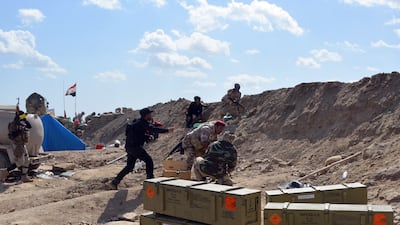
Iraqi government forces and allied militias take a position in the northern part of Diyala province as part of an assault to retake the city of Tikrit from ISIS, on March 2, 2015. All photos: AFP -
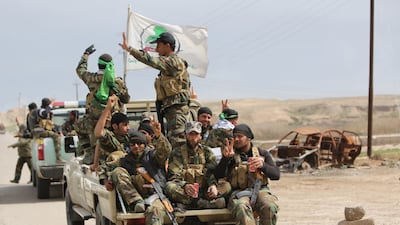
Members of the Iraqi paramilitary Popular Mobilisation units flash the 'V' for victory sign after regaining control of the village of Albu Ajil, near Tikrit, on March 9, 2015. -
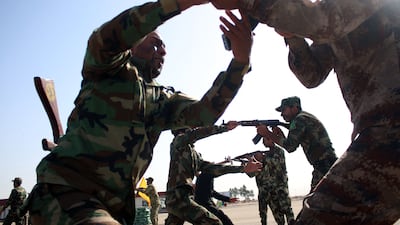
Fighters from a Popular Mobilisation unit take part in an exercise during their graduation ceremony in the southern Iraqi city of Basra, on April 9, 2015. -
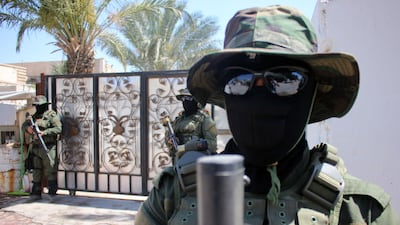
Iraqi fighters of the Shiite group Asaib Ahl Al Haq (The League of the Righteous) stand guard outside their headquarters on May 18, 2015, in the mainly Shiite southern city of Basra, as Shiite militias converged on Ramadi in a bid to recapture it from ISIS. -
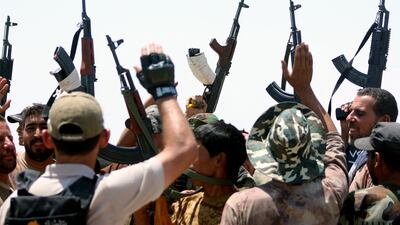
Iraqi government forces and members of the Popular Mobilisation units raise their weapons on the front line during battles with ISIS on the road leading to Saqlawiya, in Iraq's Anbar province, on August 4, 2015. -
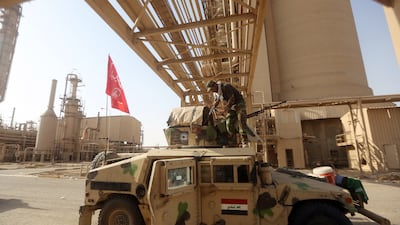
An Iraqi Shiite fighter cleans his weapon on his vehicle at the petrochemical plant in the town of Baiji, north of Tikrit, on October 16, 2015. -
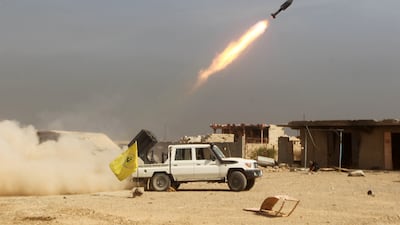
Iraqi Shiite fighters fire a rocket during a military operation against ISIS as they advance towards the centre of Baiji, about 200 kilometres north of Baghdad, on October 19, 2015. -
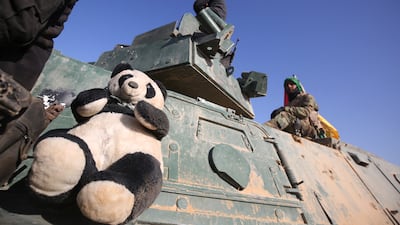
Iraqi Shiite fighters from the Hashed Al Shaabi paramilitaries advance in a desert area near the village of Tall Abtah, south-west of Mosul, on November 28, 2016, during a broad offensive by Iraq forces to retake Mosul from ISIS. -
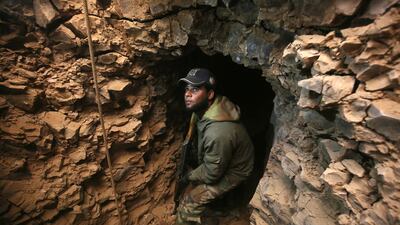
An Iraqi Shiite fighter from the Hashed Al Shaabi paramilitary forces inspects an underground tunnel in the town of Tal Abtah, south of Tal Afar, on December 10, 2016. -
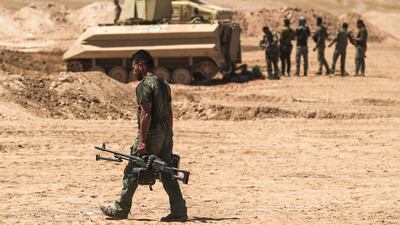
Iraqi pro-government forces advance towards the Unesco-listed ancient city of Hatra, south-west of Mosul, during an offensive to retake the area from ISIS fighters, on April 26, 2017. -
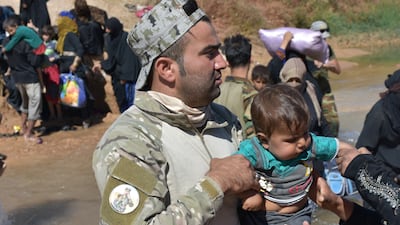
A fighter from the Hashed Al Sahaabi units helps displaced people who fled from battles to oust ISIS from Hawija cross a river in the area of Zarga, about 35km south-east of Kirkuk, on October 4, 2017. -
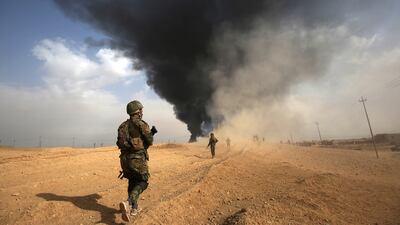
Iraqi forces advance towards the city of al-Qaim, in Iraq's western Anbar province near the Syrian border, as they fight against remnant pockets of ISIS forces, on November 3, 2017. -
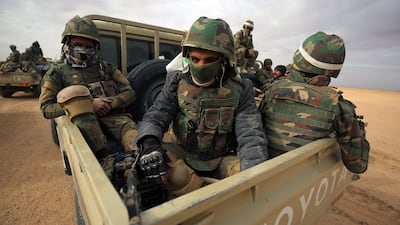
Iraqi forces ride in the back of pick-up trucks during the advance through Anbar province in the western desert bordering Syria, on November 25, 2017, to flush out remaining ISIS fighters in the region. -
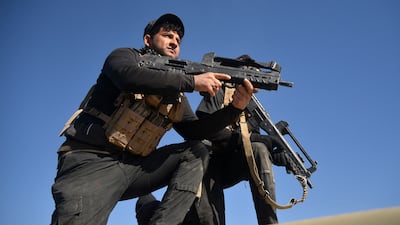
Members of the Iraqi forces and the Hashed Al Shaabi carry their firearms as they stand on an infanty-fighting vehicle near the Iraqi-Syrian border, about 80km west of the border town of al-Qaim, on December 9, 2017. -
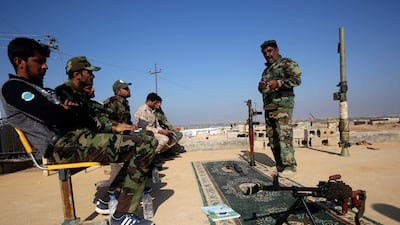
Abbas Hamza Hassan, a 56-year-old Iraqi fighter, is pictured on November 13, 2018 while training fellow Hashed members how to use weapons in the western Iraqi province of Anbar.


Alia Nassif, an Iraqi MP loyal to former Prime Minister Nouri Al Maliki – who is now linked to the Iran-supported groups – gave a warning that war could be on the cards.
"I hold Sunnis and Kurds accountable for creating a rift between the Shiites," she said, warning that "fire will catch them," if the divide grows.
Three political parties — two Sunni and one Kurdish, have suffered grenade attacks on their Baghdad offices in recent weeks.
On November 7, there was an assassination attempt on Mr Al Kadhimi, using weapons some experts linked to Iran-backed groups. Six of his bodyguards were injured.
Militia intimidation
But even before the contested election, tensions had been building.
The November attack came after a warning by Iraqi militia Kataib Hezbollah in 2020, which called Mr Al Kadhimi, who has previously led the Iraqi National Intelligence Service, an “American agent”. The group accused him of involvement in the death of former Kataib Hezbollah commander Abu Mahdi Al Muhandis.
An Iraqi investigation did not implicate Kataib Hezbollah in the attack on the prime minister, but the attempt on his life preceded a warning from an affiliated group, Asaib Ahl Al Haq, whose leader warned Mr Al Kadhimi the previous day, "the blood of the martyrs will judge you."
Bitterness remains over the killing of Al Muhandis in a January 2020 US drone strike near Baghdad airport, alongside Iranian General Qassem Suleimani.
Kataib Hezbollah fighters surrounded Mr Al Kadhimi’s guesthouse in April 2020 and sent a large force into the government centre in June that year, after a number of their men were detained by the Iraqi army for trying to fire rockets at an Iraqi-Coalition base.
That month, a senior officer in the Iraqi Intelligence Service was assassinated in Baghdad, one of at least two senior security figures to be killed in the capital, again following militia threats against the government.
Kataib Hezbollah fighters stand accused of murdering hundreds of Shiite protesters, political activists and Sunni residents of western Iraq.
The group now has a party known as the Huqooq Movement.
Iran linked groups crumble at polls
Like many militia groups with political parties, Huqooq did not fare well in the recent elections, winning just one seat.
Their main Shiite rival, Mr Al Sadr, has joined forces with two of the largest Sunni parties, Taqadum and Azm, as well as the Kurdish Democratic Party and is on track to form the largest bloc in parliament.
That would, according to the constitution, give him the right to nominate a Prime Minister and form a Cabinet. It would deepen his already extensive influence in the Iraqi state.
Unless a far reaching compromise is reached, this would be a huge setback for pro-Iran parties, as well as a number of prominent politicians now part of an alliance which has challenged election results, the Coordination Framework.
Mr Al Sadr’s recent rhetoric has almost consistently rejected what he calls foreign interference in Iraq, a reference to Iranian and US support for various groups.
“The idea of civil war, I think, does not exist between the political parties at the present time. The conflict is now between two parties,” said Mr Al Jaberi.
“The first party calls for a majority government that includes the winning blocs in the elections and some independents and to end the quota system in the government.”
A ruling coalition would hold enough sway in parliament to quickly turn policy into law.
Previous Iraqi governments have been accused of dividing the state through sectarian quotas, a system Iraqis call Muhasasa Ta’ifia, or sectarian apportionment.
Critics said ministries and positions were being parcelled out to ethnic and religious groups, and policies were made to keep each party happy, rather than benefiting society as a whole.
“The other party is the one calling for a consensual government, [structured] like the previous one based on the principle of quotas,” said Mr Al Jaberi.
If violence erupts between Shiite groups, it would not be the first time.
In 2008, a wave of politically motivated assassinations hit the Shiite-majority southern provinces of the country. Leaked US State Department cables at the time put much of the violence down to animosity between the Badr Organisation, the most powerful Iran-backed group in Iraq, and the Sadrists, but smaller groups were also involved.
Nouri Al Maliki, prime minister at the time, led an Iraqi army offensive to retake the oil rich city of Basra from Mr Al Sadr’s militia. About 300 people were killed.
One of Iraq's Kurdistan leading political parties, the Kurdistan Democratic Party, believes that all sides must reach an understanding about establishing the next government, putting Iraq's development first.

"We have an understanding with Sadr, Taqadum and Azm Alliance and we believe this will help us enter a new phase. Since 2003 Iraq has had an all-party coalition government, and this has not led Iraq to have a stable government and developments in the country," said a senior official in the KDP who wished to remain anonymous.
He fears the attacks might continue but on a low level. He also said that an agreement will likely be reached between the Co-ordination Framework and Sadr but, if not, the government would be facing many challenges.
Iran-backed militias have already been accused of attacks on targets within the Kurdish region, acts seen by some as intimidation directed against Kurdish parties.
Amid this complexity, a senior Iraqi military commander told The National on condition of anonymity that the army was not well placed to intervene in continuing militia violence.
"These attacks are politically motivated and they will end whenever the political rivals reach a compromise. We are not intending to interfere in any way in this and get the security forces into this," he said.
"It is very dangerous for the social peace. The government policy is to keep the security forces out of any political conflict," he said.
Government formation talks will continue this week, and further meetings are scheduled between leaders from the main blocs on Friday.

